
Skunks Under Your Deck or Shed: Signs, Risks and Humane Removal in Toronto
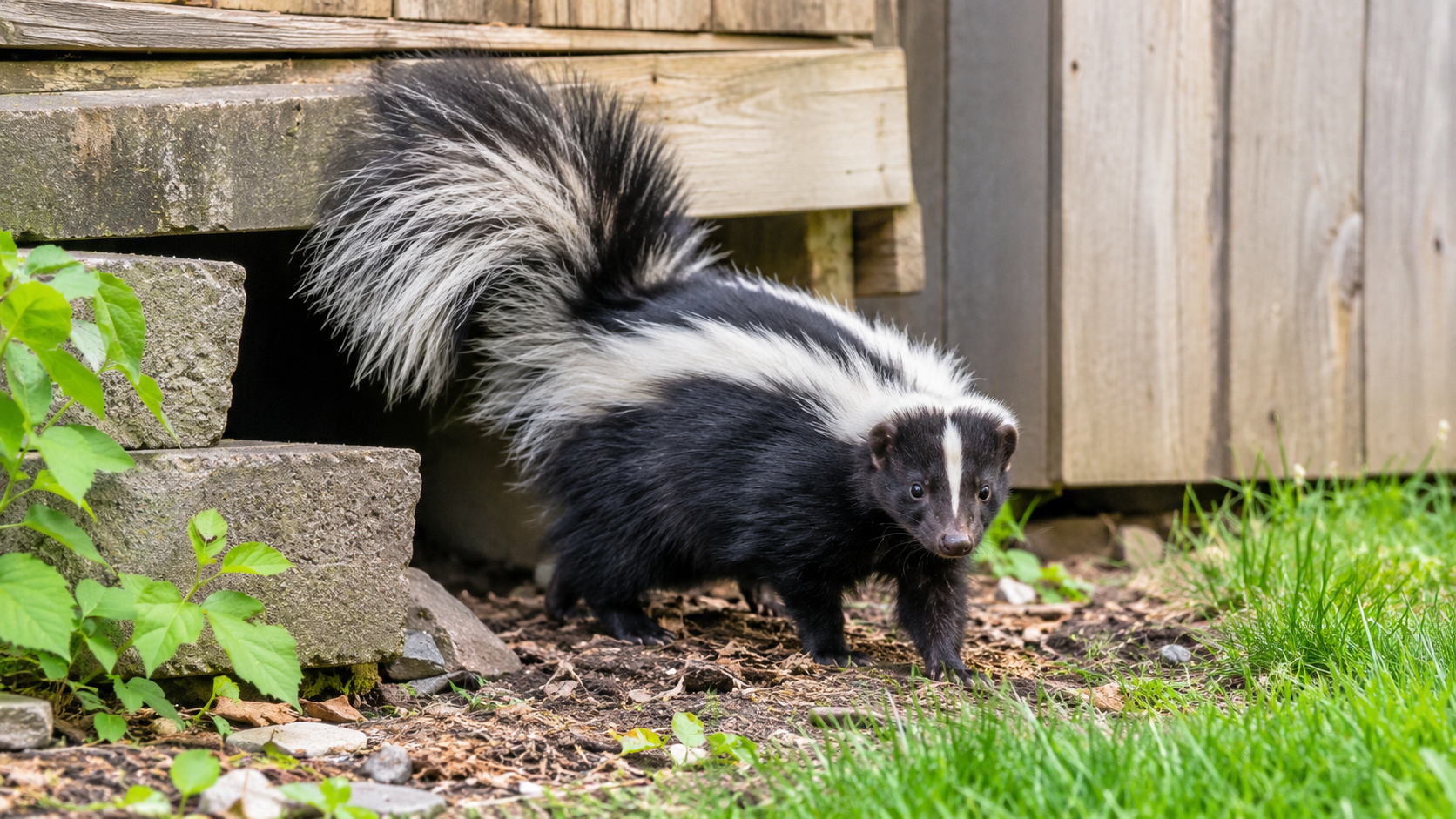
A sharp, musky smell drifting across the backyard at dusk is often the first hint that a skunk has moved in. Decks, sheds and porches give skunks exactly what they want: a dry, dark, protected space close to food. The animal itself is usually not the biggest concern. The real problem is what happens when homeowners react the wrong way, such as blocking the den, startling the animal or ignoring the damage building beneath the structure.
This guide covers why skunks den under Toronto properties, how to spot the signs, what to avoid, and how professional wildlife removal in Toronto and the GTA handles skunks humanely.
Why Do Skunks Den Under Decks and Sheds?
Skunks are opportunistic and prefer ready-made shelter over digging from scratch. In the GTA, the space under a raised deck, a shed with a gap at ground level, a porch or a crawl space often fits the bill.
Common den locations include:
• Under decks: Low clearance and loose or missing skirting leave easy openings.
• Under sheds: Gaps between the base and the ground are simple to dig beneath.
• Porches and steps: Open lattice or damaged skirting can let skunks in.
• Crawl spaces and foundation gaps: Small openings at ground level can lead to larger voids.
• Window wells and woodpiles: Sheltered pockets near the house can also attract skunks.
Food plays a role too. Unsecured garbage, pet food left outdoors, fallen fruit and grubs in the lawn can draw skunks to a yard and encourage them to stay.
What Are the Signs of a Skunk on Your Property?
Skunks are mainly active at dusk and at night, so many signs show up before you ever see the animal. Look for several clues rather than one.
• A musky odour around the yard, deck, shed or foundation.
• Small cone-shaped holes in the lawn where a skunk has dug for grubs.
• A burrow entrance or freshly disturbed soil beside a deck, shed or porch.
• Low shuffling or digging sounds beneath the structure at night.
• Disturbed garbage, pet food or compost.
• Tracks or fur around an opening.
A smell or a dug-up lawn does not confirm a skunk on its own. Raccoons, groundhogs and other animals can leave similar signs. An inspection can identify the species before any action is taken. If you suspect raccoons instead, see our guide to raccoon removal in Toronto.
Spray, Odour and Safety
Skunks spray when they feel threatened. The spray can reach several feet, and the odour is strong enough to linger on pets, clothing and outdoor surfaces. For pets and children, the main risk is surprise contact in the yard at dusk, which is why they should be kept away from any suspected den.
If a skunk is under your deck or shed:
• Keep pets inside or on a leash near the area, especially in the evening.
• Keep children away from the opening.
• Do not approach, corner or try to scare the animal.
• Avoid direct contact with any animal that looks sick or behaves oddly.
Skunks can carry diseases such as rabies. For general information on rabies, see Public Health Ontario. If you or a pet has been in contact with a skunk, especially if bitten or scratched, contact a medical professional or your veterinarian promptly.
What Should You Not Do?
A few common reactions make the situation worse.
• Do not seal the den right away. The skunk, or a mother with young, may still be inside.
• Do not use harsh chemicals, smoke or foul-smelling deterrents. These can provoke a defensive spray, may be unsafe, and do not fix the underlying entry point.
• Do not poke, flood or dig out the burrow. This can startle the animal and increase the chance of spraying.
• Do not rely on trap-and-relocate. Ontario restricts the relocation of live wildlife, and moving an animal can separate a mother from dependent young.
• Do not ignore it. A den under a structure can erode soil and weaken the area over time.
Is a Skunk Out in Daylight a Problem?
Skunks are generally active at dusk and at night, but seeing one in the daytime is not always a sign of a problem. Mothers with young or animals searching for food can be active at odd hours. What matters is the animal's behaviour. If a skunk seems confused, unsteady, unusually aggressive or unresponsive, keep your distance, keep pets and children away, and contact a wildlife professional or local authority for guidance.
What Do the Ontario Rules Say?
Ontario generally restricts the capture and relocation of live wildlife, with a limited exception for protecting private property. The rules depend on the species and circumstances. The Government of Ontario explains how to harass, capture or kill wild animals that are damaging private property and offers practical guidance on preventing and managing conflicts with small animals.
The provincial guidance also notes that exclusion at the wrong time can separate a mother from dependent young. That is why a responsible approach starts with checking whether young are present.
How Does Humane Skunk Removal Work?
Humane removal focuses on helping the animal leave on its own and then closing the opening, rather than trapping or harming it. A typical process looks like this.
1. Inspect the Property
The technician examines the deck, shed, porch, foundation and yard, confirms the species, finds every active entry point and checks for signs of young.
2. Plan Around Young and Timing
If young may be present, the timing and method are adjusted so babies are not trapped and the family is not unnecessarily separated. The plan depends on what the inspection finds.
3. One-Way Exclusion
Where appropriate, a one-way door is placed at the active opening. It lets the skunk exit but helps prevent it from getting back in. The skunk leaves on its own, which reduces the chance of a defensive spray.
4. Confirm the Space Is Clear
The door stays in place while activity is monitored, so the area can be confirmed clear before anything is closed permanently.
5. Seal and Reinforce
Once the space is confirmed empty, the burrow entrance and other access points are closed with durable, wildlife-resistant materials. For decks and sheds, that commonly means burying mesh or fitting a barrier around the perimeter to stop digging back in. Methods vary with the property.
Timelines vary. A straightforward case is quicker than one with young, several entry points or hard-to-reach areas.
Cleaning Up and Dealing With Odour
If a skunk has sprayed near your home, the smell can linger. Ventilate the area, and keep pets away until it fades. Wash anything that has been sprayed with a pet-safe or fabric-safe product suited to the material, and avoid mixing household cleaning chemicals. For an affected pet, speak to your veterinarian about safe options.
If an animal has been living beneath a structure for some time, the space may also have soiled soil or debris. Cleanup and repair can be arranged after the animal has been excluded, depending on the condition of the area.
How Can You Keep Skunks From Coming Back?
Sealing the den is what stops re-entry. Good habits around the yard reduce what draws skunks in.
• Secure garbage and Green Bin lids.
• Bring pet food inside and clean up spilled seed or fallen fruit.
• Close gaps under decks, sheds and porches with durable skirting or buried mesh.
• Keep the area tidy. Clear brush and woodpiles close to the house.
• Check the lawn for grubs. Persistent digging may mean a food source worth addressing.
• Investigate recurring activity. Repeat visits may mean an opening is still available.
These steps reduce attractants and weak points, but they do not replace a proper inspection once an animal has already denned.
Real Example: Why the Entry Point Comes First
Across wildlife cases, the pattern is the same: the animal is the symptom and the opening is the cause. In one East York case, GTA Pest Solutions found a roof vent with its cap ripped off by a raccoon, installed a one-way door so the animal could leave safely, and secured the vulnerable areas to help prevent re-entry. Read the full East York case study.
That result relates to one property and species and is not a guaranteed outcome for every home. The same principle applies to skunks: find the opening, let the animal leave, and close it properly. For another example, see our guide to squirrels in a porch ceiling. Late spring and summer can also involve young animals, so read our guide to wildlife baby season in Toronto.
Frequently Asked Questions
Why is there a skunk under my deck?
Decks and sheds offer dry, dark, sheltered space close to food. Skunks often use an existing gap or dig a small entrance and settle in.
How do I know if a skunk is living under my shed?
Common signs include a musky odour, a burrow entrance or disturbed soil beside the structure, low digging or shuffling sounds at night and cone-shaped holes in the lawn. An inspection can confirm the species.
Will the skunk spray if I try to remove it?
Skunks spray when frightened. Startling, cornering or trying to flush out the animal increases the chance. A calm, planned exclusion lets the skunk leave on its own and lowers the risk.
Should I seal the hole under my deck?
Not until you know the space is empty. Sealing while a skunk or its young are inside can trap them and make the problem worse.
Can I trap the skunk and release it elsewhere?
Ontario generally restricts relocating live wildlife, with limited exceptions for protecting private property, and relocation can separate a mother from young. Check provincial guidance or speak with a wildlife professional first.
Do skunks carry rabies?
Skunks can carry rabies, among other diseases. Keep your distance from any skunk that appears sick or behaves unusually, and contact a medical professional or veterinarian if you or a pet have had contact with one.
How do I get rid of skunk smell?
Ventilate the area and keep pets away until it fades. Use suitable cleaning products for each surface, and ask your veterinarian before treating a pet. Preventing re-entry matters as much as the cleanup.
How much does skunk removal cost in Toronto?
Cost depends on the number of entry points, access to the area, whether young are present, and the proofing, cleanup or repairs needed. GTA Pest Solutions provides a recommendation and quote after inspecting the property.
Smelling Skunk Near Your Deck or Shed?
Do not block the den or try to scare the animal out. An inspection finds the entry point, checks for young and sets out a humane plan that gets the skunk out and keeps it out.
Book a free wildlife inspection or call +1 (437) 430-3007. GTA Pest Solutions serves Toronto, Mississauga, Brampton, Vaughan, Markham, Scarborough, North York, Etobicoke and more, and you can see all areas we serve.

 Arabic
 French
 Spanish
 Portuguese
 Deutsch
 Turkish
 Dutch
 Italiano
 Russian
 Romaian
 Portuguese (Brazil)
 Greek