
How Much Floor Space Should You Leave Behind a Barber Chair?
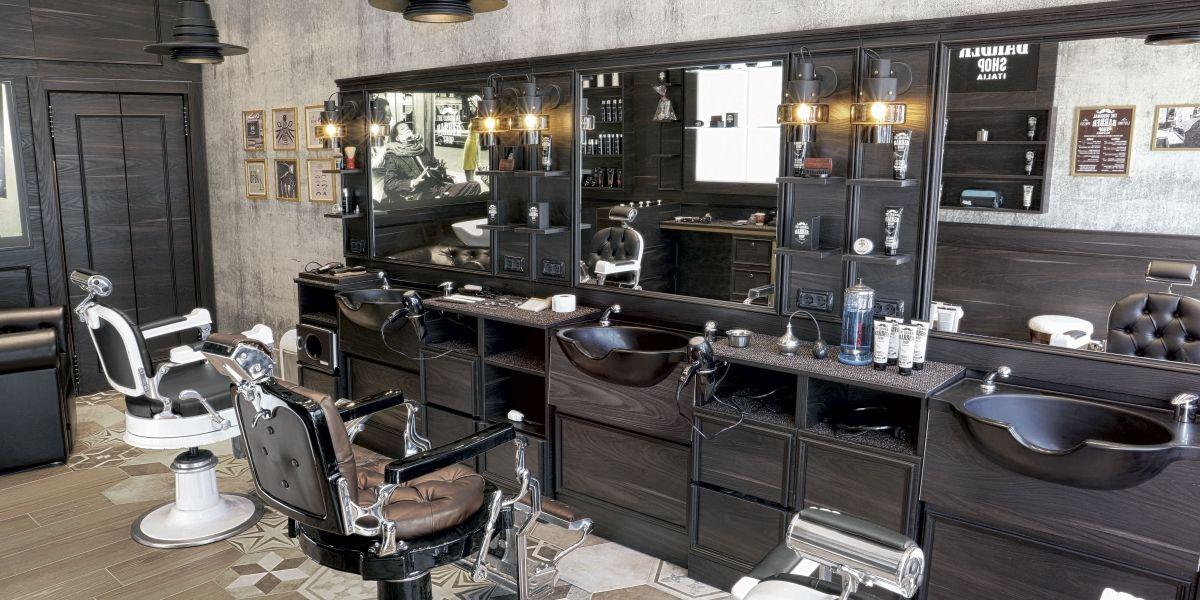
The owner of the shop chooses the chairs, hangs the mirrors, and plans out everything. Barbers find they can't step behind a client without having to turn to the side on the first busy day, and when the chair is leaned back, it hits the back wall. The plan showed how the tools would fit, but no one checked to see if anyone could work in the room.
This is the quick answer. There is no one clearance measurement that works for all stores. What you offer, how the barber moves, the size of the chair, how far it reclines and rotates, and what's close all affect how much space you need behind a chair. It tells you how to find the right figure for your layout.
What Does the Space Behind the Chair Actually Mean?
It's easy to get two different distances mixed up. The first is the space between the chair's back and the wall or the next fixed item. Second, there is the usable working clearance. This is the space the barber needs to stand, move, reach, and change his weight.
The difference is hidden when you only measure the chair's footprint. After putting a chair in its marked square, the space behind it might still be too small for someone to stand there with clippers, a comb, and a gown. The barber's body, arm swing, and the tools they carry are all in the working zone. Not just the metal base, but also that area.
How Much Clearance Is a Practical Starting Point for a Barber Chair?
There isn't a good source for that number I can give you. Different chair manufacturers list different sizes and instructions for fitting, and I couldn't find a standard that sets this size for barbershops. So be careful with any numbers you read online unless they come from the company that made them or the rules at work.
Plan in three levels instead of one:
-
A person must be able to walk behind a fixed, upright chair without touching it or the wall. This only helps with basic movement, not cutting comfortably.
-
Enough room for the barber to stand directly behind the customer and still have enough room to move around without touching the wall.
-
Operating allowance: extra space so the chair can fully recline or turn without running into anything.
Start with the installation instructions that came with your model from the manufacturer. Then, look at any local building, fire, or accessibility rules that say how walking routes should be set up in businesses. These rules may limit how close furniture can be to paths of travel. The government in your area can tell you what to do.
Measure the Chair in Its Different Positions
The size of a barber chair when it's not in use doesn't tell you everything about it. Check out each of these spots:
-
Straight up: the base footprint and the space between the backrest and the wall.
-
When you lie down, the backrest tilts and the back edge swings backward, often farther than people think.
-
Backrest movement: Check to see if the back moves separately from the seat and how far the top edge of the back moves.
-
Rotation: A chair that turns goes around in a circle, and its sides may reach closer to things nearby than its upright footprint would suggest.
-
When the floor extension is put in place, it changes the length of the front of the chair, which changes how the barber stands on that side.
The final layout shouldn't take into account the chair's resting position, but its full range of motion.
Consider the Barber's Movement During a Service
Barbers don't stay still very often. For one haircut, they move behind the client for the nape, step to the side for a trim, lean in for details, and step back to make sure they're steady. While they do it, they use scissors, combs, sprays, and towels.
If there isn't much room behind the chair, each of those moves is like negotiating with the wall. Barbers often twist their bodies, hold their arms close, or lean in strange ways. Over the course of a day, that hurts both ease and work quality. Not only should the barber's body fit, but the arms should also be able to move freely.
What Else Can Reduce the Available Clearance?
Floor space is not the same as space that can be used for work. A number of things quietly take up space:
-
Wall shelves: they may be higher than the floor, but they can catch elbows or tools that are at a good height for working.
-
When you're not using a storage cabinet, doors that swing open or drawers that pull out close the gap.
-
Trays and stands for equipment tend to move into the clearance zone during the day.
-
Outlets and cables: cords that hang down can catch your feet and make it hard to move, especially near a barber chair that is leaned back.
-
Fixed fixtures and radiators stay in place and may stick out farther than the wall shows.
-
Doors and walking paths: a door that leads into the work area or a path that goes behind the chair can turn the space between the desks into a shared hallway.
Include these features on your plan with their exact sizes, such as drawers that pull out and doors that open and close.
How Does the Number of Chairs Affect Space Planning?
One station is a small problem. A shared row has more than one item. When barber chairs are next to each other, the barber in one chair might have to move back into the space that serves a neighbour. The shared walkways behind the row can get crowded as clients and staff walk by while services are going on.
This is about the space behind each chair, not how far apart the chairs are. On your plan, keep the two questions separate. In small shops, a row of chairs along one wall leaves only a thin strip of floor behind them. This strip is used by the barbers as a walkway and to get to storage. In small commercial spaces, it might help to try out with fewer stations or to move barbers around so that they don't all step back into the same spot at the same time.
Plan for Different Types of Barbering Services
The space is needed for different services in different ways. A simple haircut where the chair doesn't need to be moved around much might take up less space than a service that involves lying the client down, working on the head and upper body, or moving the chair over and over.
For services that need to tilt or move more, the full operating range must be provided. For services where the barber goes around the client, there needs to be space on all sides. Take a look at the services you really want to offer and plan for the ones that people will use the most. Don't think they all need the same amount of space, and don't make everything bigger just in case one of them doesn't.
A Simple Way to Test Your Proposed Layout
Testing a plan on the floor doesn't take long and can save you a lot of money in the long run.
-
Measure the chair's real dimensions, not just the ones in the catalogue.
-
Check the manufacturer's instructions for installation and clearance.
-
Use tape to mark the floor where the barber chair should go.
-
Make sure you can account for tilt, rotation, and other moving parts by marking their sweep as well.
-
A coworker can act as the client while you imitate the barber's moves.
-
Check how to get to storage and stations close.
-
Make changes to the plan before putting the equipment in place for good.
Markings on the floor or temporary placement show issues while it's still easy to make changes. A tape outline and playing out a haircut for ten minutes can often show things that a drawing can't.
Signs That the Space Behind a Chair Is Too Small
Keep an eye out for these signs:
-
To get by, barbers move to the side or stop what they're doing.
-
The chair can't lean all the way back without hitting a wall or something else.
-
Shelves, cabinets, or fittings get hit by elbows, tools, or the chair.
-
While a service is going on, you can't get to storage or the next station.
-
Barbers have to work in tight or twisted spaces.
It takes longer for services to happen, equipment breaks down, and customers feel like they have to wait a long time. People who go to barbers know when they can't move around.
To Read More Blogs: Click Here
Conclusion
Good clearance lets the chair work all the way and gives the barber space to work safely and comfortably. Before you put anything down, make sure you measure the equipment, read the manufacturer's instructions, look into any local rules for walking routes, and test the plan you want to use with tape on the floor. It will tell you more than any single measurement, so act out real activities for a few minutes.

 English
 Arabic
 French
 Spanish
 Portuguese
 Deutsch
 Turkish
 Dutch
 Italiano
 Russian
 Romaian
 Greek