
KP AUTOMATIONS Pasta Production Line: Factory Layout and Plant Planning Guide
Setting up a commercial pasta manufacturing facility involves much more than installing a pasta making machine. The way equipment, raw materials, workers, utilities, drying systems, packaging areas, and finished-product storage are arranged can directly affect production efficiency and day-to-day operations.
A well-planned pasta production line should create a logical movement of materials from raw ingredients to finished packs. Each stage needs adequate space, appropriate utilities, operator access, cleaning access, and room for maintenance.
KP AUTOMATIONS manufactures pasta machinery for different production requirements, including compact and mid-size systems as well as larger industrial solutions. Its equipment portfolio also includes pasta drying and packaging solutions, allowing manufacturers to consider the complete production workflow when planning a facility.
Why Factory Layout Matters in Pasta Manufacturing
A pasta factory may contain several interconnected stages:
Raw Material Storage → Mixing → Extrusion → Shaping → Drying → Cooling → Handling → Packaging → Finished Product Storage
If these stages are positioned without considering material flow, operators may need to move products unnecessarily between areas.
Poor planning can result in:
- Unnecessary material handling
- Longer transfer distances
- Difficult maintenance access
- Congested production areas
- Packaging delays
- Inefficient use of factory space
- Difficult future expansion
A properly planned facility instead aims for a straightforward production path.
The objective is not simply to fit every machine into the available building. The objective is to create a practical production environment in which equipment and people can work efficiently.
Start With Production Requirements
Before designing the factory layout, the manufacturer should define the intended production requirements.
Important questions include:
- What pasta shapes will be produced?
- What is the target production capacity?
- Will the facility produce short-cut, long-cut, or both?
- What drying technology will be used?
- What pack sizes will be required?
- How many shifts will the plant operate?
- What level of automation is required?
- Is future capacity expansion expected?
These decisions influence the amount of machinery, floor space, electrical infrastructure, storage, and supporting equipment required.
KP AUTOMATIONS offers compact pasta machines at 50 kg/hr and 100 kg/hr, while its mid-size range includes 200 kg/hr, 300 kg/hr, and 500 kg/hr configurations. This range allows plant planning to begin with the manufacturer's intended production scale rather than using the same factory arrangement for every business.
Create a Logical Material Flow
One of the most important principles in a pasta plant is maintaining a logical movement of material.
Raw materials should enter the facility through an appropriate receiving and storage area before moving toward production.
A simplified layout can follow this sequence:
Raw Materials
↓
Ingredient Preparation
↓
Mixing and Dough Preparation
↓
Extrusion and Shaping
↓
Pre-Drying
↓
Main Drying
↓
Cooling
↓
Product Handling
↓
Weighing and Packaging
↓
Finished Goods Storage
This arrangement reduces unnecessary movement and makes it easier for operators to understand the production process.
The exact arrangement will depend on the pasta format, building dimensions, equipment specifications, and production capacity.
Raw Material Storage and Preparation
The first section of a pasta manufacturing facility should provide appropriate space for incoming raw materials.
For conventional dry pasta production, semolina or durum wheat-based ingredients and water form the core raw materials.
The storage area should be planned around:
- Expected inventory
- Material receiving frequency
- Handling equipment
- Ingredient protection
- Accessibility
- Production requirements
Raw-material movement should be arranged so that ingredients can reach the production section without crossing unnecessary traffic routes.
Keeping storage and production movement organized can also make inventory management easier.
Planning the Pasta Machine Area
The pasta machine is the central processing equipment in the production line.
KP AUTOMATIONS' pasta machines use extrusion technology to process semolina and water and form different pasta shapes through customized dies. Its compact systems are designed for products such as macaroni and vermicelli, while its mid-size machines can support additional short-cut formats such as fusilli.
When planning space around the machine, the layout should provide room for:
- Raw-material feeding
- Operator movement
- Die changes
- Cleaning
- Inspection
- Maintenance
- Product discharge
- Electrical connections
- Supporting conveyors
The machine should not be positioned so closely against walls or other equipment that routine maintenance becomes difficult.
Allow Space for Pasta Dies and Changeovers
Different pasta shapes require different die configurations.
A manufacturer producing several SKUs therefore needs to consider where dies and related components will be stored and changed.
A practical facility may require:
- Dedicated die storage
- Cleaning space
- Tool storage
- Changeover access
- Inspection area
- Safe handling space
Organized die management can make product changeovers more systematic.
For manufacturers producing multiple pasta formats, this small part of the factory layout can have a significant effect on daily workflow.
Designing the Drying Section
Drying is one of the most important areas of a dried-pasta production facility.
The dryer should be positioned after extrusion and shaping while allowing controlled movement of pasta between processing stages.
A pasta dryer may use controlled temperature, humidity, and airflow to remove moisture from the product.
For continuous manufacturing, a pasta continuous dryer can be incorporated into the production flow so that pasta moves through defined drying zones.
The layout should therefore account for:
- Dryer dimensions
- Conveyor movement
- Access doors and inspection points
- Air-handling equipment
- Electrical connections
- Maintenance clearance
- Product entry and discharge
- Cooling requirements
The drying section should be treated as a major production area rather than an accessory placed wherever space remains.
Planning Around a Pasta Continuous Dryer
A continuous dryer can create a more linear production arrangement.
A typical sequence may look like:
Extruder → Shaping/Cutting → Pre-Drying → Continuous Dryer → Cooling → Packaging
This approach minimizes unnecessary handling between extrusion and drying.
KP AUTOMATIONS' continuous drying solutions use conveyor-based movement with controlled temperature and humidity zones and PLC-based control features.
For plant designers, this means the dryer needs to be considered together with upstream and downstream equipment.
The building must provide enough room for the dryer itself as well as access for operators and maintenance personnel.
Cooling and Product Handling
After drying, pasta may need controlled cooling and transfer before packaging.
The handling section should prevent unnecessary product accumulation.
Conveyors can be used to move product between stages while reducing manual handling.
When designing this area, manufacturers should consider:
- Conveyor direction
- Transfer points
- Product accumulation
- Inspection access
- Cleaning requirements
- Packaging feed rate
The objective is to keep product movement predictable from the dryer to the packaging section.
Packaging Area Planning
The packaging section is the final major processing area before finished products enter storage or dispatch.
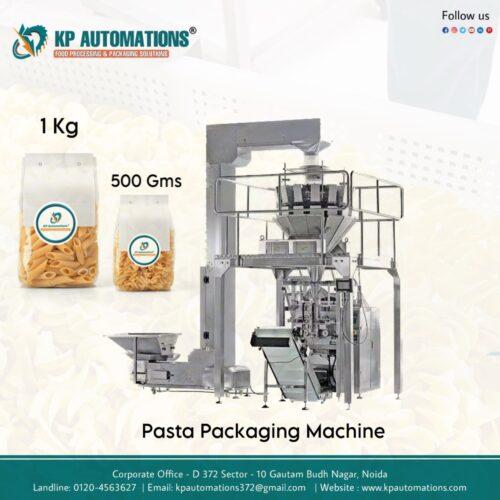
A pasta packing machine may use VFFS technology, weighing and filling systems, vacuum packaging, flow-wrap systems, or other packaging configurations depending on the product and market.
KP AUTOMATIONS lists packaging solutions for products including penne, macaroni and spaghetti, with automated weighing, filling and sealing options.
The packaging area should provide space for:
- Product feeding
- Weighing
- Filling
- Film or pouch material
- Sealing
- Date coding
- Quality inspection
- Carton handling
- Finished-pack transfer
Packaging material storage should also be positioned conveniently without obstructing the production flow.
Separate Production and Finished-Goods Movement
A well-planned facility should avoid unnecessary mixing of incoming raw materials and finished products.
Where practical, the factory can establish distinct movement paths for:
Incoming Materials
and
Finished Products
This can make internal logistics easier to manage.
Finished goods should have sufficient storage space for the planned dispatch cycle.
The warehouse area should be sized according to production output, packaging formats, order frequency, and inventory strategy.
Electrical and Utility Planning
Pasta production equipment requires supporting utilities in addition to the machines themselves.
Factory planning should consider:
- Electrical load
- Three-phase connections where required
- Control panels
- Compressed air requirements
- Water supply
- Drainage
- Ventilation
- Heating requirements
- Air circulation
- Lighting
Utility connections should be planned before equipment installation.
This helps prevent situations where machinery has been positioned but the required electrical or utility infrastructure is difficult to install.
Operator Movement and Safety
Operators need sufficient space to perform their responsibilities safely.
Factory layout should account for:
- Machine access
- Walkways
- Control panels
- Emergency access
- Cleaning
- Material handling
- Maintenance
- Inspection
Controls should be positioned where operators can monitor the relevant equipment without entering unnecessarily restricted areas.
As automation increases, the operator's role shifts from continuous manual processing toward monitoring, adjustment, inspection, and maintenance.
Hygiene and Cleaning Access
Food-processing facilities need practical cleaning arrangements.
Equipment positioning should allow operators to access product-contact areas and surrounding surfaces.
The layout should consider:
- Cleaning access
- Inspection points
- Product-contact surfaces
- Drainage
- Waste removal
- Maintenance access
KP AUTOMATIONS highlights food-grade stainless-steel construction within its pasta machinery range, supporting the requirements of food-processing environments.
However, equipment material alone does not create an efficient hygienic facility. The surrounding factory layout and operating procedures also matter.
Maintenance Space Should Be Planned From the Beginning
One common mistake during factory planning is using every available square meter for equipment.
Machines need maintenance access.
Technicians may need to inspect:
- Extruder components
- Dies
- Bearings
- Seals
- Conveyors
- Sensors
- Motors
- Drying systems
- Electrical panels
- Packaging equipment
Adequate clearance can make preventive maintenance easier and reduce disruption during servicing.
A machine that is technically installed but difficult to access can create unnecessary operational challenges later.
Designing for Future Expansion
A pasta factory should ideally be planned around both present requirements and possible future growth.
A business may start with one pasta line and later require:
- Higher extrusion capacity
- Additional pasta shapes
- More drying capacity
- Faster packaging
- Additional storage
- Automated material handling
- New production lines
KP AUTOMATIONS provides equipment across multiple production ranges, from compact 50 kg/hr and 100 kg/hr systems through mid-size 200–500 kg/hr machines and larger industrial solutions.
A scalable factory layout can make future upgrades easier by reserving appropriate areas for additional equipment and conveyors.
Planning the Factory Around the Complete Production Line
Instead of designing the building around one machine, manufacturers should design around the entire production process.
A complete planning exercise should include:
1. Production Capacity
Define the target kilograms per hour and expected operating schedule.
2. Product Range
Identify short-cut, long-cut, or specialty pasta formats.
3. Drying Method
Determine whether continuous or batch drying is appropriate for the planned process.
4. Packaging
Define pack sizes, packaging materials, weighing requirements, and target speed.
5. Utilities
Calculate electrical, water, air, ventilation, and other utility requirements.
6. Material Flow
Map the movement of ingredients, pasta, packaging materials, and finished products.
7. Maintenance
Reserve adequate access around machines and utilities.
8. Expansion
Identify where future equipment could be installed without rebuilding the entire factory.
This approach turns factory planning into a production-engineering exercise rather than simply an equipment-placement exercise.
Why Work With KP AUTOMATIONS for Pasta Plant Planning?
KP AUTOMATIONS has been involved in food processing, packaging, automation, and pasta machinery since 1998.
Its pasta machinery portfolio covers different production capacities, while its product range also includes drying and packaging equipment.
For manufacturers developing a new facility or upgrading an existing plant, considering these stages together can help create a more coherent production workflow.
The company operates from Noida, Uttar Pradesh, with a manufacturing unit in Greater Noida, supporting its focus on pasta and food-processing machinery.
Conclusion
A successful pasta production line begins with thoughtful factory planning.
The pasta machine, dryer, conveyors, cooling area, packaging equipment, utilities, storage, operator movement, and maintenance zones should work together as one production environment.
A good factory layout can reduce unnecessary handling, simplify maintenance, support hygiene, improve material flow, and provide a practical foundation for future expansion.
KP AUTOMATIONS offers pasta machinery and related drying and packaging solutions across different production requirements, allowing manufacturers to plan equipment around their intended production workflow.

 English
 Arabic
 French
 Spanish
 Portuguese
 Deutsch
 Turkish
 Dutch
Dutch
 Italiano
 Russian
 Romaian
 Portuguese (Brazil)