
Why Do Commercial Flat Roof Leaks Keep Returning After Repairs?
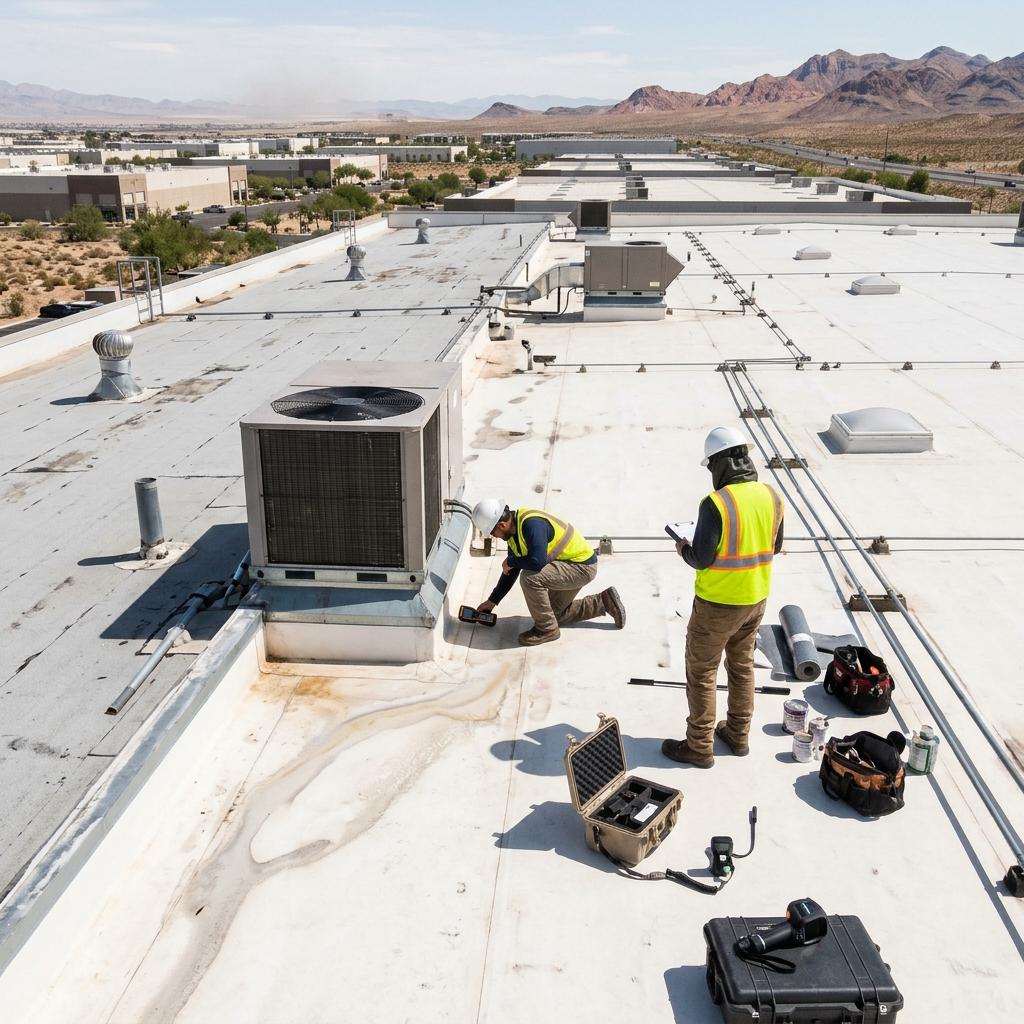
A leaking commercial roof can create problems that extend far beyond a wet ceiling. Water entering a building may damage insulation, affect electrical equipment, stain interior finishes, and interrupt normal business activities. For property managers, the challenge is not always finding the visible leak. It is understanding why water entered the building in the first place and whether the underlying problem has actually been corrected.
In Las Vegas, commercial roofing systems experience prolonged sunlight, high temperatures, seasonal wind, and occasional intense rainfall. These environmental conditions can gradually weaken roofing materials and expose vulnerable areas. When a leak appears, applying a patch without investigating its source may provide only temporary relief.
Understanding how commercial roof leaks develop, how professionals investigate them, and what makes a lasting repair possible can help building owners make better maintenance decisions.
Why Commercial Flat Roofs Develop Leaks
Flat and low-slope roofs are common on warehouses, retail buildings, offices, restaurants, and industrial facilities. Their relatively simple appearance can make them seem easier to maintain than sloped roofing systems. However, these roofs depend on carefully installed membranes, sealed seams, flashing, and drainage components to keep water outside.
Several conditions can compromise that protection.
Extreme Heat and Temperature Changes
Las Vegas experiences substantial temperature variations throughout the year. During summer, commercial roofing materials absorb considerable solar heat. As temperatures change, roofing membranes and adjoining materials expand and contract.
Repeated movement can place stress on seams, flashing connections, and other vulnerable transitions. Over time, older materials may become brittle, separate, or lose their ability to maintain a watertight connection.
Deteriorating Roof Seams
Roof membranes often contain multiple joined sections. These seams must remain properly bonded to prevent moisture from entering the underlying assembly.
Age, installation problems, physical damage, and prolonged environmental exposure can weaken these connections. A small separation may allow water to travel beneath the surface before becoming visible inside the building.
Blocked or Ineffective Drainage
Even a low-slope roof needs an effective drainage system. Drains, scuppers, and surrounding drainage pathways must allow rainwater to leave the roof efficiently.
Debris, accumulated dirt, damaged drainage components, or improper slopes can contribute to standing water. Extended ponding may place additional stress on vulnerable roofing areas and increase the likelihood of moisture intrusion.
Why Finding the Actual Leak Source Matters
One of the most confusing aspects of a commercial roof leak is that the visible water damage may appear far away from the original entry point.
For example, water can enter around an HVAC curb, travel beneath roofing materials, follow structural components, and eventually appear as a ceiling stain in another part of the building.
This makes surface-level inspections particularly unreliable when the source is hidden.
A useful investigation considers the entire potential water pathway rather than concentrating exclusively on the location where water becomes visible.
Roofing professionals may examine:
-
Membrane seams and transitions.
-
Flashing around roof edges and penetrations.
-
HVAC equipment curbs and mounting areas.
-
Expansion joints between building sections.
-
Drainage outlets and surrounding roof surfaces.
-
Areas containing visible cracks, punctures, or deteriorated materials.
The objective is to distinguish the original point of entry from the secondary damage caused by water movement.
What Happens During Professional Leak Detection?
An effective leak investigation begins with information gathering and a systematic inspection. Building managers can help by identifying when the leak first appeared, whether it occurs during particular weather conditions, and which interior areas have experienced water damage.
Reviewing the Building's Leak History
Previous repair records can reveal recurring problems. If water repeatedly appears in the same general area after separate storms, the roof may have an unresolved weakness.
Photographs, maintenance reports, and previous contractor observations can help narrow the investigation.
Examining Exterior Roofing Components
The next step involves inspecting the roof surface and its critical connections. Professionals look for membrane separation, damaged flashing, loose terminations, deteriorated sealants, and other conditions that could allow water penetration.
Particular attention should be given to roof penetrations because HVAC systems, vents, and other equipment create transitions where waterproofing details must remain intact.
Tracing Moisture Pathways
Finding the entry point sometimes requires examining both exterior and interior conditions. Water stains, damp insulation, ceiling damage, and moisture patterns can provide useful clues.
Depending on the roofing assembly and circumstances, a contractor may recommend appropriate diagnostic methods to investigate concealed moisture. The inspection should establish a reasonable connection between the suspected exterior defect and the observed interior damage.
This is where a Commercial Roof Water Intrusion Assessment in Las Vegas, NV becomes relevant to understanding the condition of a commercial roofing system before selecting a repair approach.
Why Temporary Patches Do Not Always Solve the Problem
Temporary repairs can be useful when immediate action is necessary to limit additional water entry. However, a patch should not automatically be treated as a complete solution.
Consider a commercial building with a recurring ceiling leak near an office corridor. A contractor may initially seal a visible opening above the damaged area. If the actual entry point is an improperly sealed equipment curb several feet away, the interior leak may return during the next significant rainfall.
Another common situation involves drainage problems. Repairing one damaged membrane section will not necessarily address water accumulation caused by blocked drains or inadequate drainage conditions.
A lasting repair should address the identified cause, not simply cover the most obvious symptom.
Protecting Commercial Buildings During Emergency Roof Repairs
When water enters an occupied commercial property, the response needs to consider both roofing conditions and building operations.
Property managers should first protect people and vulnerable areas. If water approaches electrical equipment, lighting systems, or exposed wiring, access should be restricted and qualified personnel should assess the electrical hazard.
Other practical steps include:
-
Moving merchandise, furniture, and equipment away from affected areas.
-
Using appropriate containers to collect dripping water where safe.
-
Documenting visible damage with photographs.
-
Notifying building maintenance personnel and relevant occupants.
-
Arranging a professional roof inspection as soon as practical.
Roof access should be restricted during lightning, strong winds, or other hazardous weather. Untrained employees should never attempt emergency roof repairs.
A coordinated response helps reduce disruption while allowing qualified roofing professionals to investigate the problem safely.
What Makes Commercial Roof Repairs More Effective?
The appropriate repair depends on the roofing material, the location of the damage, the condition of surrounding components, and the extent of moisture intrusion.
A small, isolated membrane puncture may require a different approach from a deteriorated seam or damaged flashing connection. Similarly, a roof with widespread material deterioration may need a broader evaluation rather than another localized patch.
Good repair planning generally involves several considerations.
Material compatibility: Repair products should be suitable for the existing roofing membrane and surrounding materials.
Proper surface preparation: Dirt, moisture, and loose materials can interfere with adhesion and sealing.
Attention to transitions: Roof edges, equipment curbs, penetrations, and expansion joints deserve careful attention because these areas involve changes in material or roof geometry.
Verification after repairs: The completed work should be inspected to determine whether the identified defect has been properly addressed.
Documentation is also valuable. Photographs and written repair descriptions provide property managers with a clearer maintenance record for future inspections.
Preventing Repeat Leaks Through Routine Maintenance
Emergency repairs are sometimes unavoidable, but regular inspections can help identify developing problems before they cause substantial interior damage.
Commercial property managers should establish a maintenance schedule appropriate for the building's roof type, age, condition, and exposure.
After significant weather events, it is sensible to check accessible roof drainage areas, review reports of interior moisture, and arrange professional inspections when damage is suspected.
Drainage outlets should remain clear, roof penetrations should be monitored, and previous repair locations should receive attention during subsequent inspections.
Keeping accurate maintenance records also makes it easier to identify recurring defects and determine whether a roofing system requires additional attention.
Conclusion
Recurring commercial roof leaks are rarely solved reliably by addressing visible water damage alone. The actual entry point may be hidden beneath roofing materials or located around seams, equipment penetrations, flashing, and drainage components.
For Las Vegas commercial property owners, understanding the relationship between desert weather, roofing materials, and water movement is an important part of protecting buildings.
A thorough inspection, accurate leak diagnosis, and repair approach based on the actual condition of the roof can help reduce repeated problems. Rather than treating every leak as an isolated incident, property managers should view it as an opportunity to identify weaknesses and improve the long-term condition of the entire roofing system.
More details are available at: Local Business Directory

 English
 Arabic
 French
 Spanish
 Portuguese
 Deutsch
 Turkish
 Dutch
 Russian
 Romaian
 Portuguese (Brazil)
 Greek