
Why Every Business Needs a Conversion-Focused Website in 2027
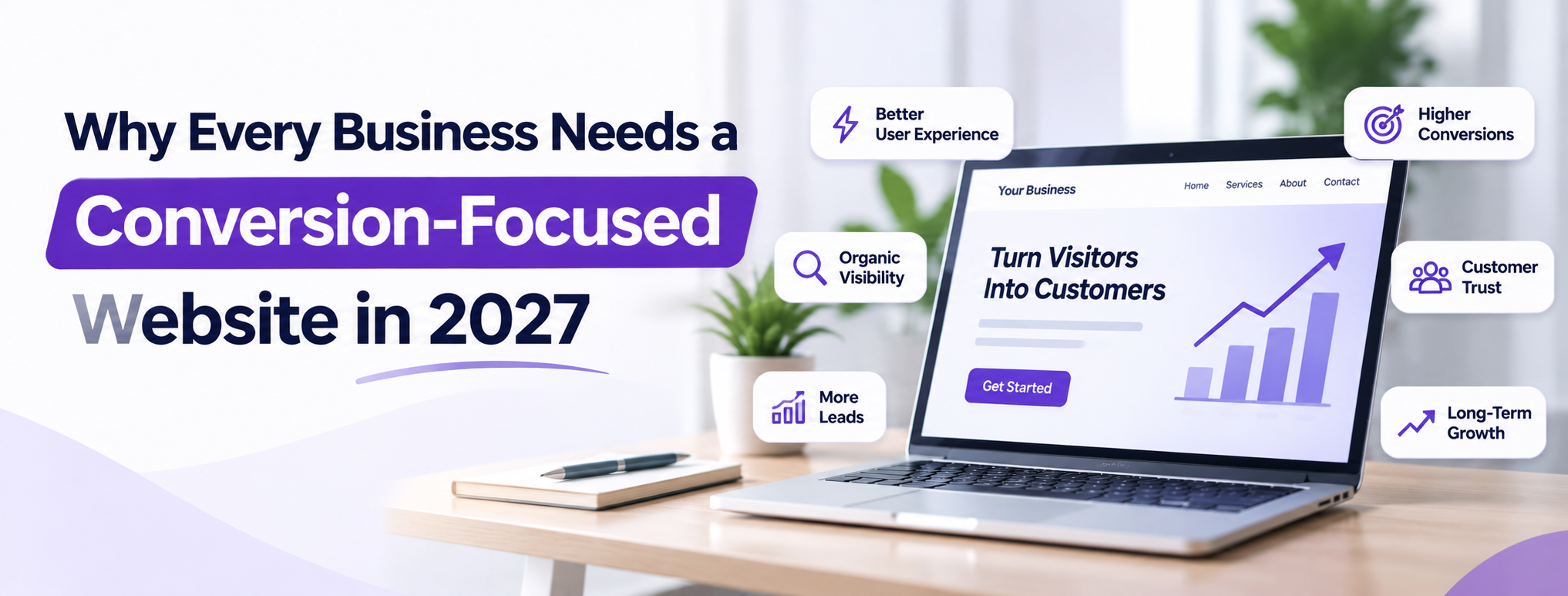
A business website is more than a digital storefront. It is a platform where potential customers discover services, evaluate credibility, compare solutions, and decide whether to take the next step. However, simply having a website does not guarantee enquiries, sales, or business growth.
Many businesses invest in attractive designs but overlook the elements that encourage visitors to take action. A website may look impressive yet struggle to generate leads because its navigation is confusing, its messaging is unclear, or its calls to action are difficult to find.
In 2027, businesses need websites that combine design, functionality, user experience, and conversion optimisation. A conversion-focused website does not simply attract visitors; it guides them towards meaningful actions that support business objectives.
Understanding how to build and optimise such a website can help businesses make better use of their digital presence.
What Is a Conversion-Focused Website?
A conversion-focused website is designed to encourage visitors to complete a specific action. Depending on the business model, that action might involve submitting an enquiry, booking a consultation, purchasing a product, downloading a resource, or signing up for a newsletter.
A conversion does not always mean an immediate sale. For businesses with longer sales cycles, generating a qualified lead may be the most valuable outcome.
Conversion-focused website design combines several elements, including:
-
Clear messaging that communicates the business's value.
-
Intuitive navigation that helps visitors find information.
-
Relevant content that answers customer questions.
-
Trust signals that reduce uncertainty.
-
Prominent calls to action.
-
Fast-loading, mobile-friendly pages.
-
Simple forms and checkout processes.
The objective is to remove unnecessary friction and make the next step obvious to the visitor.
1. First Impressions Influence Customer Decisions
When visitors land on a website, they quickly begin evaluating whether the business appears relevant and trustworthy. An outdated layout, inconsistent branding, or unclear messaging can create doubt before visitors even explore the available services.
A professional website should communicate three things immediately: what the business offers, who it helps, and why visitors should consider it.
For example, a web development company could use a clear headline explaining its services, a short supporting statement describing its value, and a visible button inviting visitors to discuss a project.
Businesses should prioritise clean layouts, consistent typography, appropriate spacing, and relevant visual elements.
Good design does not mean adding more animations or decorative effects. It means making information easier to understand and actions easier to complete.
2. Clear Calls to Action Improve Conversions
A website can attract relevant traffic and still fail to generate results if visitors do not know what to do next.
Calls to action, commonly known as CTAs, guide users towards specific actions. Examples include "Request a Quote," "Book a Consultation," "Shop Now," and "Get Started."
Effective CTAs should be clear, relevant, and easy to locate.
Businesses can improve their calls to action by:
-
Using action-oriented language.
-
Placing buttons near relevant content.
-
Making buttons visually distinguishable.
-
Matching the CTA to the visitor's intent.
-
Avoiding competing actions on the same page.
-
Explaining what happens after the visitor clicks.
For example, a visitor reading a service page may be ready to request a consultation, while someone reading an introductory blog article may prefer a detailed guide.
Matching calls to action to the visitor's stage in the customer journey can create a more natural conversion path.
3. Mobile-Friendly Design Is Essential
Mobile devices play a major role in how people discover businesses, research products, and interact with websites. A website that works well on a desktop but performs poorly on a smartphone can create unnecessary barriers.
Responsive web design allows a website to adapt to different screen sizes and devices.
A mobile-friendly website should offer readable text, appropriately sized buttons, accessible navigation, and forms that are easy to complete on smaller screens.
Businesses should also review how key elements behave on mobile devices. Pop-ups that cover important content, menus that are difficult to use, and checkout processes that require excessive input can frustrate visitors.
Testing important customer journeys on actual mobile devices can help identify problems that might otherwise go unnoticed.
Mobile usability should be considered throughout the design process rather than treated as a final adjustment.
4. Website Speed Affects User Experience
Website performance is another important consideration for conversion optimisation. Visitors may abandon a page when it takes too long to load or when its layout shifts unexpectedly.
Slow performance can be caused by oversized images, unnecessary scripts, inefficient hosting, excessive third-party integrations, or poorly optimised code.
Businesses can improve website speed by:
-
Compressing and appropriately sizing images.
-
Using modern image formats where suitable.
-
Reducing unnecessary scripts and plugins.
-
Enabling browser caching where appropriate.
-
Choosing reliable hosting infrastructure.
-
Monitoring Core Web Vitals and real-user performance.
Google's Core Web Vitals measure aspects of loading performance, responsiveness, and visual stability. They are useful indicators for evaluating user experience, although meeting these metrics does not guarantee higher rankings or conversions.
A faster, more stable website makes it easier for visitors to access information and complete their intended actions.
5. Trust Signals Help Visitors Make Decisions
Potential customers often hesitate when they are unsure whether a business is credible, experienced, or capable of delivering what it promises.
A conversion-focused website addresses these concerns by providing relevant evidence and transparent information.
Useful trust signals include:
-
Genuine customer testimonials and reviews.
-
Relevant case studies and project examples.
-
Clear business contact information.
-
Transparent pricing or service details where appropriate.
-
Professional team profiles and company information.
-
Secure payment options for ecommerce websites.
-
Clear privacy policies and applicable terms.
Trust signals should be accurate and verifiable. Fabricated testimonials, exaggerated claims, and misleading guarantees can damage credibility.
Businesses should also avoid displaying unnecessary badges or security claims that they cannot substantiate.
The goal is to help visitors make informed decisions rather than pressure them into converting.
6. Search Engine Optimisation Brings Relevant Visitors
Conversion optimisation works best when a website attracts visitors who are genuinely interested in its offerings.
Search engine optimisation helps businesses improve their visibility in organic search results and connect with people looking for relevant information, products, or services.
A strong SEO strategy includes keyword research, helpful content, technical optimisation, internal linking, and a logical website structure.
For conversion-focused websites, search intent deserves particular attention.
Someone searching for general information may need an educational article, while someone searching for a specific service may be ready to compare providers or request a quote.
Creating the right landing page for each intent can improve relevance and help visitors find the information they need.
Businesses should also ensure that page titles, headings, content, and calls to action communicate a consistent message from the search result to the landing page.
Attracting more traffic is useful, but attracting the right traffic is often more valuable.
7. Simple Forms Reduce Friction
Contact forms are essential for many service-based businesses, but unnecessarily complicated forms can discourage potential customers from completing them.
Every additional field introduces another decision or task for the visitor. Businesses should therefore request only the information needed to take the next appropriate step.
For example, an initial enquiry form might require a name, email address, and brief description of the project. Additional details can be collected during a follow-up conversation.
To improve form usability:
-
Keep the number of required fields reasonable.
-
Use clear labels and helpful instructions.
-
Explain why sensitive information is needed.
-
Display understandable validation messages.
-
Make forms accessible on mobile devices.
-
Confirm successful submissions clearly.
For ecommerce businesses, a streamlined checkout can also reduce unnecessary friction by offering convenient payment methods, transparent shipping costs, and clear order summaries.
The ideal form is not necessarily the shortest one. It is the one that collects appropriate information without creating unnecessary barriers.
8. Personalisation Can Make Website Experiences More Relevant
Modern websites can deliver more relevant experiences by adapting content to visitor needs, preferences, or context.
For example, an ecommerce website may recommend related products, while a B2B company may create dedicated landing pages for different industries.
Personalisation can also involve simpler approaches, such as displaying location-specific service information or presenting relevant resources based on the page a visitor is exploring.
However, businesses should implement personalisation carefully. Excessive pop-ups, intrusive tracking, or overly specific messaging can make visitors uncomfortable.
Any personalisation involving personal data should respect applicable privacy requirements and user consent preferences.
The purpose is to make the experience more useful, not to overwhelm visitors with unnecessary targeting.
9. Use Analytics to Identify Conversion Opportunities
A website should be evaluated using measurable business outcomes rather than visual appearance alone.
Analytics tools can help businesses understand how visitors arrive, which pages they explore, and where they leave the conversion journey.
Useful metrics include:
-
Conversion rate.
-
Qualified enquiries and completed purchases.
-
Landing-page engagement.
-
Form abandonment.
-
Checkout completion.
-
Traffic sources.
-
Customer acquisition cost.
For example, if a service page attracts substantial relevant traffic but generates very few enquiries, businesses could review its messaging, trust signals, CTA placement, or form experience.
A high traffic volume combined with a low conversion rate does not automatically indicate a design problem. The audience's intent, offer relevance, pricing, and traffic quality may also be contributing factors.
Businesses should use analytics to identify potential issues and test improvements rather than making assumptions.
10. Continuous Optimisation Creates Long-Term Value
Launching a website is only the beginning. Customer expectations, competitors, technologies, and business priorities change over time.
Regular website reviews help businesses identify outdated information, broken links, usability issues, and opportunities to improve conversions.
One useful approach is A/B testing, where two versions of a page element are compared to determine which performs better against a defined objective.
Businesses might test different headlines, button text, form layouts, or page structures. Tests should have clear hypotheses and reliable measurement methods.
For smaller websites with limited traffic, collecting enough data for statistically reliable A/B tests may take considerable time. In such cases, usability testing and qualitative customer feedback can provide valuable insights.
A consistent optimisation process allows businesses to improve their websites based on evidence rather than relying solely on design preferences.
Conclusion
In 2027, a successful business website needs to do more than look professional. It must communicate value clearly, provide a smooth user experience, build trust, attract relevant visitors, and guide people towards meaningful actions.
Conversion-focused website design brings these elements together. From mobile usability and page speed to SEO, clear calls to action, and performance tracking, each component can contribute to a more effective digital presence.
Businesses should start by identifying their primary conversion goals, reviewing their existing website experience, and addressing the biggest barriers preventing visitors from taking action.
For companies looking to strengthen their digital presence, partnering with a professional website development company can help align website design, functionality, and business objectives.
Ultimately, the best website is not simply the one that attracts the most visitors. It is the one that helps the right visitors find what they need and take the next step with confidence.
 Turkish
 English
 Arabic
 French
 Spanish
 Portuguese
 Deutsch
 Dutch
 Italiano
 Russian
 Romaian
 Portuguese (Brazil)
 Greek