
The Role of Contract Management in Healthcare Reimbursement Accuracy
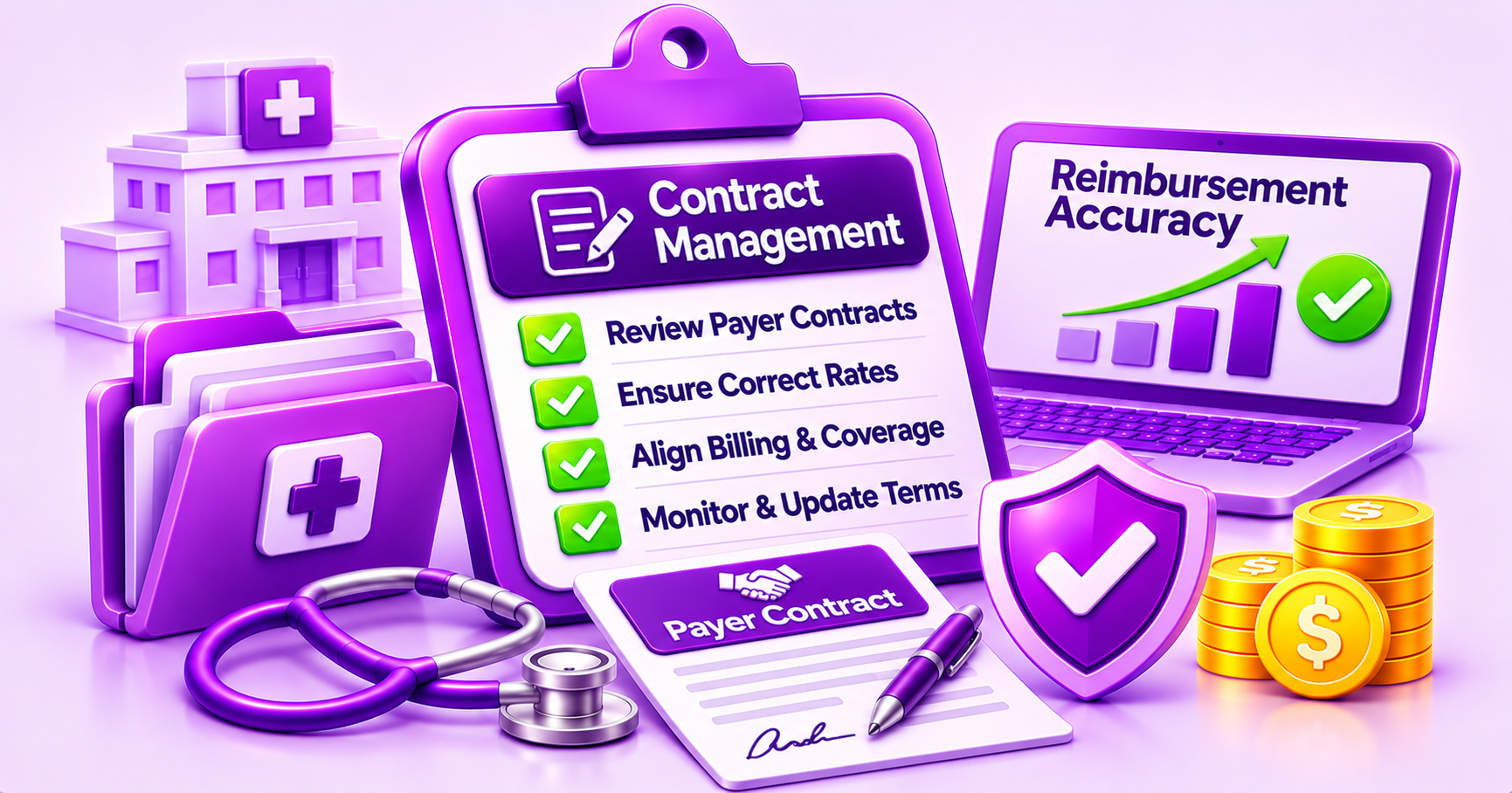
For a healthcare practice, the Role of Contract Management in Healthcare Reimbursement Accuracy is not an abstract billing concern. It affects the handoffs between clinical work, patient information, payer rules, and the money ultimately collected. The useful question is where the process breaks and what evidence would show that a correction worked.
Payer contracts are operational instructions
Reimbursement depends on more than a headline fee percentage. Agreements can define fee schedules, effective dates, claim deadlines, modifiers, bundling rules, and dispute procedures.
If billing teams do not have usable contract information, they may accept incorrect payments or challenge amounts that are contractually correct.
Maintain a reliable contract inventory
Store executed agreements, amendments, product participation lists, fee schedules, and renewal dates with controlled access. Identify which entity, tax ID, provider, and service location each agreement covers.
An outdated spreadsheet can misprice claims after a payer loads a new schedule or a provider changes participation status.
Translate terms into claim edits and expected payments
Map relevant contract rules into billing system settings and payment variance checks. Test high-volume procedures before and after fee schedule changes.
Not every contract provision can be automated, especially exceptions tied to clinical circumstances or unusual service combinations.
Watch for silent operational changes
Monitor payer bulletins, contract amendments, and network notifications. Review unexpected denial or adjustment spikes after payer system changes.
A contract team should communicate changes to coding, credentialing, scheduling, and payment posting teams, not keep them in a separate legal folder.
Use contract evidence in disputes
When a remittance conflicts with an agreement, cite the specific clause, date, and expected calculation. Maintain an audit trail of communications and outcomes.
Accurate contract management improves financial reporting because expected reimbursement becomes explainable and reproducible.
A realistic practice scenario
Consider a fictional practice that notices repeated exceptions related to translate terms into claim edits and expected payments. Rather than submitting every account again, the team isolates affected claims, checks the source documents, and determines which step introduced the discrepancy. It then corrects the accounts using the payer’s applicable procedures and updates the workflow that produced the errors. This illustration is hypothetical, not a reported client outcome.
Where outsourced billing support fits
A medical billing partner can help monitor claim status, maintain exception queues, analyze rejection and payment patterns, and coordinate corrections with practice staff. Clinical decisions, documentation integrity, payer requirements, and provider oversight remain essential. VerifiMed offers outsourced medical billing, coding, denial management, A/R follow-up, credentialing, and revenue cycle management services. Practices that need additional operational capacity may work with a Medical Billing Company such as VerifiMed for claim follow-up, exception monitoring, and billing coordination while clinical and coverage decisions remain with the appropriate professionals.
Translate contract language into billing controls
Payer agreements contain more than a reimbursement percentage. They may define fee schedules, modifiers, multiple-procedure reductions, bundling provisions, claim submission rules, and dispute timelines. Contract terms can change through amendments or annual schedule updates. A payment variance engine is only as reliable as the contract version and effective date behind it.
Maintain a centralized contract inventory with payer, product, service line, effective dates, amendment history, and designated owner. Map the terms that can be operationalized into billing and payment review rules. Flag ambiguous provisions for contract or legal review rather than allowing staff to interpret them inconsistently.
When a payer payment differs from expectations, confirm that the claim belongs to the correct network product and that the contract provision applies to that date of service. Analyze recurring discrepancies by code and payer. If several accounts share the same variance, the practice may need a payer-level resolution rather than dozens of isolated follow-up calls.
Practical review checklist
Assign a clear owner to the workflow, document the evidence required to close an exception, and set a review cadence appropriate to the volume of affected claims.
Separate problems that staff can correct immediately from those requiring payer clarification, clinical documentation, system configuration, or contractual interpretation.
Retest the process after any change. Compare the same measures over a consistent period, and keep examples of resolved cases to support training and quality review.
A final operational safeguard
A policy is only effective when staff can see the next action on an actual account. Record the reason a claim or encounter is held, the supporting evidence, the date of the most recent payer response, and the person responsible for follow-up. This makes work transferable between shifts and helps managers distinguish a one-time exception from a systemic defect. Review closed items as well as open ones: a resolved claim can still reveal an upstream error worth preventing. If a proposed correction affects coding, clinical necessity, coverage, or contract interpretation, involve the appropriate qualified reviewer before changing the record or resubmitting.
A contract-version example
A payer contract amendment becomes effective halfway through the year, but the practice’s expected-payment software still uses the older schedule. The resulting variance report flags dozens of apparent underpayments. Before opening disputes, the analyst checks the amendment, effective date, product, and affected codes. The team updates the schedule and reruns the analysis for the appropriate service dates. Any remaining discrepancies can then be investigated with confidence. Contract management is therefore not just a negotiation activity: accurate document control, implementation testing, and regular comparison with remittances are essential to reliable reimbursement reporting.
To make this review actionable, the practice should keep a small sample of affected transactions, identify the team responsible for each correction, and review whether the same error recurs after the workflow change. The purpose of measurement is to guide a specific improvement, not simply to produce another dashboard. Any correction that changes a clinical code or coverage determination should receive the appropriate professional review before submission.
Final Words
The central lesson of the role of contract management in healthcare reimbursement accuracy is that reimbursement performance depends on the details of the underlying workflow. Focus on the specific exceptions described above, verify changes against actual claim outcomes, and keep patient billing accurate throughout the process.
FAQs
1. What should a practice know about payer contracts are operational instructions?
Reimbursement depends on more than a headline fee percentage. The best next step is to check actual account records and the relevant payer rules before changing the workflow.
2. What should a practice know about maintain a reliable contract inventory?
Store executed agreements, amendments, product participation lists, fee schedules, and renewal dates with controlled access. The best next step is to check actual account records and the relevant payer rules before changing the workflow.
3. What should a practice know about translate terms into claim edits and expected payments?
Map relevant contract rules into billing system settings and payment variance checks. The best next step is to check actual account records and the relevant payer rules before changing the workflow.

 English
 Arabic
 French
 Spanish
 Portuguese
 Deutsch
 Turkish
 Dutch
 Russian
 Romaian
 Portuguese (Brazil)
 Greek