
How Do VFFS Powder Fillers Boost Speed and Consistency?
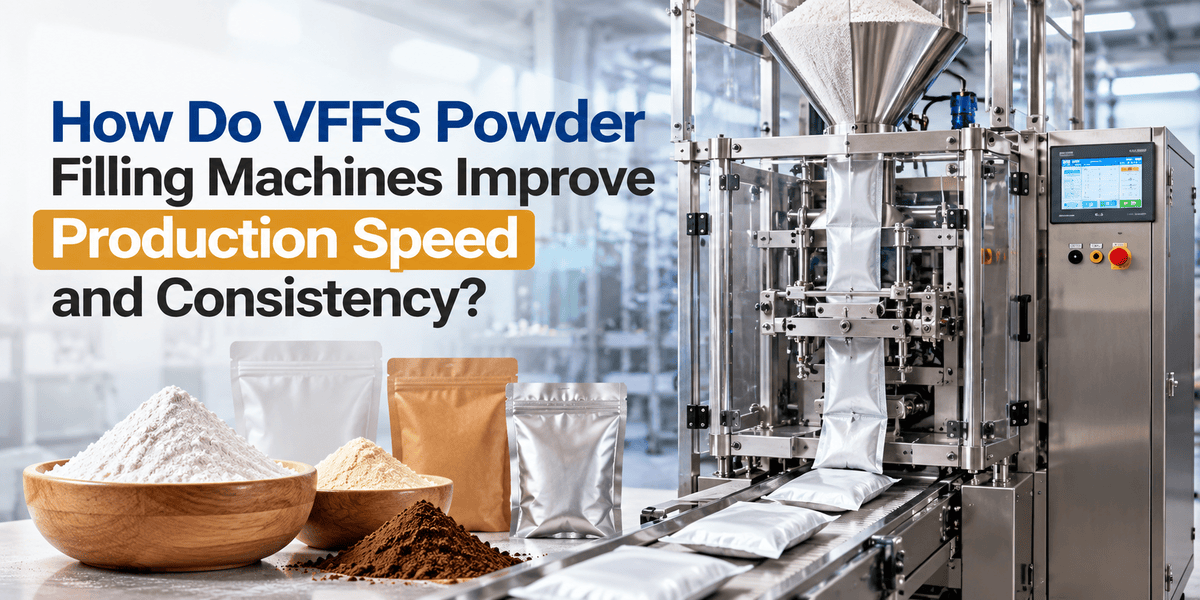
A powder packaging line has to solve two problems at the same time: produce enough packages to meet demand and keep every package within the required fill and sealing limits. That becomes difficult when powder characteristics change, film moves inconsistently, or operators have to make frequent manual adjustments.
An automatic powder filling machine integrated with a VFFS system addresses these problems by coordinating film movement, dosing, bag forming, filling, sealing, and cutting. Instead of treating each operation as a separate manual step, the machine synchronizes them into a repeatable production cycle.
The result is not simply a faster machine. Properly configured VFFS equipment can reduce unnecessary pauses, control dosing more precisely, maintain stable film registration, and respond to process variation while production continues. The actual result still depends on the powder, film, dosing technology, machine configuration, and operating conditions.
This article explains how these systems improve production speed and consistency, what components contribute to those gains, and what manufacturers should consider before selecting a VFFS powder packaging system.
A useful production target is the fastest sustainable cycle that still protects fill accuracy, seal quality, and package consistency.
Key Takeaway
An automatic powder filling machine can improve VFFS production speed and consistency by coordinating powder dosing, film movement, bag forming, sealing, and cutting within a controlled production cycle.
The biggest gains come from matching the machine configuration to the actual product and packaging requirements. Key factors include:
- Powder flow behavior: Affects the choice of dosing technology and the stability of the filling process.
- Servo-driven dosing and motion control: Can improve repeatability, but the machine still needs to be properly matched to the product.
- Film tension and registration: Become increasingly important as production speed rises and can affect bag dimensions, alignment, and material waste.
- Sealing performance: Must remain stable at the intended production speed to maintain package integrity.
- Closed-loop feedback: Can detect developing variation and support corrections before a larger quantity of packages falls outside the target.
- Changeover time: Matters because peak machine speed does not represent productive output if the line spends long periods stopped between products.
- Sustainable production speed: Higher machine speed alone does not guarantee better output; performance should be evaluated through fill accuracy, seal quality, film registration, reject rates, and reliable operation.
How Does the VFFS Process Support Higher Production Speeds?
VFFS, or Vertical Form Fill Seal, systems produce bags from roll stock rather than relying on individually prepared pouches. The film travels through the machine, forms around a forming tube, receives the product, and then passes through sealing and cutting operations.
This arrangement reduces the number of separate handling steps required to produce each package. The film is continuously supplied from a roll, while forming, filling, sealing, and cutting are coordinated around the machine's cycle.
For powder applications, gravity can also assist the movement of suitable products from the dosing system into the formed package. The exact behavior depends on characteristics such as powder flowability, density, particle size, and moisture sensitivity.
The production advantage comes from coordination. When film movement, dosing, and sealing are synchronized, the machine spends less time waiting for one station to finish before another can operate.
Intermittent VFFS machines briefly stop film movement during certain operations. Continuous-motion designs keep the film moving while sealing components travel with it during the sealing cycle. This can allow higher cycle rates when the product, film, and machine configuration are suitable.
The difference is not simply about choosing continuous motion because it sounds faster. The dosing system has to deliver the required amount within the available cycle window, while the sealing system must achieve the required seal without becoming the limiting step.
How Does Powder Dosing Technology Improve Filling Speed and Accuracy?
The dosing system is one of the most important parts of a powder packaging machine because it controls how much product enters each package and how quickly that amount can be delivered.
Different powders behave differently. Fine, cohesive powders may require a controlled auger system, while granular and free-flowing products may be better suited to weighing or volumetric systems.
Servo Auger Dosing
Servo-driven augers use controlled screw rotation to meter powder into each package. The amount delivered depends on factors such as auger configuration, rotation, product characteristics, and the selected machine settings.
Auger systems are commonly used for fine and cohesive powders because the screw provides controlled movement of the product.
Weighing Systems
Multihead weighing systems are more commonly associated with granular or free-flowing products. Multiple weigh heads can work together to reach a target weight, which can support rapid dosing when the product characteristics suit the system.
The important point is that the dosing method should be selected around the product rather than around a preferred machine type.
Density and Flow Compensation
Powder density can change during production because of aeration, settling, humidity, or other product conditions. Feedback from weighing equipment can be used to adjust subsequent doses.
Feedback systems can support gravimetric correction, film tracking, reject management, trend analysis, and seal monitoring to help maintain consistency at higher operating speeds.
Recipe Management
Stored recipes can reduce the amount of manual adjustment required when switching between powders, bag sizes, or established machine configurations.
This matters because productive capacity is influenced by more than cycle speed. A machine that reaches a high cycle rate but requires lengthy manual setup between products may produce less over an entire shift than a system with slightly lower peak speed and faster repeatable changeovers.
How Do Servo Drives and Motion Control Improve VFFS Performance?
Servo drives provide electronically controlled movement for several machine functions. In a VFFS system, they can be used for film advancement, sealing movement, dosing, and synchronization between machine stations.
Film Pull and Registration
Film must move at a controlled rate so the finished package has the intended dimensions and printed artwork remains correctly positioned.
Servo-driven film movement can provide accurate control of bag length and registration. This becomes particularly useful when printed film contains graphics, product information, barcodes, or other elements that must align with the finished package.
If film movement is inconsistent, the consequences can include incorrect bag dimensions, seal misalignment, registration errors, and material waste.
Sealing Jaw Control
Sealing requires the appropriate combination of temperature, pressure, and dwell time for the selected film structure.
Servo-controlled sealing movement can help coordinate jaw movement with the film. In continuous-motion systems, the sealing jaws travel with the moving film during part of the sealing cycle rather than requiring the entire film web to stop.
This can reduce start-stop motion and support higher cycle rates where the film and sealing process are suitable.
Electronic Synchronization
The real advantage of motion control comes from coordination.
Film movement, dosing, and sealing need to remain synchronized. If one operation falls behind, the machine may need to slow down or stop. Electronic control helps maintain the timing relationship between these operations.
That makes motion control a contributor to both speed and repeatability.
How Does Real-Time Feedback Maintain Consistency at Higher Speeds?
Higher production speed leaves less room for unnoticed variation. A small dosing error repeated hundreds or thousands of times can create substantial product giveaway or rejected packages.
Real-time feedback provides a way to identify changes during production instead of waiting until the end of a production run.
Weight Feedback
Load cells or in-line checkweighers can measure package weight and provide information to the control system. If the measured result begins to move away from the target, the dosing parameters can be adjusted for subsequent cycles.
The purpose is not to eliminate every source of variation. It is to prevent normal process changes from developing into a larger problem.
Film Tracking
Film sensors monitor position and movement so the system can detect registration drift or changes in film behavior.
Stable film tracking helps maintain consistent bag length and seal placement, particularly as the film roll diameter changes during production.
Reject Management
Packages that fall outside defined quality limits can be diverted from the acceptable product stream.
Automatic rejection prevents nonconforming packages from continuing downstream and reduces the need for operators to identify every individual problem manually.
Trend Monitoring
A control system can also provide information about weight variation, reject rates, and other process indicators. This gives operators an opportunity to respond when variation begins to increase.
These feedback functions can help maintain more consistent filling and packaging performance as production speed increases by allowing operators or control systems to identify developing variation during production.
What Is the Difference Between Continuous-Motion and Intermittent VFFS Systems?
Continuous-motion and intermittent VFFS machines use different approaches to moving the packaging film and completing sealing operations.
An intermittent system advances the film, stops for selected operations, and then advances again. A continuous-motion system keeps the film moving while sealing components move with it during the sealing stage.
Continuous-Motion Systems
Continuous motion can support higher cycle rates because the machine does not need to repeatedly stop and restart the film for every sealing operation.
This can be useful in applications where the powder, film, dosing equipment, and sealing process can all operate reliably at the intended rate.
Continuous-motion systems can provide a speed advantage when the powder, dosing system, film, and sealing process are suitable for higher cycle rates. Intermittent VFFS systems can remain practical when stationary filling, simpler operation, or application requirements make repeated film stops acceptable.
Intermittent Systems
Intermittent machines can be appropriate when the application does not require the higher cycle rates associated with continuous motion.
They can also be useful when the filling or sealing process benefits from a stationary film position.
The decision should be based on the complete production requirement rather than machine speed alone.
A manufacturer should consider required packages per minute, powder behavior, fill accuracy, film characteristics, bag format, changeover frequency, available budget, and future production requirements before choosing between the two motion types.
How Can a Powder Filling Machine Improve Fill-Weight Consistency?
Weight consistency depends on more than the dosing screw or weighing equipment. The entire product path has to deliver powder to the dosing system in a stable condition.
Controlled Powder Supply
An enclosed hopper with controlled agitation can help maintain consistent product movement toward the dosing mechanism.
Level control also matters. If the product head above the dosing system changes substantially, the conditions at the dosing point may change as well.
Precision Dosing Hardware
Servo augers and suitable weighing systems can reduce cycle-to-cycle variation when correctly configured for the product.
The actual accuracy that can be achieved depends on the powder, fill range, machine design, environmental conditions, and operating parameters. A supplier's published specification should be verified against testing with the actual product.
Enclosed Product Paths
Fine powders can be sensitive to air movement and environmental conditions. Enclosed product paths can help reduce the effect of drafts, while appropriate environmental controls can matter for moisture-sensitive products.
Rapid Reject Response
When a package is identified as outside the acceptable range, rapid rejection keeps that package from moving into the next stage of production.
Together, stable product supply, suitable dosing equipment, controlled machine movement, and feedback help create a more consistent filling process.
How Do Flexible Packaging Materials Affect VFFS Speed and Results?
Film selection and machine configuration have to work together. A packaging machine may be mechanically capable of operating at a certain rate, but the selected film still needs to form and seal correctly at that speed.
Film Tension and Registration
Film tension affects bag length, film tracking, and seal positioning. As the film roll becomes smaller, the machine has to continue controlling movement and tension.
Dancer systems, film drives, sensors, and other control elements can help maintain stable film handling.
Seal Performance
The sealing material must be compatible with the selected sealing method and operating conditions.
At higher machine speeds, the available sealing time can become shorter. If the film requires a particular temperature or dwell time, the machine configuration must provide the conditions needed to create a reliable seal.
Powder in the Seal Area
Powder contamination around the seal can compromise package integrity. This is particularly relevant for fine powders that can migrate during filling.
Fill timing, settling, product control, and sealing-jaw configuration can help keep the seal zone clean.
The relationship between film behavior and machine settings is also why flexible packaging machines should be evaluated using the actual packaging material rather than relying only on a general machine specification.
What Practical Steps Maximize Speed and Consistency Gains?
A VFFS machine can have sophisticated controls and still produce inconsistent results if the product and process have not been properly characterized.
Manufacturers should treat machine commissioning and ongoing operation as part of the performance equation.
- Powder characterization: Check flow behavior, density, particle characteristics, and moisture sensitivity before selecting dosing technology and operating parameters.
- Speed and accuracy trials: Run the actual powder at the intended production rate and measure fill-weight distribution, seal performance, rejects, and film registration.
- Recipe standardization: Store validated machine settings so operators do not have to recreate the process manually after every changeover.
- Preventive maintenance: Inspect film paths, dosing components, sealing jaws, sensors, and servo systems according to the manufacturer's maintenance requirements.
- Environmental monitoring: Pay attention to temperature and humidity where powder behavior can be affected by environmental conditions.
- Production data review: Monitor weight trends, reject rates, downtime, and changeover performance rather than judging the machine only by its advertised cycle rate.
A practical evaluation should include powder characterization, speed-and-accuracy trials, recipe standardization, preventive maintenance, environmental monitoring, and regular review of weight and reject data.
How to Choose an Automatic Powder Filling Machine for VFFS Packaging
Selecting a powder VFFS system involves more than comparing machine speeds. The machine has to fit the product, packaging material, production environment, and expected operating pattern.
Key specification areas include:
- Required output in packages per minute
- Target fill range and acceptable weight variation
- Powder flowability, density, particle size, and moisture sensitivity
- Required bag dimensions and packaging format
- Compatible film structures
- Intermittent or continuous machine operation
- Dosing technology
- Film width and forming requirements
- Sealing temperature and control
- Changeover frequency and expected setup time
- Available floor space
- Electrical power and compressed-air requirements where applicable
- Dust management and product containment
- Cleaning and maintenance requirements
- Operator training and machine controls
- Upstream powder feeding
- Downstream conveying, inspection, case packing, or palletizing
Integration should also be considered at the beginning of the project. A fast filler cannot deliver the expected line output if the conveyor, inspection system, case packer, or downstream equipment becomes the bottleneck.
ISO/TC 313 is responsible for packaging machinery standardization, including safety requirements, while ISO/DIS 24158-1 is currently under development as a draft standard covering general safety requirements for packaging machinery. Manufacturers should verify the standards applicable to the specific machine, installation, and market.
For food applications, hygiene and cleanability requirements also need to be evaluated. EN 1672-2 addresses common hygiene and cleanability requirements for machinery used in food preparation and processing.
The best specification is therefore one that defines measurable acceptance criteria before the machine is purchased. Useful criteria can include packages per minute, fill-weight variation, seal integrity, film registration, reject rate, changeover time, and successful operation using the actual product and packaging material.
A packaging line earns its production value during the hours it runs reliably, not during a short demonstration at peak speed.
Industry Snapshot
VFFS technology continues to play an important role in powder packaging because a single automated platform can combine film feeding, bag forming, powder dosing, sealing, and cutting within one production cycle.
For powder applications, machine configuration is closely tied to product characteristics. Fine and cohesive powders may require controlled auger dosing, while free-flowing or granular products can be better suited to weighing-based systems. As production requirements increase, servo-controlled movement, stable powder feeding, film tracking, and process feedback can help manufacturers maintain more consistent operation.
Manufacturers are also placing greater emphasis on sustainable production performance rather than maximum machine speed alone. A high-speed VFFS machine still needs to maintain acceptable fill-weight variation, seal quality, film registration, reject rates, and changeover performance throughout normal production.
This makes complete line evaluation increasingly important. The dosing system, VFFS machine, packaging film, inspection equipment, conveyors, and downstream equipment all need to work together if the manufacturer wants to achieve the expected production rate.
Safety and standardization are also important considerations when specifying packaging machinery. ISO/TC 313 covers packaging machinery standardization, including areas such as machine safety, classification, energy consumption, efficiency, and availability. Applicable safety and hygiene requirements should be evaluated according to the machine, product, installation, and market.
How Can a VFFS Upgrade Improve Powder Packaging Performance? An Illustrative Case
Consider a contract packager handling several powder blends in different bag sizes.
The company is using an older intermittent VFFS line. Production output is acceptable for some products, but the operation experiences frequent adjustments when changing powders and bag formats. Weight variation also increases during longer runs, requiring operator intervention.
This is an illustrative scenario rather than a documented customer case.
The Situation
The operation needs higher sustainable output without simply increasing the machine's nominal speed. It also wants more consistent filling and shorter changeovers.
The production team evaluates a continuous-motion VFFS configuration with servo-controlled auger dosing, in-line weight feedback, controlled film movement, and recipe storage.
The Approach
The team first characterizes each powder rather than applying one dosing setup to every product.
Production trials are then conducted using the actual powders and packaging films. The team records:
- Packages produced per minute
- Fill-weight distribution
- Reject rate
- Seal quality
- Film registration
- Changeover duration
- Operator adjustments
- Downtime
Validated settings are saved as product recipes.
The Outcome
In this illustrative scenario, the upgraded configuration allows the company to focus on sustainable production speed rather than a short peak-speed demonstration. Servo dosing and feedback help control fill variation, while recipe management reduces repeated manual setup.
The main lesson is that speed improvement comes from the complete system. Motion control alone does not solve powder-flow problems, and a precise dosing system cannot compensate for unstable film handling or poor sealing conditions.
A documented packaging-machine case should always be based on verified manufacturer or customer information. The supplied source likewise labels its example as an illustrative packaging performance example rather than presenting an invented customer result as a real case.
VFFS Features That Influence Production Speed and Consistency
The following table shows how major system elements affect both sides of the production equation.
|
Machine or Process Factor |
Effect on Speed |
Effect on Consistency |
What to Check |
|
Continuous motion |
Reduces repeated stop-start movement |
Can provide smoother machine operation |
Powder suitability, film, sealing |
|
Servo film control |
Supports controlled film movement |
Helps maintain bag length and registration |
Film characteristics and machine controls |
|
Servo sealing control |
Supports coordinated sealing at higher rates |
Controls sealing movement and timing |
Film seal window and dwell requirements |
|
Auger dosing |
Provides controlled powder delivery |
Supports repeatable dosing for suitable powders |
Powder flow, density, fill range |
|
Weight feedback |
Allows correction during production |
Helps respond to fill variation |
Checkweigher or load-cell configuration |
|
Stable powder supply |
Reduces interruptions to dosing |
Helps maintain consistent product flow |
Hopper design, agitation, level control |
|
Recipe management |
Shortens repeat setup |
Provides repeatable settings between runs |
Product and bag-size storage |
|
Film tracking |
Reduces registration-related interruptions |
Helps maintain bag dimensions and print position |
Sensors, tension control, film structure |
Frequently Asked Questions
How much faster can a VFFS powder machine run compared with older systems?
There is no single speed increase that applies to every VFFS powder machine. Continuous-motion and servo-controlled systems can support higher sustainable cycle rates than some older intermittent designs, but the achievable rate depends on powder behavior, dosing technology, film, bag dimensions, sealing requirements, and machine configuration.
Does higher speed always reduce powder filling accuracy?
No. Higher speed does not automatically mean lower accuracy when the dosing system, product supply, motion control, and feedback systems are properly matched. The machine still needs to be tested with the actual powder at the intended operating rate.
How accurate is an automatic powder filling machine?
The achievable filling accuracy depends on the powder, dosing technology, target fill weight, machine configuration, environmental conditions, and operating parameters. Manufacturers should verify accuracy through trials using the actual product rather than relying only on a published machine specification.
How many bags per minute can a VFFS powder filling machine produce?
There is no universal production rate for every powder VFFS machine. Output depends on the powder, dosing method, bag dimensions, film, sealing requirements, machine configuration, and whether the system uses continuous or intermittent motion. Sustainable production speed is more useful than peak cycle speed alone.
What is the difference between a powder filling machine and a VFFS machine?
A powder filling machine controls the measurement and delivery of powder, while a VFFS machine forms bags from roll film, fills them, seals them, and cuts the finished packages. In an integrated system, the powder filling equipment and VFFS machine operate together as one automated packaging line.
Wrapping Up
VFFS powder packaging systems improve production performance by coordinating several operations that would otherwise require separate handling: film feeding, bag forming, powder dosing, sealing, and cutting.
The biggest gains come when the machine is configured around the product rather than selected on speed alone. Powder flow behavior determines the dosing approach. Film properties affect forming and sealing. Servo control coordinates movement, while feedback systems can respond to changes in weight, film position, or sealing conditions.
Manufacturers should also consider changeover time, maintenance, operator training, safety, utilities, line integration, and future production requirements. A machine that performs well during a short trial still needs to remain stable throughout normal production.
The most useful measure of VFFS performance is therefore sustainable output. A successful powder packaging line maintains the required speed while keeping fill weights, seals, film registration, rejects, and downtime within acceptable limits.
The best packaging speed is the one a production team can maintain while keeping every critical quality measure under control.

 English
 Arabic
 French
 Spanish
 Portuguese
 Turkish
 Dutch
 Italiano
 Russian
 Romaian
 Portuguese (Brazil)
 Greek