
Why IB Physics Students Lose Marks Even When Their Calculations Are Correct
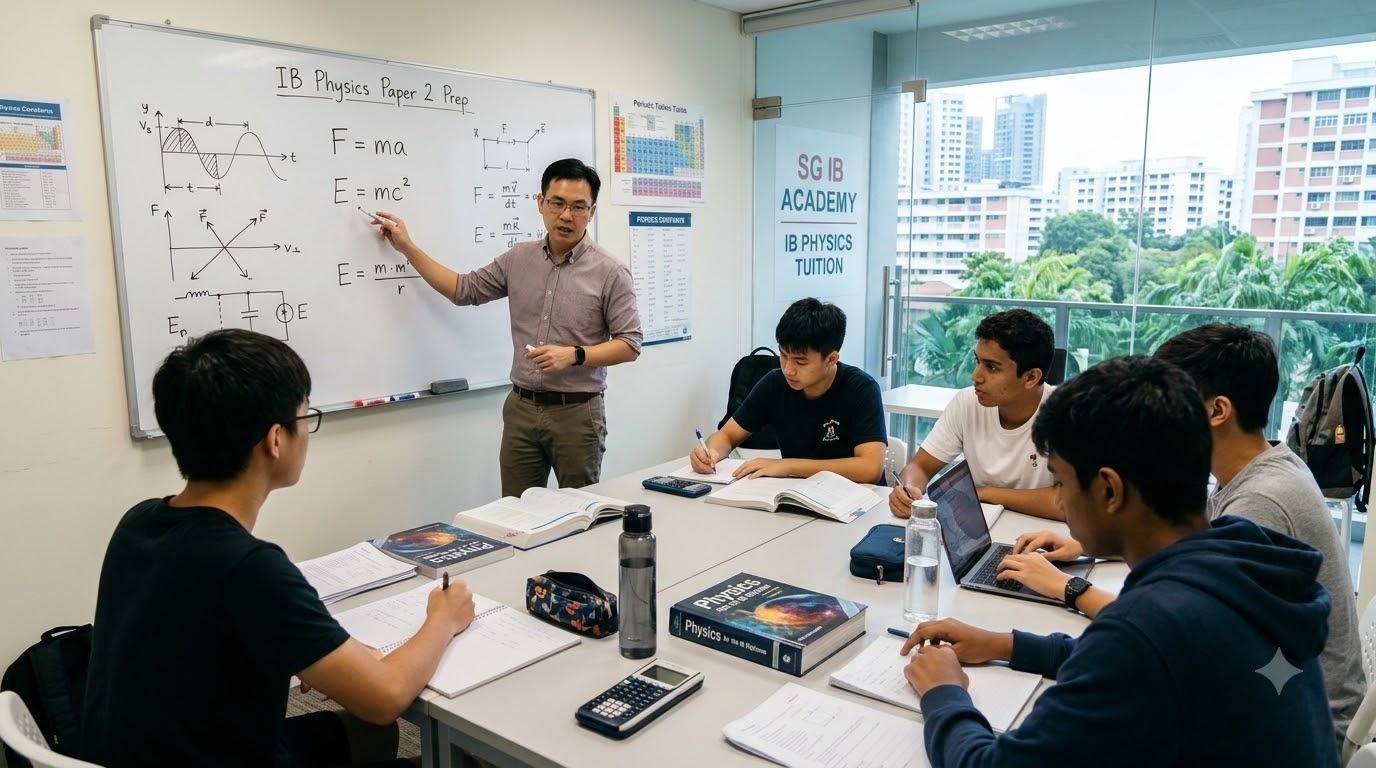
Many IB Physics students understand the formulas, complete their calculations and still lose marks in examinations. The problem is often not a lack of mathematical ability. It is the way they interpret questions, select equations, explain physical principles and present their answers.
Scoring well in IB Physics requires more than memorising formulas. Students need to understand what the question is testing, connect concepts to unfamiliar situations, analyse data and communicate their reasoning clearly. If you are considering IB Physics tuition to strengthen problem-solving and exam technique, it is worth understanding the mistakes that commonly prevent students from achieving their target grades.
The good news is that many of these mistakes can be corrected through a more structured approach to learning and exam practice. Instead of solving more questions without reviewing them, students should learn how to identify exactly where their reasoning goes wrong.
1. Why Knowing the Formula Is Not Enough
One of the biggest challenges in IB Physics is deciding which physics principle applies to a particular situation.
Students may remember equations for acceleration, momentum, energy, waves or electrical circuits. However, an examination question may describe a situation in unfamiliar language rather than directly telling students which formula to use.
For example, a question might describe a moving object travelling down a slope and ask students to determine its speed at a particular point. A student who immediately searches for an equation may overlook important information about energy transfer, friction or the forces acting on the object.
The better approach is to understand the physical situation first.
Before selecting an equation, ask:
-
What is happening physically?
-
Which quantities are given?
-
What quantity must be calculated?
-
Which physics principle connects these quantities?
-
Are there any assumptions or conditions in the question?
This process helps students avoid choosing equations simply because they recognise familiar numbers or keywords.
2. Five Common Reasons Students Lose Marks
Understanding recurring mistakes is the first step towards improving examination performance.
Mistake 1: Substituting Numbers Before Understanding the Question
Some students read a question, identify two numbers and immediately substitute them into an equation.
This can lead to errors because the values may represent different physical quantities or refer to different stages of a process.
How to improve:
Read the complete question before writing an equation. Identify the relevant variables and write down their symbols with units.
For example:
|
Information in question |
Symbol |
Unit |
|
Initial velocity |
(u) |
m s⁻¹ |
|
Final velocity |
(v) |
m s⁻¹ |
|
Acceleration |
(a) |
m s⁻² |
|
Time |
(t) |
s |
|
Displacement |
(s) |
m |
Then decide which relationship is appropriate. This small habit reduces unnecessary substitutions and helps students organise their working.
Mistake 2: Ignoring Units
A numerical answer without the correct unit is incomplete in many physics contexts.
Students sometimes calculate a value correctly but write an answer without checking whether the unit is appropriate. Others mix centimetres with metres, minutes with seconds, or grams with kilograms.
How to improve:
Convert quantities into consistent units before calculating.
For example, if a question provides a distance of 250 cm, convert it into metres:
[
250\text{ cm}=2.50\text{ m}
]
Make unit checking part of the solution rather than something you do only at the end.
Mistake 3: Memorising Definitions Without Understanding Them
Definitions are important, but simply memorising a sentence does not guarantee that a student can apply the concept.
A student might remember the definition of acceleration but struggle when asked to interpret a velocity-time graph or explain how acceleration changes during a particular motion.
How to improve:
Connect every important definition to an example.
For instance, acceleration describes the rate of change of velocity with time. Students should be able to explain what happens when:
-
An object speeds up.
-
An object slows down.
-
An object changes direction.
-
An object moves with constant velocity.
Understanding the meaning behind a definition makes it easier to answer questions that use different wording.
Mistake 4: Writing Incomplete Explanations
A calculation-based question is not the only place where students lose marks. Explanation questions can also be challenging.
Consider a question asking why the acceleration of an object changes. Writing only that "the force changes" may not provide enough explanation.
A stronger response identifies the relationship between the relevant physical quantities and explains how that relationship applies to the situation.
How to improve:
Use a simple explanation structure:
-
State the relevant physics principle.
-
Identify the quantities involved.
-
Explain the relationship between them.
-
Apply the relationship to the situation in the question.
This helps students move beyond short, unsupported statements.
Mistake 5: Not Checking Whether the Answer Is Reasonable
Students sometimes accept the first numerical result they obtain.
However, a calculation can contain an arithmetic error, an incorrect conversion or an unsuitable assumption.
How to improve:
After calculating, ask yourself:
-
Is the answer positive or negative for a valid reason?
-
Is the magnitude realistic?
-
Does the unit match the required quantity?
-
Does the result make sense in the physical situation?
Checking the reasonableness of an answer is an important examination habit.
3. A Better Method for Solving IB Physics Questions
A structured method can make unfamiliar questions easier to approach. Rather than jumping between formulas, students should follow a consistent sequence.
Step 1: Read the Question Carefully
Read the complete question and identify what it is asking.
Pay attention to words such as calculate, determine, explain, compare and describe. These words indicate the type of response expected.
Step 2: Identify the Relevant Information
Write down the given quantities and the unknown quantity.
If the question includes a diagram, graph or table, examine it carefully. Information in a diagram may be just as important as information in the written question.
Step 3: Identify the Physics Concept
Before choosing an equation, identify the principle involved.
For example:
-
Motion questions may involve velocity, acceleration and displacement.
-
Energy questions may involve energy transfers and conservation.
-
Momentum questions may involve changes in momentum and interactions.
-
Circuit questions may involve current, potential difference and resistance.
-
Wave questions may involve frequency, wavelength and wave behaviour.
These are examples of broad areas of physics. Students should always follow the topics and requirements of their own IB Physics course.
Step 4: Select the Appropriate Relationship
Choose an equation that connects the known quantities to the unknown quantity.
Avoid selecting an equation simply because it contains a familiar variable. Make sure its conditions are suitable for the situation described.
Step 5: Show the Working Clearly
Write the equation, substitute the values and show the calculation.
For example, if an object starts from rest and accelerates uniformly at (2.0\text{ m s}^{-2}) for 5 seconds:
[
v=u+at
]
[
v=0+(2.0\times5)
]
[
v=10\text{ m s}^{-1}
]
Showing the working makes your reasoning easier to follow and helps you identify mistakes.
Step 6: Check the Final Answer
Check the unit, significant figures where relevant and whether the result makes physical sense.
This method is particularly useful when a question combines multiple concepts or presents information in an unfamiliar way.
4. How to Improve Data Analysis and Graph Interpretation
Data analysis is an important part of studying physics. Students need to interpret experimental information, recognise patterns and draw conclusions from evidence.
Some students are comfortable solving textbook calculations but become less confident when questions include unfamiliar graphs or experimental data.
A graph is not simply a picture. It represents a relationship between physical quantities.
When interpreting a graph, consider the following:
-
What quantities are represented on the horizontal and vertical axes?
-
What units are used?
-
Is the relationship linear or non-linear?
-
Does the gradient have a physical meaning?
-
What does the intercept represent?
-
Are there any unusual data points or limitations?
For example, students may be asked to interpret a graph showing how one physical quantity changes with another. They should explain the relationship using the information shown rather than merely describing the shape of the graph.
A practical graph-analysis checklist
|
What to check |
Why it matters |
|
Axis labels |
Identifies the quantities being compared |
|
Units |
Prevents incorrect interpretation |
|
Gradient |
May represent a physical relationship |
|
Intercept |
Can provide information about initial or fixed values |
|
Data pattern |
Helps identify trends |
|
Anomalies |
May indicate unusual measurements |
|
Limitations |
Helps evaluate the quality of the data |
Students should practise interpreting graphs from different topics instead of relying only on familiar examples.
5. How to Prepare for HL and SL Physics More Effectively
Both Standard Level (SL) and Higher Level (HL) students need strong conceptual understanding and problem-solving skills. However, HL students study a broader and deeper body of material.
A common mistake is to use exactly the same revision approach for every topic and every level.
A better strategy is to identify the demands of the course and organise revision accordingly.
For SL students
Focus on building a reliable understanding of the core material.
Priorities should include:
-
Understanding important concepts and relationships.
-
Practising structured calculation questions.
-
Learning how to interpret graphs and experimental data.
-
Explaining physical processes using accurate terminology.
-
Revising regularly rather than leaving everything until the examination period.
For HL students
Alongside the core material, HL students should give additional attention to the greater depth and breadth expected at their level.
Useful priorities include:
-
Connecting concepts across different topics.
-
Working through more challenging multi-step problems.
-
Practising unfamiliar applications.
-
Reviewing the assumptions behind physical models.
-
Developing clear explanations for complex situations.
Students at both levels should use current course materials and check that their practice questions match the syllabus and assessment requirements they are studying.
6. Practical Examples: Turning Weak Answers into Stronger Solutions
The following examples are illustrative learning scenarios. They show how a student can improve their approach rather than simply memorise a model answer.
Example 1: A Motion Calculation
Question: A car increases its velocity from 5 m s⁻¹ to 20 m s⁻¹ in 3 seconds. Calculate its average acceleration.
A common weak approach:
A student sees the two velocity values and performs a calculation without identifying the relationship.
A stronger approach:
First, identify the relevant quantities:
-
Initial velocity: (u=5\text{ m s}^{-1})
-
Final velocity: (v=20\text{ m s}^{-1})
-
Time: (t=3\text{ s})
Use the relationship:
[
a=\frac{v-u}{t}
]
Substitute:
[
a=\frac{20-5}{3}
]
[
a=5\text{ m s}^{-2}
]
The student should also understand what the result means: the car's velocity increases by an average of 5 m s⁻¹ every second during the stated interval.
Example 2: Explaining a Physics Concept
Question: Explain why increasing the resistance in a circuit affects the current when the potential difference remains constant.
A common weak answer:
"Because resistance reduces current."
This gives a general statement but does not explain the relationship.
A stronger answer:
For a circuit with constant potential difference, Ohm's law gives:
[
I=\frac{V}{R}
]
If the potential difference remains constant and resistance increases, the current decreases. This is because current is inversely proportional to resistance under the stated conditions.
The important difference is that the stronger answer identifies the relevant relationship and applies it directly to the question.
7. How to Build a Weekly IB Physics Revision Routine
Students often revise physics only when a test is approaching. This creates pressure and encourages short-term memorisation.
A weekly routine is more effective because it allows students to revisit concepts, practise questions and correct misunderstandings before they become bigger problems.
Here is one example of a manageable revision schedule.
|
Day |
Revision activity |
Main purpose |
|
Monday |
Review one difficult concept |
Strengthen understanding |
|
Tuesday |
Complete calculation questions |
Improve mathematical accuracy |
|
Wednesday |
Practise explanation questions |
Develop scientific communication |
|
Thursday |
Interpret graphs and data |
Improve analytical skills |
|
Friday |
Review mistakes from the week |
Identify recurring weaknesses |
|
Saturday |
Complete timed examination questions |
Improve exam technique |
|
Sunday |
Short revision and planning |
Prepare for the next week |
Students can adjust this schedule depending on their school workload, HL or SL level, and upcoming assessments.
The most important part is not the number of hours spent studying. It is whether each revision session has a clear purpose.
8. Why Reviewing Mistakes Matters More Than Repeating Questions
Completing dozens of practice questions does not automatically lead to improvement.
If a student repeatedly makes the same mistake without understanding why, the problem is unlikely to disappear.
After every practice session, create a mistake log.
|
Mistake category |
Example |
What to do next |
|
Conceptual error |
Misunderstanding a physics principle |
Relearn the concept |
|
Formula selection |
Using an unsuitable equation |
Practise identifying relevant relationships |
|
Calculation error |
Incorrect substitution |
Show each calculation step |
|
Unit error |
Mixing different units |
Practise unit conversion |
|
Explanation error |
Giving an incomplete response |
Review how to structure explanations |
|
Data interpretation |
Misreading a graph |
Practise analysing graphs |
Review this log every week. Look for patterns rather than treating every incorrect answer as an isolated problem.
For example, if several mistakes involve interpreting graphs, spend more time on data-based questions. If most errors occur in multi-step calculations, practise breaking those questions into smaller stages.
9. How the Right Tuition Support Can Improve Physics Learning
Some students can identify their mistakes independently, while others need guidance to understand why their approach is not working.
This is where structured IB Physics tuition in Singapore can be helpful.
A good learning programme should do more than explain formulas or provide additional worksheets. It should help students develop the reasoning skills required to solve different types of questions.
Useful tuition support may include:
-
Concept clarification: Breaking difficult topics into understandable steps.
-
Problem-solving practice: Learning how to approach unfamiliar questions.
-
Calculation guidance: Improving equation selection, substitutions and unit handling.
-
Data analysis: Developing confidence with graphs, tables and experimental results.
-
Exam preparation: Practising structured questions and reviewing common mistakes.
-
Individual feedback: Identifying specific weaknesses and setting clear improvement goals.
At IB-DP, students can explore IB subject tuition and academic support. The aim of effective subject guidance should be to build understanding and independent problem-solving ability, not simply encourage students to memorise answers.
Before choosing additional support, students should consider their current difficulties. Someone who struggles with basic concepts may need a different learning approach from someone who understands the syllabus but loses marks through incomplete explanations or calculation errors.
10. What Students Should Do Before Their Next Physics Examination
As the examination approaches, students should avoid trying to revise every topic in the same way.
Instead, use a targeted preparation plan.
First, review the syllabus. Identify the areas that require more attention and separate topics you understand from those you find difficult.
Second, practise a variety of questions. Include calculations, explanations, graphs and data-based problems.
Third, work under timed conditions. This helps you become more comfortable managing the examination paper without rushing.
Fourth, review your working. Do not focus only on whether the final answer is correct. Check your equation selection, reasoning, units and explanations.
Finally, revise your mistakes. Return to questions you previously answered incorrectly and attempt them again without looking at the solution.
Consistent preparation is more useful than last-minute memorisation.
Illustrative Case Study: From Formula Memorisation to Structured Problem-Solving
Consider a hypothetical IB Physics student who regularly performs well on straightforward textbook questions but struggles with unfamiliar examination problems.
The student knows many equations but often chooses the wrong one when a question combines multiple concepts. They also lose marks because their explanations are too brief.
Instead of simply increasing the number of questions they complete, the student changes their revision method.
They begin by identifying the physics principle behind each question before selecting an equation. They write down known quantities, show each calculation step and check units. For explanation questions, they practise stating the relevant principle and connecting it to the situation.
They also maintain a weekly mistake log and revisit questions they previously found difficult.
Over time, this approach gives the student a clearer understanding of their weaknesses and a more organised way to tackle unfamiliar problems.
The key lesson is that improvement comes from understanding the reason behind each mistake, not merely completing more practice questions.
Frequently Asked Questions
1. Why do I lose marks in IB Physics even when I know the formulas?
Knowing formulas is only one part of physics. You also need to identify the correct relationship, understand the physical situation, show your working and interpret the final result. Mistakes in units, substitutions and explanations can also affect your answers.
2. How can I improve my IB Physics problem-solving skills?
Start by identifying the known quantities and the unknown quantity. Then determine the relevant physics concept, select an appropriate equation, show your working and check the final answer. Practising this method regularly can help you approach unfamiliar questions more confidently.
3. Is IB Physics HL much harder than SL?
HL covers greater depth and breadth than SL. Students taking HL should be prepared for additional content and more demanding applications. However, both levels require a strong understanding of concepts, mathematical reasoning and scientific communication.
4. How often should I practise IB Physics questions?
Regular practice is generally more useful than studying only before examinations. A weekly routine that includes calculations, explanations, graph interpretation and review of mistakes can help students maintain their understanding.
5. Should I memorise all IB Physics formulas?
Students should understand the relationships behind the equations rather than depend entirely on memorisation. They should also become familiar with the relevant formula resources and data booklet provided for their course and assessment.
6. Can IB Physics tuition help if I understand the theory but struggle with examination questions?
Yes. Focused tuition can help identify gaps between theoretical understanding and practical application. A tutor can guide students through problem-solving methods, calculation techniques, data interpretation and structured explanations.
Conclusion
IB Physics becomes more manageable when students understand how to apply concepts rather than simply memorise equations. Correct calculations matter, but so do logical reasoning, accurate units, data interpretation and clear explanations.
The most effective way to improve is to identify recurring mistakes, practise different question styles and review every incorrect answer carefully. Students should also develop a revision routine that gives enough attention to both conceptual understanding and examination technique.
With consistent effort and the right learning support, students can become more confident when facing unfamiliar problems and improve the quality of their answers. Strong preparation is not about memorising more formulas. It is about learning how to think like a physicist.

 English
 Arabic
 French
 Spanish
 Portuguese
 Deutsch
 Turkish
 Dutch
 Italiano
 Russian
 Romaian
 Portuguese (Brazil)