
Real Estate App Development Company in UAE: Build Smart Property Applications
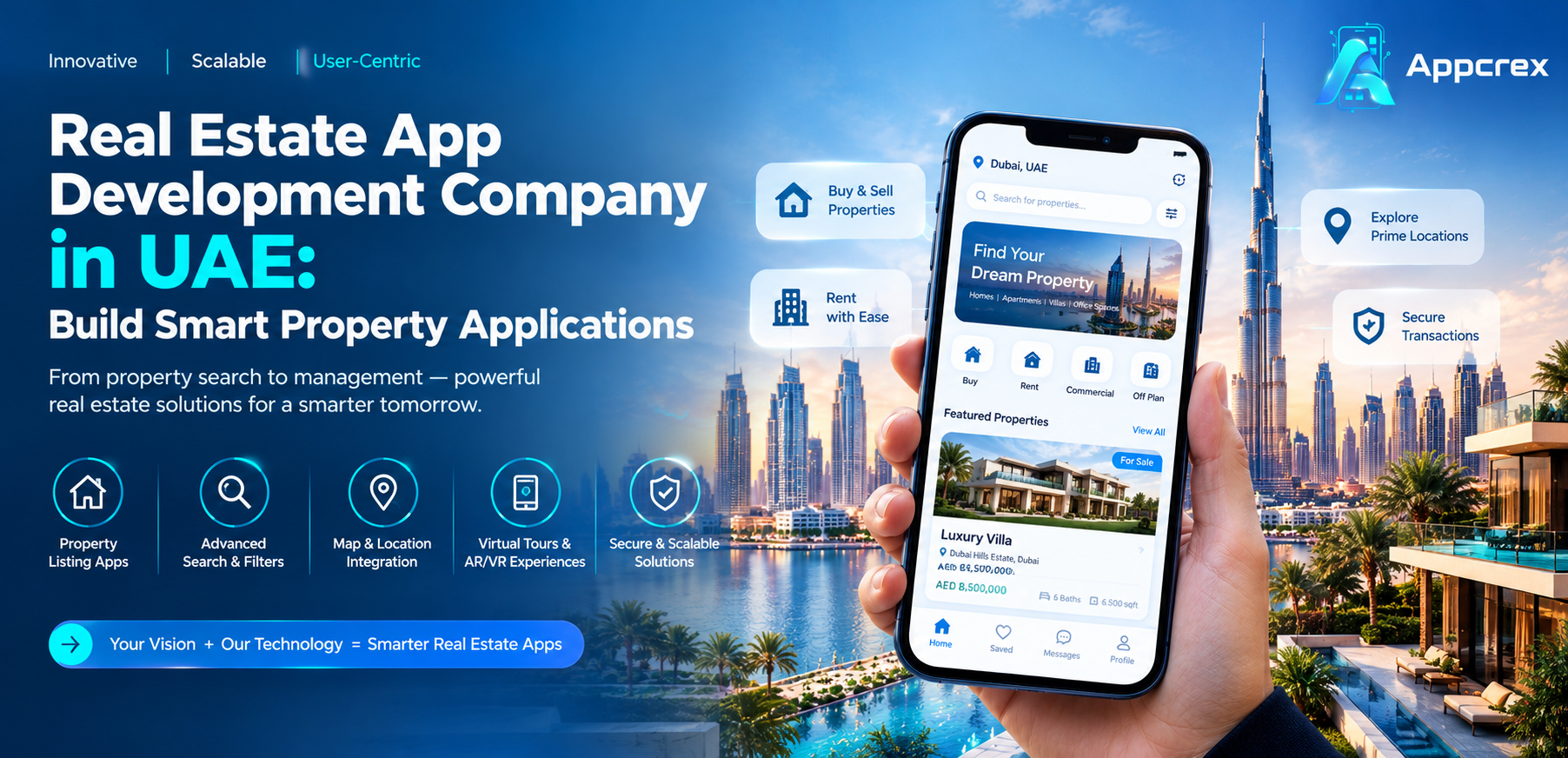
The real estate industry in the United Arab Emirates is adopting digital technology to simplify property searches, improve customer engagement, and manage property transactions. Buyers, sellers, tenants, landlords, and real estate agents increasingly depend on digital platforms to explore properties and connect with potential customers.
Real estate mobile applications make these activities more convenient by bringing property listings, virtual tours, agent communication, and booking features into one platform.
Working with a reliable Real Estate App Development Company in UAE helps property businesses build customized applications that meet their operational requirements and customer expectations.
Appcrex helps businesses explore modern software and mobile application development solutions. With the right real estate technology, companies can improve property management, simplify communication, and create better digital experiences for customers.
In this blog, we will discuss real estate app development services, essential features, business benefits, development costs, and how to choose the right development partner in the UAE.
What Is Real Estate App Development?
Real estate app development involves designing and building mobile or web applications for property-related activities.
These applications help users search for properties, compare prices, contact agents, schedule visits, manage listings, and explore investment opportunities.
For example, a property marketplace application allows users to filter properties by location, price, property type, number of bedrooms, and other preferences.
Similarly, property management applications help landlords and property managers handle rental information, maintenance requests, payments, and tenant communication.
Therefore, real estate applications help businesses organize property services through accessible digital platforms.
Why Is Real Estate App Development Important in UAE?
The UAE real estate market includes residential properties, commercial spaces, rental properties, luxury developments, and investment opportunities.
As customers increasingly use digital platforms to research properties, real estate companies need convenient ways to present listings and communicate with potential buyers.
A customized real estate application offers several advantages:
- Digital property discovery: Users can explore available properties through mobile applications.
- Wider customer reach: Businesses can connect with customers through online platforms.
- Better communication: Buyers and tenants can contact agents directly.
- Convenient property management: Landlords can manage rental information and maintenance requests.
- Improved property presentation: Images, videos, maps, and virtual tours help users evaluate listings.
- Faster lead management: Real estate teams can organize customer inquiries and follow-ups.
Consequently, real estate mobile applications support the digital operations of property businesses across the UAE.
Types of Real Estate Applications Businesses Can Develop
A professional real estate app development company can build different applications depending on business requirements.
1. Property Listing Applications
Property listing applications allow users to browse properties available for sale or rent.
Common features include:
- Property images and videos
- Property descriptions
- Price and rental information
- Location details
- Search filters
- Agent contact information
- Property comparison
- Saved listings
These applications help real estate agencies display their property portfolios through a centralized platform.
Just read: Real Estate IT Services
2. Real Estate Marketplace Applications
A real estate marketplace connects property buyers, sellers, landlords, tenants, and agents.
Users can search for properties, publish listings, contact property owners, and compare available options.
Additionally, marketplace applications can include verified user profiles, inquiry management, saved searches, and notification features.
3. Property Rental Applications
Rental applications help tenants search for available properties and connect with landlords or property managers.
Important features include:
- Rental property listings
- Monthly or annual rental prices
- Property availability
- Online inquiry forms
- Visit scheduling
- Tenant profiles
- Rental payment tracking
- Maintenance requests
As a result, rental applications help organize communication between tenants and property owners.
4. Property Management Applications
Property management software helps landlords and property managers handle daily property operations.
These applications may include rent tracking, tenant information, maintenance requests, document storage, expense management, and property reports.
Furthermore, centralized property management tools help businesses organize information across multiple properties.
5. Real Estate Agent Applications
Real estate agents need tools to manage leads, property listings, appointments, and customer communication.
A dedicated agent application can include:
- Lead management
- Customer profiles
- Property inventory
- Appointment scheduling
- Inquiry tracking
- Follow-up reminders
- Performance reports
Therefore, agent applications help real estate professionals organize their daily activities.
6. Real Estate Investment Applications
Real estate investment applications provide users with property information and tools to evaluate investment opportunities.
Depending on the business model, features may include property listings, investment details, rental yield calculations, market information, portfolio tracking, and financial reports.
However, investment-related information should be accurate and presented with suitable disclosures.
7. Commercial Real Estate Applications
Commercial real estate applications focus on offices, retail spaces, warehouses, industrial properties, and other business premises.
Users can search by property size, location, rental price, facilities, and availability.
These platforms help commercial property businesses connect with organizations looking for suitable spaces.
Essential Features of a Real Estate Mobile Application
The right features improve usability, simplify property searches, and support business operations.
1. User Registration and Login
Users should be able to create accounts through email, phone numbers, or supported social login options.
Separate account types for buyers, sellers, tenants, landlords, and agents help provide relevant features.
2. Advanced Property Search
A property search system allows users to find listings based on their requirements.
Useful filters include:
- Location
- Property type
- Price range
- Sale or rental status
- Number of bedrooms
- Property size
- Available facilities
Additionally, search suggestions and saved filters can make property discovery more convenient.
3. GPS and Map Integration
Map integration helps users view property locations and explore nearby facilities.
A real estate application can display nearby schools, hospitals, shopping centres, transport options, and other points of interest.
However, location information should be accurate and updated.
4. High-Quality Images and Video Tours
Property images and videos help users understand the appearance and layout of a property.
Businesses can also include 360-degree images and virtual tours to provide more interactive property viewing experiences.
5. Property Comparison
Property comparison allows users to evaluate multiple listings based on price, size, location, facilities, and other details.
This feature helps customers organize their property searches and compare available options.
6. In-App Chat and Calling
Communication features allow buyers, tenants, and investors to contact property agents or owners.
In-app messaging, calling, and inquiry forms help users request additional information and arrange property visits.
7. Appointment Scheduling
Users should be able to request property visits through an appointment booking feature.
Agents can manage schedules, confirm visits, and send appointment reminders.
8. Push Notifications
Push notifications keep users informed about new listings, price changes, appointment confirmations, and inquiry updates.
Furthermore, personalized alerts can help users track properties matching their saved preferences.
9. Payment Gateway Integration
Depending on the application model, payment integration can support service fees, booking charges, rental payments, or other approved transactions.
Businesses should select payment providers that support their operational requirements and applicable financial regulations.
10. Admin Dashboard
An administrative dashboard allows business owners to manage the application.
Common features include:
- User management
- Property listing management
- Agent management
- Inquiry tracking
- Payment monitoring
- Content management
- Reports and analytics
As a result, administrators can monitor platform activities through a centralized system.
Advanced Technologies in Real Estate App Development
Modern technologies help real estate businesses create more interactive and efficient applications.
Artificial Intelligence and Property Recommendations
AI-powered recommendation systems analyze user preferences and search activity to suggest relevant properties.
For example, an application can recommend listings based on preferred locations, budgets, property types, and saved searches.
Virtual Reality and Augmented Reality
Virtual Reality (VR) and Augmented Reality (AR) technologies can improve property viewing experiences.
Virtual tours allow users to explore selected properties remotely, while AR features can support interior visualization and furniture placement.
Big Data and Real Estate Analytics
Data analytics helps real estate businesses understand user activity, property demand, listing performance, and customer preferences.
Consequently, organizations can use these insights to improve marketing strategies and business planning.
Cloud-Based Real Estate Applications
Cloud infrastructure supports application hosting, data storage, scalability, and system availability.
It also helps businesses manage application resources as user activity increases.
Blockchain-Based Property Solutions
Blockchain technology can support selected property-related workflows, including document verification and transaction records.
However, any implementation involving property ownership, legal records, or financial transactions requires appropriate regulatory and legal review.
Benefits of Real Estate App Development for UAE Businesses
A customized real estate application offers several benefits to property businesses.
Improved Customer Experience
Customers can browse properties, compare listings, contact agents, and schedule visits through a single digital platform.
Therefore, the property search process becomes more convenient.
Better Lead Generation
Online property listings and inquiry forms help businesses attract potential buyers, tenants, and investors.
Additionally, lead management features help agents organize customer inquiries and follow-ups.
Increased Business Reach
A mobile application provides another channel for customers to explore property services.
This helps real estate companies connect with users who prefer digital property searches.
Simplified Property Management
Property management applications help landlords and agencies organize rental records, tenant information, maintenance requests, and payment details.
Consequently, businesses can manage property-related activities more efficiently.
Improved Communication
In-app messaging, notifications, and appointment scheduling help reduce communication delays between customers and agents.
Data-Driven Business Decisions
Analytics tools provide information about property searches, customer interests, and listing performance.
As a result, real estate businesses can identify customer preferences and improve their services.
Real Estate App Development Process
Developing a successful real estate application requires proper planning, design, development, and testing.
Step 1: Business Requirement Analysis
First, identify the purpose of the application and its target users.
For example, a property marketplace requires different features from a rental management application.
Clear requirements help define the project scope and development priorities.
Step 2: UI/UX Design
Next, designers create the application structure and user interface.
The design should make property searches, filters, listing details, and communication features easy to access.
Additionally, the application should provide a consistent experience across supported devices.
Step 3: Technology Selection
The development team selects suitable technologies based on the application requirements.
Common options include:
- Frontend: Flutter, React Native, Swift, Kotlin
- Backend: Node.js, Laravel, Python
- Database: PostgreSQL, MySQL, MongoDB
- Cloud: AWS, Microsoft Azure, Google Cloud
- APIs: Maps, payment gateways, notifications, and property data integrations
The final technology stack depends on performance, scalability, budget, and integration requirements.
Step 4: Application Development
Developers build the required features, including user registration, property listings, search filters, maps, chat, and administrative tools.
The backend manages application data, user permissions, and business workflows.
Step 5: Third-Party Integration
Real estate applications often require integrations with map services, payment providers, notification systems, analytics tools, and CRM platforms.
These integrations help connect the application with relevant business services.
Step 6: Testing and Quality Assurance
Before launch, the application should undergo functional, usability, performance, compatibility, and security testing.
Testing helps identify technical issues and improve the user experience.
Step 7: Deployment and Maintenance
After successful testing, the application is published on the selected platforms.
Regular maintenance, security updates, performance monitoring, and feature improvements help maintain application quality.
How Much Does Real Estate App Development Cost in UAE?
The cost of developing a real estate application in the UAE depends on its features, complexity, technology stack, integrations, and development requirements.
A basic property listing application generally requires less development effort than a complete marketplace with virtual tours, payment integration, advanced analytics, and multiple user roles.
The main factors affecting development costs include:
- Application complexity: Advanced functionality requires additional development and testing.
- Platform selection: Android, iOS, and cross-platform development have different requirements.
- UI/UX design: Custom interfaces and interactive experiences affect design effort.
- Backend development: Complex databases and business workflows increase technical requirements.
- Third-party integrations: Maps, payment gateways, and CRM systems influence project scope.
- Security: User authentication, data protection, and payment security require appropriate implementation.
- Maintenance: Hosting, updates, monitoring, and technical support contribute to ongoing expenses.
Therefore, businesses should define their application requirements before requesting a project estimate.
Starting with a Minimum Viable Product (MVP) is a practical approach. It allows companies to launch essential features, collect user feedback, and plan future improvements.
Important Considerations for Real Estate Apps in UAE
Real estate applications operating in the UAE should consider local business requirements and applicable regulations.
Property Listing Accuracy
Businesses should establish processes to review property information, prices, images, availability, and ownership-related details before publishing listings.
Data Protection
Applications that collect personal information should include appropriate security controls and follow applicable UAE data protection requirements.
Real Estate Advertising Requirements
Property advertising and brokerage activities are subject to relevant local regulations. Businesses should review the requirements of the applicable authority, such as the Dubai Land Department and Real Estate Regulatory Agency (RERA) for relevant Dubai activities.
Secure Payment Processing
Applications handling payments should use suitable payment providers and implement appropriate transaction security measures.
Arabic and English Language Support
Supporting Arabic and English can improve accessibility for different customer groups.
For Arabic interfaces, businesses should also consider right-to-left layouts and suitable language presentation.
How to Choose the Right Real Estate App Development Company in UAE?
Selecting the right development partner is important for building a reliable real estate application.
Consider these factors before choosing a company.
Review Technical Expertise
Check the company's experience with mobile applications, backend development, cloud platforms, APIs, and third-party integrations.
Evaluate Previous Projects
Review portfolios and relevant project examples to understand the provider's development capabilities.
Check Customization Capabilities
Your application should support your business model, target audience, and operational requirements.
Choose a development partner that understands your objectives and offers suitable customization.
Understand Security Practices
Ask about authentication, encryption, data storage, access permissions, and application security testing.
Discuss Scalability
Your application should support future growth in users, listings, transactions, and features.
Therefore, discuss infrastructure planning and performance requirements before development begins.
Review Maintenance and Support
Post-launch support is important for fixing issues, updating features, and maintaining application performance.
Discuss the available maintenance services before finalizing the project.
Why Choose Appcrex for Real Estate App Development?
Appcrex helps businesses explore customized software and mobile application development solutions designed around their business objectives.
For real estate companies, selecting the right technology is an important step toward improving property discovery, customer engagement, and business operations.
Depending on project requirements, a real estate application may include:
- Property listing and marketplace features
- Rental and property management systems
- Real estate agent applications
- Advanced property search
- Map and location integration
- Virtual property tours
- Payment gateway integration
- AI-powered property recommendations
- Admin dashboards and analytics
Appcrex focuses on understanding business requirements and exploring suitable digital solutions that support business growth.
Whether you are planning a property marketplace, rental application, or customized real estate platform, the right development strategy helps turn your idea into a functional digital product.
Visit Appcrex to explore its software and mobile application development services.
Future Trends in Real Estate App Development
Real estate technology continues to evolve as businesses adopt new digital tools.
AI-Powered Property Recommendations
AI can analyze user preferences and recommend properties based on search behaviour, budget, location, and property requirements.
Virtual Property Tours
Virtual tours help customers explore property interiors remotely and understand layouts before arranging physical visits.
Smart Property Management
Connected applications can help property managers track maintenance requests, rental information, and building-related activities.
Voice-Based Property Search
Voice search allows users to find properties by speaking their requirements instead of entering multiple search filters.
Advanced Real Estate Analytics
Analytics platforms help businesses understand customer behaviour, listing performance, and property search patterns.
Consequently, real estate companies can use data to improve their digital services.
Frequently Asked Questions (FAQs)
1. What does a Real Estate App Development Company in UAE do?
A real estate app development company designs and develops mobile and web applications for property businesses. Services may include property listing platforms, rental applications, property management systems, agent applications, and real estate marketplaces.
2. What features should a real estate mobile app include?
Important features include user registration, property listings, advanced search filters, map integration, images, virtual tours, agent communication, appointment booking, notifications, and an admin dashboard.
3. How much does real estate app development cost in UAE?
The cost depends on application complexity, features, platform selection, integrations, design, security, and maintenance. A customized project estimate is required to determine the budget.
4. How long does it take to develop a real estate application?
The development timeline depends on the number of features, application complexity, integrations, and testing requirements. A basic MVP generally requires less development time than a complete property marketplace.
5. Can a real estate app support both Arabic and English?
Yes. Real estate applications can support Arabic and English interfaces. Arabic applications should include suitable right-to-left layouts and language formatting.
6. Can real estate applications include virtual property tours?
Yes. Applications can integrate 360-degree images, video tours, and virtual reality features to help customers explore properties remotely.
7. Is real estate app development suitable for startups?
Yes. Startups can begin with an MVP containing essential features such as property listings, search filters, user registration, and inquiry management. Additional features can be introduced as the business grows.
8. What technologies are used for real estate app development?
Common technologies include Flutter, React Native, Swift, Kotlin, Node.js, Laravel, Python, PostgreSQL, MongoDB, and cloud platforms such as AWS and Microsoft Azure.
9. Are real estate applications secure?
Real estate applications can include authentication, encryption, access controls, secure APIs, and protected payment integrations. Regular testing and maintenance are also important.
10. How do I choose the right real estate app development company in UAE?
Review technical expertise, previous projects, customization capabilities, security practices, integration experience, scalability, and post-launch support before selecting a development partner.
Conclusion
Real estate app development is helping property businesses in the UAE improve property discovery, customer communication, and property management.
From property listing platforms and rental applications to virtual tours and AI-powered recommendations, customized mobile applications offer practical ways to improve digital real estate services.
However, successful development requires clear business objectives, suitable technology, user-friendly design, strong security, and ongoing maintenance.
If your business is planning to build a real estate mobile application, Appcrex can help you explore customized software solutions aligned with your requirements and digital growth goals.

 English
 Arabic
 French
 Spanish
 Portuguese
 Deutsch
 Turkish
 Dutch
 Italiano
 Romaian
 Portuguese (Brazil)
 Greek