
Mexico Cold Chain Warehousing Market Size, Share, Research & Forecast Report 2026-2034
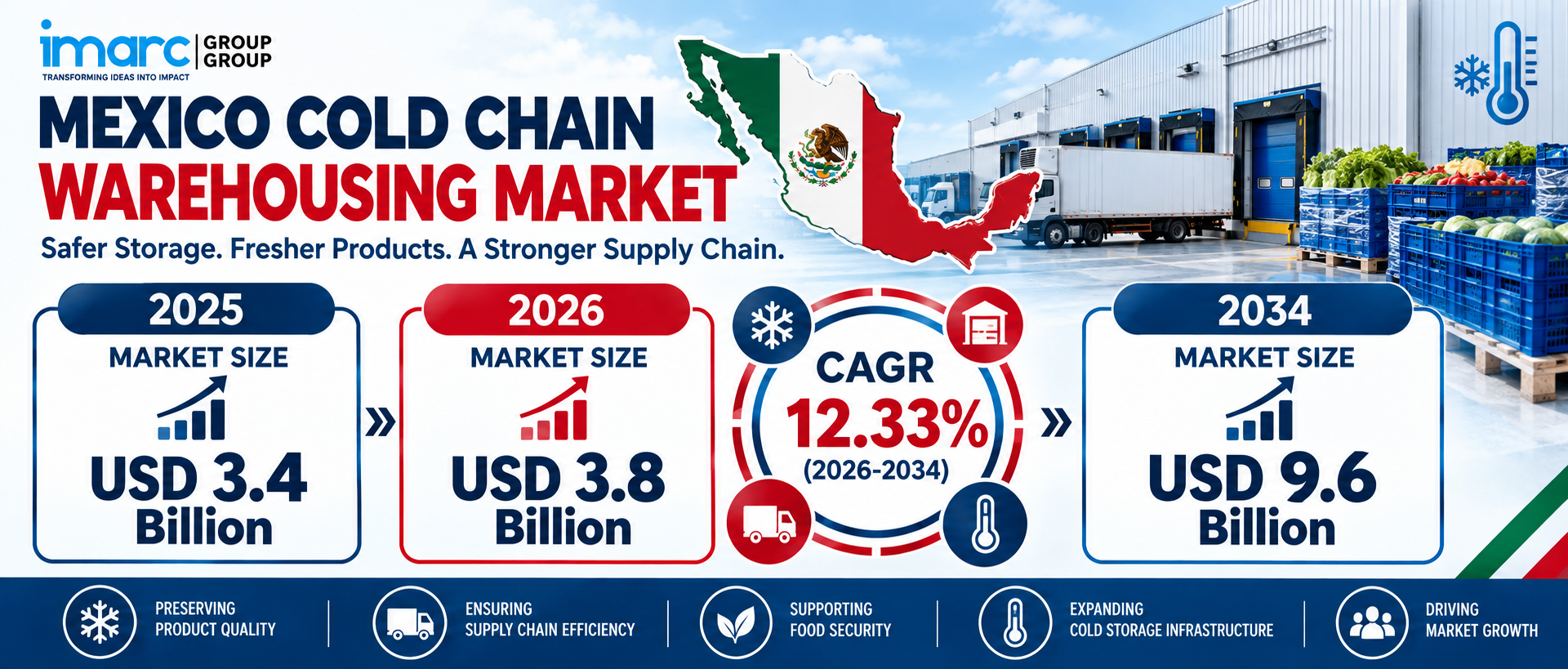
IMARC Group, a leading global market research and management consulting firm, has published its latest market intelligence report on the Mexico cold chain warehousing market. The Mexico cold chain warehousing market size reached USD 3.4 Billion in 2025, is estimated at USD 3.8 Billion in 2026, and is projected to reach USD 9.6 Billion by 2034, exhibiting a CAGR of 12.33% during 2026-2034. Growth is propelled by rising demand for temperature-sensitive goods such as pharmaceuticals and fresh produce, expanding exports of perishable products, the rapid rise of e-commerce and online grocery, and government-backed development of modern logistics hubs.
Mexico’s position as a gateway to North America is a defining strength of the market, and the report notes that the country’s agri-food exports increased by 14 percent between 2023 and 2024, reaching USD 43.3 Billion. Stringent food safety requirements, rising foreign direct investment in logistics and food processing, and port expansions that improve connectivity for perishable cargo are encouraging operators to build reliable, technology-enabled temperature-controlled capacity close to production centers and export corridors.
Mexico Cold Chain Warehousing Market at a Glance:
- Market Size (2025): USD 3.4 Billion
- Market Size (2026): USD 3.8 Billion
- Forecast Market Size (2034): USD 9.6 Billion
- CAGR (2026-2034): 12.33%
- Leading Storage Type: Frozen storage plays the key role, preserving meat, seafood, and frozen foods below -18°C for both domestic distribution and export activity
- Leading End Use Industry: Fruits and vegetables form a dominant segment, relying on temperature-controlled storage to protect freshness and reduce post-harvest losses
- Key Regional Hub: Central Mexico, home to high-density urban areas and large consumer markets that drive high-volume perishable distribution
How AI is Reshaping the Future of the Mexico Cold Chain Warehousing Market
- AI-Driven Forecasting and Replenishment: In July 2025, Petco Mexico partnered with RELEX Solutions to apply AI-driven forecasting and replenishment tools across its 145 stores and two distribution centers, aiming to improve inventory efficiency and product availability. The deployment shows how Mexican retailers are using AI planning to match stock with demand, an approach that carries particular value for perishable and temperature-sensitive inventory where overstocking leads directly to spoilage.
- Smart Sensors, IoT, and AI Analytics in Storage Facilities: According to the report, cold storage operators are modernizing facilities with smart sensors, IoT-enabled temperature monitoring, automated inventory management, AI-based analytics, and cloud-based systems. These tools support real-time tracking, improve traceability across the chain, reduce spoilage, and lower energy consumption, helping operators meet food safety and pharmaceutical compliance requirements.
- AI Voice Agents for Freight Operations: In July 2025, logistics technology company Fr8Tech launched AI voice agents with Fetch.ai to automate freight logistics, improve data capture, and boost efficiency across freight operations. Automation of this kind supports the faster, more reliable movement of goods that cold storage networks depend on.
Grab a sample PDF of this report: https://www.imarcgroup.com/mexico-cold-chain-warehousing-market/requestsample
Mexico Cold Chain Warehousing Market Trends and Drivers:
The core demand driver for the Mexico cold chain warehousing market is the rising consumption of perishable and temperature-sensitive goods, including fresh fruits and vegetables, dairy, meat, and pharmaceuticals. Urbanization, the spread of modern retail formats, and growing consumer awareness of food quality and freshness are pushing retailers and distributors to invest in more sophisticated cold storage. Mexico’s role as a gateway to North America adds export-led demand, particularly toward the United States, and in 2025 UPS Healthcare opened three new cross-dock facilities in Mexico City, Milan, and Frankfurt capable of handling pharmaceutical shipments with varying temperature and time sensitivity.
The market’s structural differentiator is the pace of technology adoption and capacity expansion. Operators are embracing automation, IoT, and real-time tracking systems to strengthen temperature management, cut energy use, and improve traceability from storage to delivery. Capacity additions are visible on the ground, with Emergent Cold Latin America completing its Villagrán, Guanajuato expansion in 2024, which increased the facility’s capacity by 16,000 pallets, while continuing to invest in another expansion in Apodaca and a new warehouse in Monterrey.
E-commerce and online grocery form the third growth pillar. As more consumers buy groceries and perishables online, providers are expanding cold storage capacity, upgrading refrigeration systems, and improving last-mile delivery to protect product quality, with the Mexico e-commerce market projected to attain USD 176.6 Billion by 2033 according to an industry report. In parallel, expanding pharmaceutical manufacturing and biotechnology, tourism and hospitality activity, and the growth of processed and ready-to-eat food segments are adding to warehousing requirements across the country.
Ask an analyst for customized report: https://www.imarcgroup.com/request?type=report&id=34989&flag=E
Government Schemes, Regulations, and Industry Initiatives Driving Demand:
- Plan México and the Nearshoring Decree: Introduced by President Claudia Sheinbaum in January 2025, Plan México is the national economic strategy to position the country as a destination for advanced manufacturing and nearshoring investment. The Nearshoring Decree, published on January 21, 2025, grants fiscal incentives including accelerated depreciation and additional deductions for training and innovation, which supports demand for industrial and logistics assets.
- Industrial Parks Program: Plan México targets 100 new industrial parks by the end of the current administration, and the first 20 parks tied to the program entered operation in early 2026, adding ready-built industrial and logistics space across the country.
- Infrastructure Investment Pipeline: Plan México projects infrastructure investment of 5.6 trillion pesos between 2026 and 2030, according to estimates compiled by GRI Institute, including improvements in road, rail, and port connectivity. The report also points to port expansions and dedicated logistics corridors as enablers of faster and more reliable movement of perishable goods.
- Food Safety and Pharmaceutical Storage Regulation: Mexico’s sanitary framework, overseen by COFEPRIS and SENASICA, shapes how perishable and regulated products are imported, stored, and handled. Standards such as NOM-059-SSA1-2015 on good manufacturing and storage practices for medicines, and NOM-242-SSA1-2009 for fishery products, which references maintaining frozen products at -18°C, raise the bar for reliable temperature control and drive demand for compliant cold storage.
- ANETIF and GCCA Cold Chain Cooperation: In April 2025, the National Association of Federal Inspection Type Establishments (ANETIF) and the Global Cold Chain Alliance (GCCA) signed a cooperation agreement to modernize Mexico’s cold chain through certification programs, training, and best practices, with industry leaders also calling for an update to NOM-008-ZOO-1994 to include construction criteria for cold storage facilities.
Mexico Cold Chain Warehousing Market Industry Segmentation:
The report has segmented the market into the following categories:
Breakup By Type of Storage:
- Frozen Storage
- Chilled Storage
Frozen storage plays a key role in the market, preserving meat, seafood, dairy, and other highly perishable goods at temperatures typically below -18°C. High-capacity frozen facilities help manufacturers and distributors manage seasonal demand, limit spoilage, and support both domestic distribution and export activity. Chilled storage, typically held between 0°C and 8°C, serves fruits, vegetables, dairy, and pharmaceuticals, keeping freshness and shelf life intact while supporting shorter supply chains and timely delivery to supermarkets, restaurants, and foodservice providers.
Breakup By Temperature Range:
- Ambient
- Refrigerated
- Frozen
- Deep-Frozen
Ambient storage, kept at roughly 15°C to 25°C, handles grains, packaged foods, and some beverages without the cost of temperature control, while refrigerated storage at 0°C to 8°C protects dairy, fresh foods, and certain pharmaceuticals by slowing microbial growth and chemical degradation. Frozen storage below -18°C enables long-term holding of meat, seafood, and frozen foods, helping stakeholders reduce wastage and regulate seasonal demand, and deep-frozen capacity covers goods that require the lowest temperatures. Together these ranges let providers match each product to its required storage conditions.
Breakup By Ownership:
- Private Warehouses
- Public Warehouses
- Bonded Warehouses
Private warehouses are owned and operated by individual businesses, manufacturers, or retailers, giving full control over inventory handling, security, and temperature-sensitive movement for high-value or specialty perishables. Public warehouses, operated by third-party providers, offer flexible storage without heavy capital investment, which makes them accessible to small and medium-sized firms. Bonded warehouses hold imported merchandise under customs suspension, allowing frozen foods, drugs, and specialty imports to be stored under temperature control with tax deferment, which strengthens Mexico’s role as a gateway for imported perishables.
Breakup By End Use Industry:
- Fruits and Vegetables
- Meat and Fish
- Dairy Products
- Pharmaceuticals and Healthcare Products
Fruits and vegetables are a dominant end-use segment, as temperature-controlled storage slows ripening and spoilage, reduces post-harvest losses, and supports both domestic supply and export prospects. Meat and fish depend on precise frozen and refrigerated control to protect food safety and quality from processing through retail distribution. Dairy products such as milk, cheese, and yogurt need dependable refrigeration to preserve taste, texture, and shelf life, while pharmaceuticals and healthcare products are gaining importance with the expansion of pharmaceutical manufacturing and the healthcare sector.
Breakup By Region:
- Northern Mexico
- Central Mexico
- Southern Mexico
- Others
Central Mexico is the hub of the industry, with high-density urban areas and large consumer markets that require high-volume distribution of dairy, fresh produce, and processed foods, and its location gives easy access to both northern and southern markets. Northern Mexico benefits from proximity to the United States and a cluster of manufacturing, agribusiness, and export-oriented industries that depend on cold storage for fruits, vegetables, meat, and dairy. Southern Mexico is gaining importance as agricultural output and industrial activity expand, with storage capacity supporting local fruits, vegetables, and seafood and creating opportunities for perishable exports.
Competitive Landscape:
The Mexico cold chain warehousing market features a combination of organized and emerging players competing on technology, service diversification, and strategic growth. Companies referenced in recent market developments include:
- Emergent Cold LatAm
- Americold
- Friopuerto
- UPS Healthcare
According to the report, operators are investing in automation, real-time monitoring, and sophisticated temperature-controlled systems while adding value-added services such as inventory management, last-mile delivery, and integrated logistics. Strategic alliances, joint ventures, and partnerships with logistics players are common ways to extend geographic presence, with companies concentrating on high-demand metropolitan areas and industrial corridors while eyeing underserved regions, and green measures are expected to feature in new business models.
What Does The Full Report Cover?
- Historical market performance from 2020-2025 and forecasts for 2026-2034, with market size in Billion USD
- Detailed analysis by type of storage, covering frozen storage and chilled storage
- Temperature range analysis across ambient, refrigerated, frozen, and deep-frozen storage
- Ownership analysis of private, public, and bonded warehouses
- End use industry analysis across fruits and vegetables, meat and fish, dairy products, and pharmaceuticals and healthcare products
- Regional analysis of Northern Mexico, Central Mexico, Southern Mexico, and others
- Market drivers, challenges, opportunities, and Porter’s Five Forces analysis
- Competitive landscape with insight into the current positions of key players in the market
Recent News and Developments in Mexico Cold Chain Warehousing Market
- December 2024: CPKC and Americold announced plans to expand cold logistics in Mexico, building on their 2023 partnership. The collaboration aims to enhance temperature-controlled food distribution across North America, supported by CPKC’s intermodal network and Americold’s upcoming Kansas City facility, with investments of up to USD 1 Billion over 10 years.
- March 2025: Emergent Cold LatAm inaugurated its first greenfield cold storage facility in Monterrey, Mexico, with a capacity of 23,000 pallets. Developed as part of a multi-year investment strategy, the facility is designed to enhance food logistics, generate approximately 330 new jobs, and reinforce the company’s standing as the fastest-growing cold storage provider in Latin America.
- April 2025: ANETIF and the Global Cold Chain Alliance signed a cooperation agreement to strengthen Mexico’s cold chain infrastructure, focusing on certification programs, training, and best practices to modernize temperature-controlled storage and improve food safety and supply chain reliability nationwide.
Note: If you require specific details, data, or insights that are not currently included in the scope of this report, we are happy to accommodate your request. As part of our customization service, we will gather and provide the additional information you need, tailored to your specific requirements. Please let us know your exact needs, and we will ensure the report is updated accordingly to meet your expectations.
Key Questions This Report Answers
- How has the Mexico cold chain warehousing market performed so far, and how will it perform in the coming years?
- What is the breakup of the Mexico cold chain warehousing market on the basis of type of storage?
- How are ambient, refrigerated, frozen, and deep-frozen storage positioned within the market?
- What is the breakup of the market on the basis of ownership, and what role do private, public, and bonded warehouses play?
- Which end use industries drive the strongest demand for cold chain warehousing in Mexico?
- Which regions of Mexico offer the strongest growth opportunities for cold chain warehousing providers?
- What are the key drivers, challenges, and regulatory factors shaping the Mexico cold chain warehousing market?
- What is the structure of the market, and who are the key players?
Author IMARC Group
IMARC Group is a global management consulting firm that helps the world's most ambitious changemakers to create a lasting impact. The company provide a comprehensive suite of market entry and expansion services. IMARC offerings include thorough market assessment, feasibility studies, company incorporation assistance, factory setup support, regulatory approvals and licensing navigation, branding, marketing and sales strategies, competitive landscape and benchmarking analyses, pricing and cost research, and procurement research.
Contact Us
IMARC Group,
134 N 4th St. Brooklyn, NY 11249, USA,
Email: [email protected],
United States: +1-201971-6302

 English
 Arabic
 French
 Portuguese
 Deutsch
 Turkish
 Dutch
 Italiano
 Russian
 Romaian
 Portuguese (Brazil)
 Greek