
Food Safety & Medical Device Certification Body in Taiwan | ISO 22000 & ISO 13485 Certification
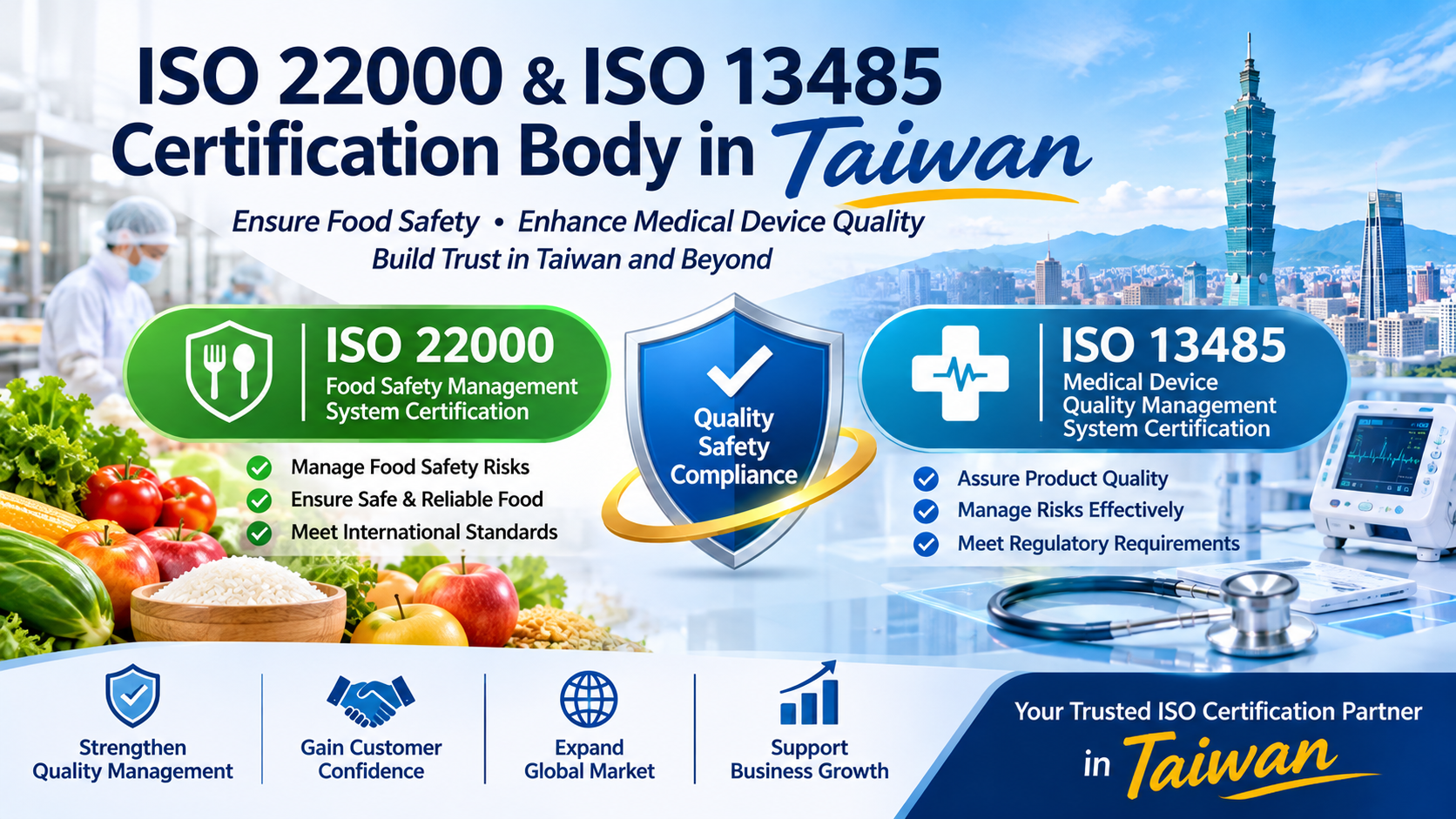
Taiwan has developed into an important manufacturing, food processing, healthcare, and medical technology market in Asia. With increasing international trade, growing consumer awareness, and strict regulatory expectations, organizations across Taiwan are focusing on product safety, quality assurance, and internationally recognized management systems.
ISO certification helps organizations establish systematic processes, improve operational efficiency, manage risks, and demonstrate their commitment to quality and safety. Among the important international standards, ISO 22000 and ISO 13485 play significant roles in strengthening food safety management and medical device quality management.
Organizations looking for Food Safety Management System Certification in Taiwan, an ISO 22000 Certification Body in Taiwan, an ISO 13485 Certification Body in Taiwan, or Medical Device Certification in Taiwan can benefit from implementing internationally recognized management system requirements.
ISO 22000 Certification Body in Taiwan
ISO 22000 is an internationally recognized Food Safety Management System (FSMS) standard designed for organizations operating within the food supply chain. It provides a structured framework for identifying food safety hazards, controlling risks, and ensuring that food products are safe for consumption.
Choosing a competent ISO 22000 Certification Body in Taiwan is an important step for food industry organizations seeking to demonstrate their commitment to food safety and international quality requirements.
Taiwan has a diverse food industry that includes food manufacturing, seafood processing, agricultural production, food packaging, beverage production, catering, transportation, storage, and distribution.
ISO 22000 certification is suitable for organizations involved in different stages of the food supply chain.
The major benefits of ISO 22000 certification include:
-
Improved food safety management practices.
-
Identification and control of food safety hazards.
-
Implementation of Hazard Analysis and Critical Control Points (HACCP) principles.
-
Better supplier and supply chain management.
-
Improved food hygiene and sanitation practices.
-
Compliance with applicable food safety requirements.
-
Increased customer and consumer confidence.
-
Improved access to international business opportunities.
-
Continual improvement of food safety performance.
ISO 22000 follows a systematic approach that combines management system principles, interactive communication, prerequisite programmes (PRPs), and HACCP-based hazard control.
Organizations in Taipei, Taichung, Kaohsiung, Tainan, Hsinchu, and other regions of Taiwan can implement ISO 22000 to strengthen food safety practices and improve their competitiveness.
A qualified certification body evaluates the organization's food safety management system through a structured certification audit to determine whether it meets the applicable requirements of ISO 22000.
Food Safety Management System Certification Taiwan
Food Safety Management System Certification in Taiwan is valuable for organizations that want to establish effective food safety controls and demonstrate their commitment to delivering safe and reliable food products.
Food safety is an essential responsibility for food manufacturers, restaurants, hotels, supermarkets, food distributors, agricultural businesses, and packaging companies.
ISO 22000 provides an internationally recognized framework that helps organizations control food safety hazards throughout their operations.
The standard focuses on several important areas:
1. Hazard Identification and Risk Assessment
Organizations identify biological, chemical, and physical hazards that may affect food safety and establish appropriate control measures.
2. HACCP Implementation
The HACCP approach helps organizations identify critical control points and establish monitoring procedures to prevent or reduce food safety risks.
3. Supplier Management
Food businesses can establish supplier evaluation procedures to ensure that raw materials, ingredients, and packaging materials meet defined safety requirements.
4. Food Hygiene and Sanitation
Effective cleaning, sanitation, pest control, and personal hygiene practices help maintain safe food production environments.
5. Traceability and Product Recall
Organizations establish traceability systems to identify products, monitor distribution, and respond effectively to food safety incidents.
6. Continual Improvement
Internal audits, corrective actions, management reviews, and performance monitoring help organizations maintain and improve their food safety management systems.
By achieving ISO 22000 certification, Taiwanese food businesses can strengthen their reputation, improve customer satisfaction, and demonstrate their commitment to international food safety practices.
ISO 13485 Certification Body in Taiwan
ISO 13485 is an internationally recognized Quality Management System (QMS) standard specifically developed for the medical device industry.
It establishes requirements for organizations involved in the design, development, manufacturing, storage, distribution, installation, and servicing of medical devices.
Selecting an experienced ISO 13485 Certification Body in Taiwan is important for medical device manufacturers and suppliers that want to demonstrate their commitment to product quality, regulatory compliance, and patient safety.
Taiwan has a growing medical technology and healthcare manufacturing industry, including medical equipment, diagnostic devices, surgical instruments, medical components, laboratory equipment, and healthcare products.
ISO 13485 certification helps organizations establish consistent quality management processes throughout the medical device lifecycle.
Key benefits include:
-
Improved medical device quality management.
-
Better product safety and reliability.
-
Effective risk management throughout product development.
-
Improved design and development controls.
-
Stronger supplier evaluation and monitoring.
-
Better production and process validation.
-
Improved documentation and record management.
-
Effective complaint handling and corrective actions.
-
Enhanced customer and regulatory confidence.
-
Support for international market opportunities.
ISO 13485:2016 is the current edition of the standard, as confirmed by ISO in its 2025 review.
Medical device manufacturers in Taiwan can implement this standard to establish a robust quality management system and improve their ability to meet applicable customer and regulatory requirements.
A competent certification body conducts an independent audit to assess whether the organization's quality management system meets the requirements of ISO 13485.
Medical Device Certification Taiwan
Medical Device Certification in Taiwan is an important consideration for manufacturers, importers, suppliers, and other organizations involved in the medical device industry.
Medical devices must meet applicable safety, performance, and quality requirements before they can be introduced into relevant markets.
ISO 13485 provides a structured framework for managing quality throughout the medical device lifecycle, from initial design and development to manufacturing, distribution, servicing, and post-market activities.
Organizations that can benefit from medical device quality management certification include:
-
Medical device manufacturers.
-
Surgical equipment manufacturers.
-
Diagnostic equipment manufacturers.
-
In-vitro diagnostic (IVD) manufacturers.
-
Medical instrument suppliers.
-
Medical device component manufacturers.
-
Healthcare technology companies.
-
Medical device packaging organizations.
-
Medical equipment servicing companies.
-
Medical device distributors, where applicable to their activities.
ISO 13485 certification supports organizations in establishing systematic procedures for product quality, regulatory documentation, risk management, supplier controls, production monitoring, and customer feedback.
Taiwan Medical Device Regulatory Requirements
In Taiwan, the Taiwan Food and Drug Administration (TFDA), under the Ministry of Health and Welfare, regulates medical devices.
Under Taiwan's Medical Devices Act, medical device manufacturers are required to establish a quality management system that complies with the applicable Medical Device Quality Management System Regulations.
These regulations are based on ISO 13485 requirements.
Domestic manufacturers may need to undergo the relevant TFDA quality management system inspection and obtain the required manufacturing authorization before commencing regulated manufacturing activities.
Foreign manufacturers supplying medical devices to Taiwan may also need to complete the applicable Quality System Documentation (QSD) review process through the relevant regulatory channels.
It is important to understand that ISO 13485 certification and TFDA regulatory QMS conformity assessment are related but separate processes. Obtaining an ISO 13485 certificate does not automatically replace the applicable TFDA regulatory requirements.
Organizations should evaluate their product classification, manufacturing activities, and regulatory obligations before planning certification and market entry.
How to Choose the Right ISO Certification Body in Taiwan
Selecting the right certification body is essential for obtaining credible and internationally recognized management system certification.
Organizations should consider the following factors when selecting an ISO certification provider:
Accreditation: Verify that the certification body holds valid accreditation for the specific standard and relevant technical scope.
Industry Experience: Choose a certification body with appropriate auditing experience in the food processing or medical device industry.
Auditor Competence: Ensure that auditors possess the required technical knowledge and industry-specific expertise.
International Recognition: Check the certification body's accreditation status and applicable international recognition arrangements.
Transparent Certification Process: Understand the audit stages, certification requirements, costs, and expected timelines.
Continual Support: Confirm that surveillance audits and recertification arrangements are available.
Organizations should independently verify the certification body's accreditation scope through the Taiwan Accreditation Foundation (TAF) or the relevant accreditation authority.
Why Choose ISO 22000 and ISO 13485 Certification?
ISO 22000 and ISO 13485 help organizations establish effective management systems that support product safety, operational consistency, and customer confidence.
ISO 22000 focuses on preventing food safety hazards and ensuring safe food throughout the supply chain.
ISO 13485 focuses on medical device quality management, regulatory requirements, risk management, and product consistency.
Both standards encourage organizations to adopt a structured approach to risk management, performance monitoring, corrective actions, and continual improvement.
For businesses operating in Taiwan's food manufacturing, healthcare, and medical technology sectors, these certifications can strengthen organizational credibility and support long-term business development.
Get Started with ISO Certification in Taiwan
Are you looking for Food Safety Management System Certification in Taiwan, an ISO 22000 Certification Body in Taiwan, an ISO 13485 Certification Body in Taiwan, or Medical Device Certification in Taiwan?
Take the next step toward improving your organization's quality and safety performance.
Work with a competent certification body that understands your industry requirements and has the appropriate accreditation for your desired certification scope.
Contact our certification team today to discuss your ISO 22000 or ISO 13485 certification requirements in Taiwan.
Build customer confidence, improve operational performance, and demonstrate your commitment to internationally recognized quality and safety standards.
#ISO22000 #ISO22000Certification #ISO22000Taiwan #FoodSafetyCertification #FoodSafetyManagementSystem #FSMS #HACCP #FoodSafetyTaiwan #FoodManufacturing #FoodQuality

 English
 Arabic
 French
 Portuguese
 Deutsch
 Turkish
 Dutch
 Italiano
 Russian
 Romaian
 Portuguese (Brazil)
 Greek