
Cloud Phone System: Streamlining Business Communication for Today's Teams.
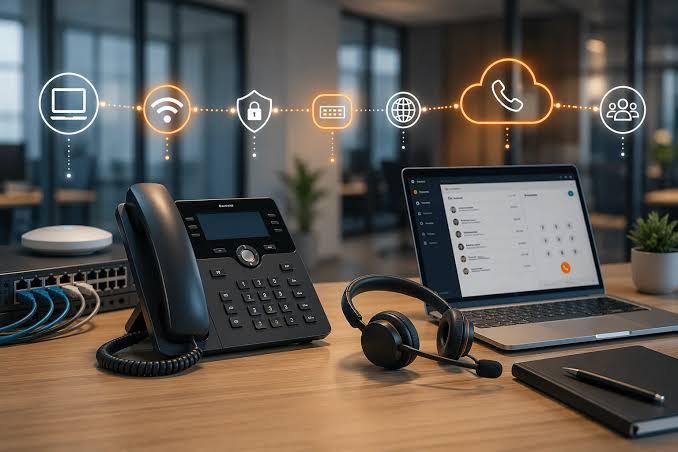
Communicating well is crucial for any business. Businesses must have an effective solution that allows them to reach customers, handle calls, and maintain their employees. Older telephone systems are costly with regard to equipment and maintenance. For a business, a cloud phone system is flexible because it provides them with the option to control calls using an internet connection.
This technology can help businesses with better communication, remote working, and more efficient call management. It does not matter if you are a small-scale business or a big organisation, a cloud phone system can offer you the devices you require to help with expert company communication.
What is a Cloud Phone System?
A cloud phone system is a business phone service that operates on a remote server and utilizes the Internet to connect to it. Rather than having to use only standard telephone hardware, businesses can use compatible desk phones, computers, laptops and even smartphones.
The service provider controls the central platform, and the businesses regulate users and calling features via an online dashboard. Included features can range from call forwarding to voicemail, call routing, conference calling or automated attendants, depending on the package.
This can minimize the requirement for a sophisticated telephone system at the company location.
A Cloud Phone System has several benefits.
1. Flexible Communication
Cloud phone systems enable workers to communicate with each other with compatible devices from various locations. It is especially beneficial for companies that have remotely working employees or multiple offices.
Staff can be kept on the business telephone service without having to be in the office all of the time.
2. Cost-Effective Management
Older telephone systems may be a need to install, maintain and add hardware. Uses of cloud services can help mitigate some of these costs as the provider takes on the responsibility for managing the central infrastructure.
Prior to choosing a package business should check the subscription fees, call rates, equipment costs, and contract details.
3. Professional Call Handling
Automated attendants, call queues and call forwarding are among the features that aid businesses to deal with customer enquiries.
For instance, the caller can choose from a menu to call sales or customer support, rather than having it transferred manually. This can lead to a better-structured client journey.
4. Easy Scalability
When businesses are expanding, there is a need for more users and telephony capabilities. Cloud systems usually enable administrators to add employees and alter settings without having to install an entire new telephone network.
This flexibility allows businesses to tailor their communication services to their evolving needs.
5. Improved Remote Working
Supported mobile and desktop apps are available for employees to place and receive business calls. This enables teams to stay in touch while on the go or visiting customers.
Depends on availability of provider, subscription, device compatibility and internet connection.
The most crucial features to take into account are the following:
Businesses need to determine what features they require before selecting a cloud phone system.
Call Forwarding: forwards to another supported number or device.
- **Voicemail:** Provides customers with message functionality when employees are not in the office.
- **Auto attendant:** Provides direct dial to the department.
- Call recording: Facilitates quality reviews, when applicable and legally allowed.
Call analytics: Supplies information about call volume and performance to businesses.
- **Mobile Apps:** Enable employees to access business calling features while away from the office.
Other factors to consider include security measures, customer service, service reliability, and emergency calling systems.
How to Choose the Right Provider
The first step is to evaluate your business size, the number of staff and the frequency of calls you make a day. Compare providers by features, price, voice quality and availability for integration with current business numbers.
Good internet connections are a must as a poor connection may impact on voice quality. It's also a good idea to check data protection, account security and backup options.
Carefully reading the terms and conditions of the contract can help to uncover other fees and prevent additional costs.
Frequently Asked Questions
What is a cloud phone system used for?
It lets businesses place and receive phone calls via the web, and control functions like voicemail, call forwarding, and automated call routing.
Yes. Professional telephone features are available for little businesses without needing to have abundant onsite telephone systems.
Do employees have the ability of accessing a cloud phone system from afar?
Yes. Many providers have applications for computers and phones that are compatible with each other, so that employees can make business calls from anywhere.
Is a cloud phone system Internet-dependent?
Yes. Internet-based calling needs a proper connection for maintaining the call quality.
Conclusion
Cloud phone systems offer a flexible solution for handling business calls, supporting remote workers, and enhancing customer communication. Its scalable capabilities can ease the management of telephones, while helping to meet evolving business requirements.
Businesses can make informed decisions on which solution will provide them with the most efficient communication and sustainable growth by comparing features, security, reliability, and costs.

 English
 Arabic
 Spanish
 Portuguese
 Deutsch
 Turkish
 Dutch
 Italiano
 Russian
 Romaian
 Portuguese (Brazil)
 Greek