
How to Launch Your Own Taxi Booking App Using a White-Label Solution
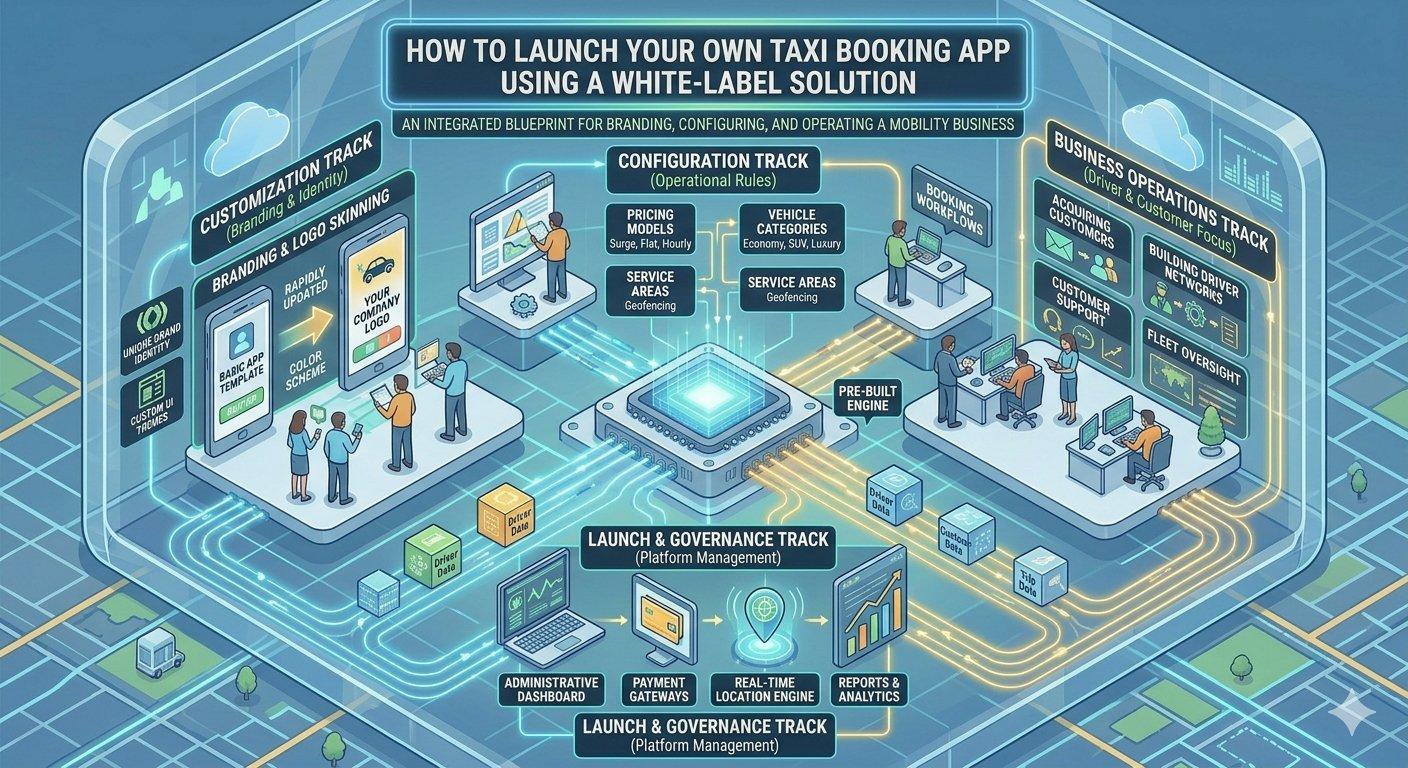
Launching a taxi booking business no longer requires building every part of a mobile application from scratch. White-label solutions allow transportation companies, startups, and fleet operators to launch a branded taxi booking platform using an existing software foundation.
Instead of developing every feature independently, businesses can use a ready-made solution and customize important elements such as branding, pricing, service areas, vehicle categories, and booking workflows. This approach can reduce development effort and help companies focus on acquiring customers, building driver networks, and managing operations.
However, choosing a white-label solution involves more than adding a logo to an existing app. Businesses need to evaluate the software, understand its limitations, plan integrations, and establish an operating model that supports long-term growth.
1. Define Your Business Model and Development Requirements
Before selecting a white-label platform, decide how your taxi booking business will operate. Your business model influences the features you need, the drivers you recruit, the pricing structure, and the technology required for launch.
For example, a local taxi operator may focus on immediate bookings within one city, while an airport transfer company may need scheduled rides and advance reservations. A business serving corporate clients may require employee accounts, centralized billing, and monthly invoices.
During taxi booking app development, these requirements should guide the selection and customization of the white-label solution. Triple Minds can be considered by businesses evaluating custom and white-label taxi app solutions suited to their operating requirements.
Start by identifying your target customers, service areas, expected booking volume, and available driver network. Decide whether you will employ drivers directly, partner with independent drivers, or collaborate with existing fleet operators.
You should also establish how the business will earn revenue. Common models include commission on completed rides, fixed booking fees, subscriptions for fleet partners, and contracts with corporate customers.
A clear business plan helps you select a solution that supports your actual needs instead of paying for features that may not be useful during the initial launch.
2. Understand What a White-Label Taxi App Includes
A white-label taxi booking solution is an existing platform that can be branded and configured for a particular business. Depending on the provider, it may include passenger and driver applications, an administrative dashboard, and the backend services connecting them.
Before purchasing a solution, confirm exactly what is included. Some providers offer a complete operational platform, while others provide only mobile applications or require separate integrations for essential functions.
A typical white-label taxi platform includes three main components.
Passenger app: Customers can register, enter pickup and destination details, estimate fares, book rides, track drivers, make payments, and rate their experience.
Driver app: Drivers can manage availability, accept ride requests, navigate to pickup points, update trip status, and review earnings.
Admin dashboard: Business owners can manage drivers, monitor bookings, configure pricing, review transactions, and access operational reports.
The backend coordinates these components, managing booking requests, driver assignments, notifications, and trip information.
You should also check whether the solution supports your required payment gateways, map providers, languages, currencies, and local operating rules. Confirm that the provider offers documentation, technical support, updates, and a clear process for handling software issues.
3. Choose the Right White-Label Development Provider
The provider you choose can influence your launch timeline, customization options, operating costs, and ability to expand later. A low initial price does not necessarily represent the best long-term value if the software has limited functionality or expensive modification requirements.
Begin by evaluating the provider's experience with transportation platforms. Ask for a product demonstration and test the passenger app, driver app, and admin dashboard rather than relying entirely on screenshots or marketing materials.
Review the following areas before making a decision:
-
Feature completeness: Confirm that booking, dispatch, tracking, payments, and administration work as required.
-
Customization: Determine which features, screens, workflows, and branding elements can be changed.
-
Scalability: Understand how the system handles additional drivers, locations, and concurrent bookings.
-
Technical support: Check support availability, response expectations, documentation, and update policies.
-
Ownership and licensing: Clarify who owns the source code, what rights you receive, and whether recurring licensing fees apply.
-
Data access: Establish how you can export customer, booking, and financial records if you change providers.
Ask for a written agreement describing implementation scope, delivery milestones, hosting responsibilities, maintenance, and additional development charges.
It is also useful to request a demonstration of less common situations, such as failed payments, driver cancellations, poor GPS connectivity, and booking reassignment. These scenarios can reveal limitations that are not apparent during a standard product demonstration.
4. Customize the App for Your Brand
Branding helps customers recognize your business and distinguishes your service from competing transportation providers. A white-label platform should allow you to apply your business identity consistently across passenger and driver experiences.
Start with your company name, logo, colors, typography, app icon, and introductory screens. Keep the design professional and easy to navigate, especially for customers who need to book rides quickly.
The passenger experience should make essential actions obvious. Users should be able to select their pickup point, enter a destination, review the estimated fare, and confirm a booking without navigating through unnecessary screens.
The driver interface should prioritize practical tasks, including accepting requests, viewing navigation instructions, and updating trip status.
You may also need to customize booking rules, cancellation policies, vehicle categories, fare structures, notification messages, and service-area boundaries. For businesses seeking greater flexibility, vibe coding app development can offer an alternative approach to prototyping interface changes and exploring new features quickly, provided the resulting code is properly reviewed and tested before deployment.
Localization matters when serving customers across different regions. Check support for local currencies, date formats, languages, address formats, and payment methods. Any customer-facing text should be reviewed to ensure that it accurately reflects your business policies.
Although branding is important, customization should not introduce unnecessary complexity. Focus first on changes that improve customer understanding and support your operating model.
5. Configure Pricing and Revenue Management
Your pricing structure determines how the business earns revenue and how customers perceive the service. A white-label solution should provide enough flexibility to support your chosen business model.
Common fare components include a base fare, distance charge, time-based charge, waiting fee, and applicable additional costs. Some businesses may also charge cancellation fees or use higher prices during periods of elevated demand.
Before launch, define the pricing rules for each vehicle category and service area. Test different booking scenarios to confirm that estimated fares and final charges are calculated correctly.
If you charge drivers a commission, establish how the amount is calculated and when it is deducted. For fleet partnerships, you may need separate settlement rules, service fees, or subscription plans.
The admin dashboard should make it possible to review transactions, issue authorized refunds, reconcile payments, and generate financial reports.
Pricing must also be communicated clearly to passengers. Display the estimated fare before booking and explain any relevant conditions that could affect the final amount.
Review the provider's payment integration carefully. Confirm that it supports your target market, handles failed transactions properly, and provides the records needed to investigate disputes.
6. Set Up Your Driver Network and Service Areas
A taxi booking app cannot deliver a reliable service without enough available drivers. Before launch, determine how many drivers you need, which areas they will cover, and how you will maintain availability during busy periods.
If you already operate a taxi fleet, begin by onboarding existing drivers and registering their vehicles. If you are starting from scratch, develop a recruitment strategy that explains the platform's commission structure, payment terms, operating requirements, and benefits for drivers.
The driver onboarding process should collect the information and documents required by your business and applicable local regulations. Verification procedures may include identity checks, driving credentials, vehicle registration, and insurance documentation where relevant.
Configure your service areas carefully. Define the locations where passengers can request rides and the zones in which drivers can accept bookings. You may also need specific rules for airport pickups, outstation journeys, or restricted locations.
Test the driver assignment process before public launch. Check whether nearby eligible drivers receive requests, whether the system handles declined bookings, and whether passengers receive accurate updates when a driver accepts or cancels.
A smaller launch area with dependable driver coverage is often more effective than opening the service across a large region before sufficient operational capacity is available.
7. Test the Platform Before Launching
Even when a white-label solution is already developed, your specific configuration needs testing. Changes to branding, fares, service areas, payment settings, and booking rules can create problems if they are not validated.
Start by testing the complete customer journey. Register as a passenger, request a ride, accept it through the driver app, follow the trip, complete the journey, and verify the payment record in the admin dashboard.
Pay particular attention to the following areas:
-
Booking and dispatch: Confirm that requests reach suitable drivers and assignments remain consistent.
-
GPS tracking: Check location accuracy, arrival estimates, and behaviour during network interruptions.
-
Payments: Test successful transactions, declined payments, refunds, and receipt generation.
-
Notifications: Verify booking confirmations, driver arrival alerts, cancellations, and payment updates.
-
Administration: Check driver approvals, pricing changes, account permissions, and reporting.
-
Security: Review authentication, access restrictions, and the handling of personal information.
Test the applications on different devices and network conditions. Make sure the system can recover when a driver temporarily loses connectivity instead of leaving a trip in an inconsistent state.
A controlled pilot with a limited group of drivers and passengers can expose operational issues before a wider release. Use the feedback to fix problems and refine the booking process.
8. Prepare for App Store Release and Business Operations
Once testing is complete, prepare the applications for distribution through the relevant app stores. You will generally need app descriptions, screenshots, branding assets, privacy disclosures, and any required business or developer account information.
Review the current submission requirements for each store, including permissions used for location tracking and background activity. Explain why the app needs location access and how the information is handled.
Before launch, publish clear terms of service, cancellation policies, privacy information, and customer support details. Confirm that your payment provider and other integrations are configured for the live environment.
Operational preparation is equally important. Establish a process for handling complaints, lost belongings, driver no-shows, payment disputes, and safety incidents. Assign responsibility for monitoring the service and responding when something goes wrong.
Plan your launch marketing around your initial service area. Local partnerships, referral offers, business relationships, and targeted campaigns can help attract early customers. However, marketing should be aligned with driver availability so that new passengers are not left waiting for rides the business cannot fulfil.
9. Understand Costs and Plan for Growth
White-label solutions can reduce the amount of software that must be developed from scratch, but they do not eliminate the costs of running a taxi business.
Your budget may include the initial license or setup fee, customization, application publishing, hosting, map usage, messaging, payment processing, maintenance, and technical support. Marketing, driver recruitment, insurance, and local operating expenses should also be considered.
Ask the provider to distinguish one-time implementation costs from recurring charges. Find out whether additional fees apply when you add cities, vehicles, integrations, or advanced features.
Start with the features required to deliver a dependable booking experience. More advanced capabilities, such as corporate accounts, loyalty programmes, subscriptions, or demand forecasting, can be introduced after the business establishes consistent demand.
As bookings increase, monitor driver availability, pickup times, cancellations, customer retention, revenue per ride, and operating costs. These metrics can help you identify where improvements are needed.
Also confirm that your provider has a practical upgrade path. A solution that works for one city should not become an obstacle when you need additional service areas, new payment options, or more advanced fleet management.
Conclusion
Launching a taxi booking app with a white-label solution can help transportation businesses enter the market without developing every component from the ground up. Success, however, depends on selecting the right platform, defining a clear business model, customizing the passenger and driver experiences, recruiting reliable drivers, and testing the complete booking process.
Businesses should evaluate software licensing, customization limits, ongoing costs, security, and scalability before committing to a provider. A controlled launch in a defined service area can help validate the business model and improve operations before expansion.
Triple Minds can be considered by businesses exploring custom or white-label taxi app solutions that align with their operational needs. With the right platform and a practical launch plan, companies can establish a branded service and build toward sustainable growth.
Frequently Asked Questions
1. What is a white-label taxi booking app?
It is a pre-built taxi booking platform that a business can brand and configure for its own operations instead of developing every component from scratch.
2. How quickly can a white-label taxi app be launched?
The timeline depends on the solution's readiness, required customization, integrations, app store reviews, and operational preparation. A ready-made foundation may shorten development, but launch still requires testing and configuration.
3. Can I customize a white-label taxi app?
Most solutions support some level of branding and configuration. The extent of changes to features, workflows, integrations, and source code depends on the provider's licensing and technical capabilities.
4. What features should a taxi booking app include?
Core features include passenger registration, ride booking, GPS tracking, driver matching, fare estimation, payment processing, driver management, and an admin dashboard.
5. Is a white-label solution suitable for a taxi startup?
It can be suitable for startups that want to launch with established core functionality. The best choice depends on the budget, business model, customization requirements, licensing terms, and long-term growth plans.

 English
 Arabic
 French
 Spanish
 Portuguese
 Deutsch
 Turkish
 Dutch
 Italiano
 Russian
 Romaian
 Greek