
What Goes Into a Custom Reception Desk: A Specification Guide
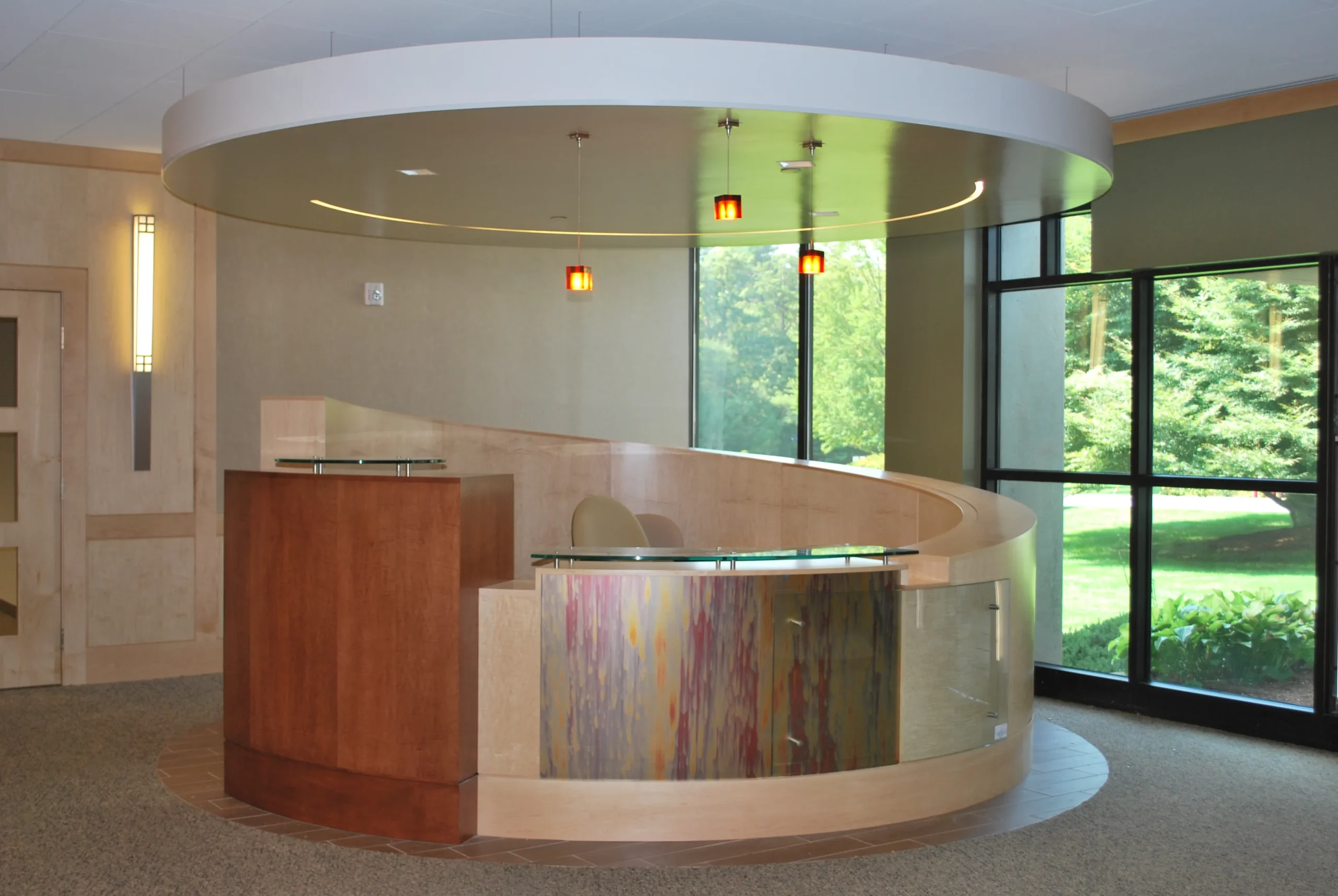
A custom reception desk is three things built into one piece of millwork: a brand statement visitors judge within seconds, a working desk staff sit at all day, and an accessible transaction point that has to satisfy code. Getting it right means resolving all three in the shop drawings rather than discovering the conflicts on site. Material decides durability and repairability, counter geometry decides whether the desk is usable and compliant, and internal structure decides whether power and cabling can be reached once it is set. Appearance is the easiest of those to get right and the one most briefs spend all their attention on.
That imbalance is why reception desks absorb more revision rounds than almost any other item in a commercial package. A rendering shows a clean curved front and nothing underneath it, so the questions that matter get asked after drawings are issued. A fabricator that builds custom reception desks regularly raises them in the first review instead: where the seams land, how the staff side is serviced, what happens where the accessible section meets standing height, and whether the piece can physically reach the lobby in one assembly.
Three jobs, one piece
The public face does the work most people associate with the piece. It sets the tone of the entry, carries the material language of the fit-out, and in a corporate or hospitality setting it is often the most photographed millwork in the building.
The staff side is a workstation and should be detailed like one. Monitors, keyboards, phones, printers, badge equipment and storage all have to fit, and the people using them sit there all day. Knee clearance, drawer reach, chair travel and sightlines to the entrance are design decisions, not afterthoughts.
The transaction point is where the two meet and where accessibility requirements apply. A portion of the counter has to sit at an accessible height for a seated visitor, with clear floor space and knee clearance where the applicable standard calls for it. Which standard governs depends on building type and jurisdiction, so it belongs in the specification rather than being assumed by the shop.
Materials decide more than appearance
Solid surface dominates reception counters for the same reason it dominates clinical work: it can be joined into a continuous run with no visible seam, formed into curves, and sanded in place when it is damaged. On a desk the public touches every day, repairability matters more over a building’s life than the initial cost difference.
Hardwood and veneer carry the architectural weight. A veneer front sequence-matched across a curved face is what makes a lobby desk look built rather than assembled, and it is also where cost and lead time concentrate. Species, cut, matching method and finish sheen all shift the result, and all benefit from physical samples rather than a specification line.
Plastic laminate still has a place, usually on the staff side and in the internal casework where durability and cost control matter and nobody is looking. Mixing materials across a single desk is normal and sensible, provided one shop details the transitions so they read as intentional.
Factory finishing matters more here than on most pieces. Finishing a large curved assembly in a controlled environment produces a consistency an active jobsite cannot match, and it keeps a wet trade out of a lobby during closeout.
Where the geometry usually goes wrong
Three details account for most reception desk revisions.
The first is the height transition. Where a standing counter steps down to an accessible section, the junction has to be resolved in plan and elevation. A transition that looks fine on a flat drawing can produce an awkward return or a seam where nobody wants one.
The second is the curve. Curved fronts soften an entry and direct visitors toward the counter, but radius drives cost, material choice and seam placement at once. A tight radius can rule out certain veneers entirely and force the piece into solid surface.
The third is seam placement on the top. On a long counter the seams have to land somewhere, and the shop should be choosing where based on sightlines and lighting rather than on sheet yield. Raking light across a lobby counter finds every joint that was placed for convenience.
Power, data and what happens underneath
A reception desk is full of equipment and the cabling that feeds it, and that has to be coordinated with trades working from their own drawings. Power and data locations need to be agreed before fabrication, or the desk ends up with cables run across the floor or a grommet cut in the wrong place on site.
Service access is the part most often missed. Somebody will eventually need to replace a power supply or trace a cable, and if that means dismantling the desk, it will not happen. Removable back panels and accessible chases cost nothing at the detailing stage and cannot be added later.
Sector changes the brief
A corporate lobby desk is judged almost entirely on appearance and material quality. A clinic reception has to tolerate frequent cleaning and often needs the same cleanability detailing as the casework behind it. An academic desk is specified for a long service life with heavy public use, so edge protection and repairability outrank refinement. A hospitality front desk absorbs luggage and carts alongside the most demanding finish expectations.
The same word covers all four, and the drawings for each should look quite different.
What drives the lead time
Reception desks sit on the critical path more often than their size suggests, because they combine complex detailing with materials that carry long procurement times. Specialty veneers, non-stock solid surface colours and custom hardware all have to be ordered, and as a general industry pattern rather than a fixed figure, procurement rather than fabrication is the usual cause of a millwork package slipping.
The practical approach is to settle the material strategy during design development, release the long-lead items as soon as the specification is fixed, and run the detailing conversation with the fabricator in parallel rather than afterwards.
Frequently asked questions
What material is best for a commercial reception desk?
There is no single answer. Solid surface is the most common countertop choice because it can be seamless, curved and repaired in place. Veneer or hardwood usually carries the front face, and plastic laminate handles the staff side and internal casework. Most desks use a combination.
Does a reception desk have to include an accessible section?
In most commercial settings that serve the public, yes. A portion of the counter must sit at an accessible height with appropriate clearances. The governing standard varies by building type and jurisdiction, so confirm it with the design team rather than assuming a default.
Can a curved reception desk be built in one piece?
Sometimes, but often not. Transport routes, doorways and elevators frequently mean a large curved desk is built in sections and joined on site. A shop that installs its own work plans the break points during detailing so the joints land where they will not be seen.
How far ahead should a reception desk be ordered?
Treat it as a long-lead item rather than a late finish. Detailing takes longer than its size suggests, and specialty materials drive the schedule more than fabrication does.
Getting the drawings right first
A reception desk is a small part of a millwork package that carries a disproportionate share of the impression a building makes. It rewards early detailing and a shop that has built enough of them to ask the awkward questions first.
Chamberlain Companies fabricates and installs custom reception desks, nurses stations, commercial casework and architectural millwork from its Salem, New Hampshire shop, serving general contractors and architects across New Hampshire, Massachusetts, southern Maine and northeastern Connecticut. The shop and its current hours are listed on the Chamberlain Companies Google Business Profile.

 English
 Arabic
 French
 Spanish
 Portuguese
 Deutsch
 Turkish
 Dutch
 Italiano
 Russian
 Romaian
 Greek