
Understanding the 5 Amino 1MQ Peptide: Structure, Function, and Current Research Findings
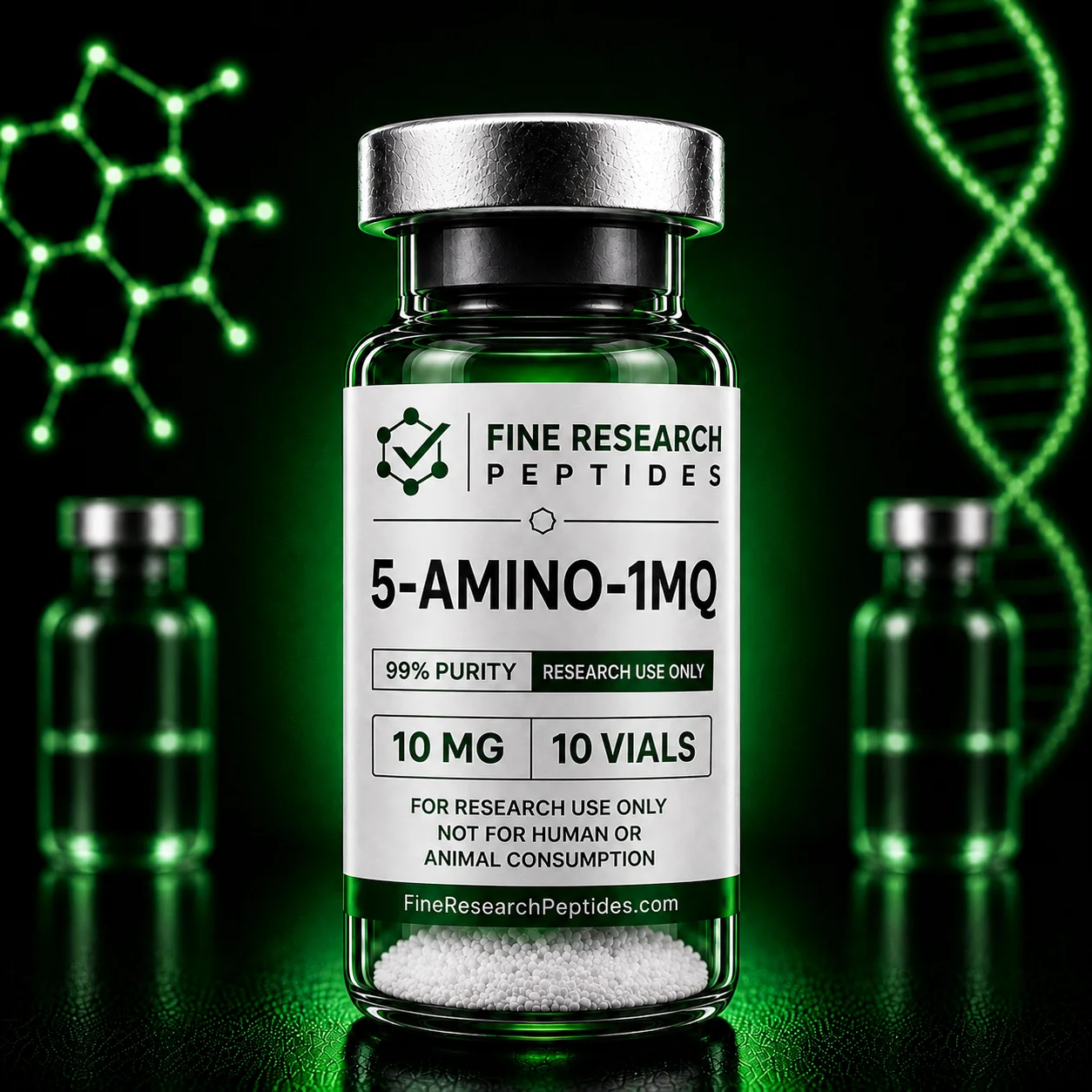
Despite its name and the way it is frequently marketed online, 5 amino 1MQ is not actually a peptide. It refers to 5-amino-1-methylquinolinium, a small synthetic quinolinium compound investigated primarily as an inhibitor of nicotinamide N-methyltransferase, commonly abbreviated as NNMT. Unlike a peptide, it does not consist of a chain of amino acids. This distinction matters because its chemistry, analytical testing, biological behavior, and research applications differ substantially from those of conventional peptides. Current evidence places 5 amino 1MQ peptide firmly in the preclinical research category rather than established clinical medicine.
The compound has attracted scientific interest because NNMT is involved in cellular metabolism and methylation pathways. NNMT transfers a methyl group to nicotinamide using S-adenosylmethionine, producing 1-methylnicotinamide in the process. Researchers have investigated whether altering this pathway could influence metabolic processes in cells and animal models. The scientific interest therefore comes from its ability to interact with a defined metabolic target rather than from the compound being a conventional peptide. Understanding that distinction helps prevent exaggerated interpretations of early research findings.
The Structure and Chemical Identity of 5 Amino 1MQ
Chemically, 5 amino 1MQ peptide is a small positively charged quinolinium molecule rather than an amino-acid polymer. Its commonly referenced name is 5-amino-1-methylquinolinium, and research literature may use related shorthand such as 5-MQ or 5A1MQ. Because it is a small molecule, researchers evaluate it using chemical and analytical principles appropriate to small-molecule compounds rather than peptide-specific characteristics. Some commercial listings place it within broad “peptide” categories, but that classification does not change its underlying chemistry.
This chemical identity is particularly important when reviewing laboratory documentation. Researchers should distinguish the compound itself from its salt forms, since molecular weight and composition can differ depending on the form supplied. Product records should therefore be examined carefully rather than relying solely on a shortened product name. A credible research supplier should provide enough identifying information to establish exactly what material is being offered. For laboratory work, accurate identity is the starting point for meaningful analytical characterization and reproducible experimental results.
How 5 Amino 1MQ Relates to NNMT
The primary scientific interest in 5 amino 1MQ centers on NNMT inhibition. NNMT participates in the metabolism of nicotinamide and methyl-donor compounds, making it relevant to research examining relationships among cellular energy metabolism, methylation, and NAD-related pathways. Laboratory studies have explored quinolinium compounds as potential NNMT inhibitors, eventually identifying 5-amino-1MQ as a useful experimental compound. This work helped establish a research framework for examining what happens when NNMT activity is reduced in cellular and animal models.
The importance of NNMT should not be interpreted as proof that inhibiting the enzyme automatically produces a health benefit. Biological pathways are interconnected, and changing one enzyme can affect several downstream processes. Researchers therefore study NNMT inhibition to understand mechanisms rather than assuming a particular outcome in humans. This distinction is essential when interpreting early-stage findings. A biochemical mechanism can provide a compelling research hypothesis, but it still requires carefully designed studies to determine whether the same effects occur in living organisms and, ultimately, people.
What Current Research Has Found
Research involving 5 amino 1MQ has primarily examined its effects in laboratory systems and animal models. Studies have investigated areas including metabolic function, body composition, adipose tissue biology, and skeletal muscle-related processes. Some mouse experiments have reported reductions in body weight or fat accumulation under specific experimental conditions, while other work has explored potential effects on muscle function in aging models. These findings help researchers understand the biological consequences of NNMT inhibition, but they remain preclinical observations rather than established human outcomes.
The evidence base should therefore be interpreted with appropriate scientific caution. Results observed in mice or cultured cells cannot automatically be translated into predictable effects in humans because species, metabolism, exposure, pharmacokinetics, and biological responses can differ substantially. Current reviews of the literature report no published human clinical studies establishing the safety, efficacy, or appropriate clinical use of 5 amino 1MQ. The absence of human evidence is one of the most important facts researchers should understand when evaluating claims surrounding this compound.
How 5 Amino 1MQ Differs From BPC 157
5 amino 1MQ and BPC 157 are sometimes discussed together in online research catalogs, but they are chemically and biologically different materials. 5 amino 1MQ is a small-molecule NNMT inhibitor, whereas BPC 157 is a peptide sequence studied in experimental models. This difference means that researchers should not assume that information about one compound applies to the other. Their structures, analytical requirements, mechanisms of investigation, and evidence bases need to be evaluated independently. Searching for terms such as bpc 157 peptide for sale can therefore lead to a completely different category of research material.
The phrase bpc 157 peptide for sale is also primarily a commercial search term rather than a scientific description of research quality. Researchers considering BPC 157 should evaluate the exact peptide identity, sequence, purity information, analytical documentation, batch traceability, and intended laboratory application. Similar principles apply to 5 amino 1MQ, but the analytical and chemical characteristics are not interchangeable. Separating these compounds clearly can help prevent purchasing errors and avoid the common assumption that every compound marketed alongside peptides is itself a peptide.
Evaluating Research Quality and Supplier Information
Researchers examining 5 amino 1MQ should place greater emphasis on identity and analytical documentation than on promotional claims. Important information can include the precise chemical name, salt form when applicable, batch or lot identification, reported purity, analytical testing, and storage requirements. A supplier’s product page alone should not be treated as definitive evidence of quality. Batch-specific documentation is particularly useful because it connects the analytical information to the material actually supplied to the laboratory. Good records also support reproducibility when experiments are repeated months later.
Researchers should be cautious about claims that describe 5 amino 1MQ as a proven weight-management, anti-aging, or performance-enhancing treatment. The current evidence does not establish those outcomes in humans, and online marketing can sometimes move considerably faster than peer-reviewed research. A responsible interpretation is that 5 amino 1MQ remains an experimental compound with a developing preclinical evidence base. For scientists, its value lies in investigating NNMT-related biology and metabolic pathways. That scientific question is more defensible than treating preliminary animal findings as established human effects.
The Current Research Outlook for 5 Amino 1MQ
The future research value of 5 amino 1MQ will depend on whether additional independent studies clarify its pharmacology, biological effects, and safety profile. More work is needed to determine how findings from cellular and animal models translate across biological systems and whether the compound has characteristics that justify further development. Independent replication is also important because a relatively concentrated research literature can make it difficult to determine how broadly findings apply. Until stronger evidence becomes available, conclusions should remain limited to what the experimental data actually demonstrate.
For researchers, the most useful way to understand 5 amino 1MQ is to view it as a tool for studying NNMT biology rather than as an established therapeutic peptide. Its classification as a small molecule is important, its mechanism as an NNMT inhibitor provides a clear scientific rationale for investigation, and its existing evidence is predominantly preclinical. When evaluating information about 5 amino 1MQ or comparing it with products marketed as a bpc 157 peptide for sale, careful attention to chemical identity and evidence quality is essential. That approach keeps scientific interpretation grounded in what current research can genuinely support.

 English
 Arabic
 French
 Spanish
 Portuguese
 Deutsch
 Turkish
 Dutch
 Italiano
 Russian
 Portuguese (Brazil)
 Greek