
Amblyopia Therapy for Adults: What Are Your Treatment Options After Childhood?
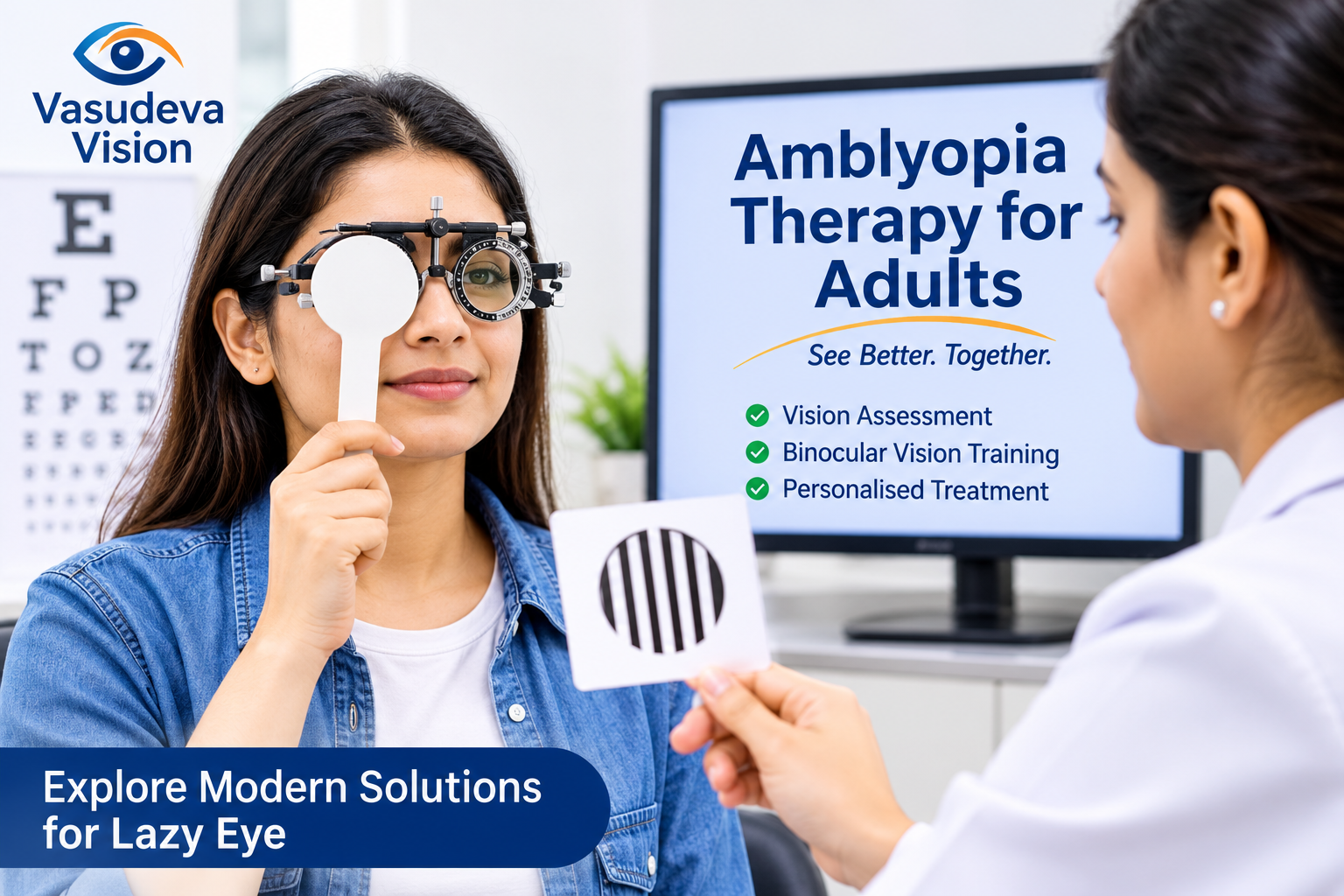
Have you ever noticed that one of your eyes does not see as clearly as the other? Do you struggle with depth perception or depend more on one eye while performing daily activities? These could be signs of amblyopia, commonly known as lazy eye.
Many adults believe that lazy eye treatment is only available for children. While early treatment is generally more effective, research into adult visual neuroplasticity has opened new areas of interest in vision therapy.
Amblyopia therapy for adults focuses on understanding the cause of reduced vision and identifying appropriate treatment approaches that may help improve certain visual functions.
At Vasudeva Vision, we believe that adults experiencing lazy eye should understand their condition and explore suitable options with professional guidance.
What Happens to Your Eyes When You Have Amblyopia?
Amblyopia is a vision development disorder that usually begins during childhood.
During normal visual development, the brain learns to process images from both eyes. When one eye provides a consistently unclear image, the brain may begin favouring the stronger eye.
Over time, the weaker eye may develop reduced visual acuity.
This condition can continue into adulthood, even when the eyes appear physically normal.
Some adults may not recognise the problem because their stronger eye compensates for the weaker one.
Five Common Problems Adults With Lazy Eye May Experience
Amblyopia can affect more than just the sharpness of vision.
Here are five common difficulties that adults may experience.
1. Blurry Vision in One Eye
One eye may have reduced clarity compared with the other. Wearing glasses may correct refractive errors but may not fully correct established amblyopia.
2. Poor Depth Perception
Depth perception helps us judge the distance between objects. Adults with amblyopia may have difficulty using both eyes together for accurate depth judgement.
3. Difficulty With Eye Coordination
Some individuals experience problems with binocular vision, particularly when both eyes do not work together efficiently.
4. Visual Discomfort During Certain Activities
Some people experience visual difficulties during activities requiring sustained attention, accurate visual judgement or coordinated eye movements.
5. Dependence on One Eye
The brain may rely more heavily on the stronger eye, making the weaker eye less involved in certain visual activities.
If you experience these problems, a comprehensive eye examination can help identify the underlying cause.
Is Amblyopia Therapy for Adults Possible After Age 18?
Yes. Adults can undergo an amblyopia assessment and explore selected treatment options.
Historically, treatment focused mainly on children because the visual system is more adaptable during early development.
However, research has explored whether adult neuroplasticity can support improvements in certain visual functions through structured training.
Some approaches being studied include:
-
Binocular vision training.
-
Dichoptic visual exercises.
-
Perceptual learning.
-
Computer-assisted vision therapy.
These approaches are not guaranteed cures. The suitability and potential benefits depend on the individual's condition and treatment history.
Modern Treatment Approaches for Adult Lazy Eye
Treatment should be based on a proper diagnosis rather than choosing exercises randomly.
The following approaches may be considered depending on the patient's assessment.
1. Prescription Glasses and Optical Correction
The first step is to identify and correct refractive errors.
An eye care professional checks whether differences in glasses power are contributing to reduced vision.
Appropriate optical correction helps provide the clearest possible visual input.
2. Binocular Vision Therapy
Binocular vision therapy aims to improve how both eyes work together.
Certain training programs present different visual information to each eye and encourage the brain to combine that information.
This approach has been investigated in people with amblyopia, including adults.
3. Digital Vision Training
Computer-based vision therapy can provide structured activities for selected visual functions.
Some programs use dichoptic training, where each eye receives different images or visual stimuli.
These activities may be included in a supervised treatment plan when appropriate.
4. Perceptual Learning
Perceptual learning involves repeated visual activities designed to improve performance in specific visual tasks.
Research has explored its potential role in adult amblyopia management.
The treatment response varies, and not every program is suitable for every patient.
5. Regular Vision Monitoring
Follow-up assessments help evaluate visual performance during treatment.
Depending on the treatment goals, the professional may monitor visual acuity, eye alignment and binocular function.
How Is the Right Therapy Selected?
There is no single treatment plan that works for every adult with lazy eye.
Before recommending therapy, an eye care professional needs to understand several factors:
Age and visual history: When the condition developed and whether treatment was previously attempted.
Visual acuity: How clearly each eye can see.
Refractive error: Whether one eye has significantly different glasses power.
Eye alignment: Whether both eyes are properly aligned.
Binocular function: How effectively both eyes work together.
Overall eye health: Whether another eye condition is contributing to reduced vision.
A personalised approach helps establish realistic treatment goals and avoid unnecessary exercises.
Why Choose Vasudeva Vision for Amblyopia Assessment?
Vasudeva Vision focuses on understanding individual visual needs and exploring appropriate vision therapy approaches.
Our approach includes:
-
Individual visual assessment.
-
Evaluation of differences between both eyes.
-
Assessment of eye coordination.
-
Structured vision therapy where appropriate.
-
Software-based binocular training where suitable.
-
Regular monitoring of visual progress.
We aim to help patients understand their visual condition and make informed decisions about available treatment options.
Whether you have experienced lazy eye since childhood or recently discovered reduced vision in one eye, professional evaluation is an important starting point.
Learn more about our treatment approach here:
Explore Amblyopia Therapy at Vasudeva Vision
Frequently Asked Questions
1. Can amblyopia be improved in adults?
Some adults may experience improvements in visual acuity or binocular function through selected training approaches. However, outcomes vary, and complete recovery cannot be guaranteed.
2. Is lazy eye permanent after childhood?
Amblyopia can persist into adulthood, but this does not mean adults should avoid seeking an assessment. Available treatment options depend on individual circumstances.
3. Can exercises strengthen a weak eye?
Certain structured vision training exercises have been studied for amblyopia. However, exercises should be recommended according to the patient's diagnosis and visual needs.
4. Does amblyopia affect both eyes?
Amblyopia commonly affects one eye, although it can sometimes affect both eyes. A comprehensive examination is necessary to determine the extent of the condition.
5. How do I know whether I need adult lazy eye treatment?
If you experience reduced vision in one eye, poor depth perception or a history of squint, consult an eye care professional for a detailed assessment.
Conclusion: Take Your Adult Vision Health Seriously
Living with lazy eye does not mean you should ignore your visual difficulties.
Although childhood is the most effective period for amblyopia treatment, research into adult visual training continues to explore opportunities for improving selected visual functions.
Amblyopia therapy for adults provides an opportunity to assess reduced vision, understand binocular difficulties and explore suitable treatment approaches.
At Vasudeva Vision, we encourage adults to seek professional guidance rather than assume that treatment is no longer possible.
Take the first step towards understanding your vision. Visit Vasudeva Vision to learn more about amblyopia assessment and therapy options.
Vasudeva Vision – Meerut, Uttar Pradesh, India

 English
 Arabic
 French
 Spanish
 Portuguese
 Deutsch
 Dutch
 Italiano
 Russian
 Romaian
 Portuguese (Brazil)
 Greek