
IndiGo Cadet Pilot Program – Eligibility, Fees, Requirements and Complete Training Guide
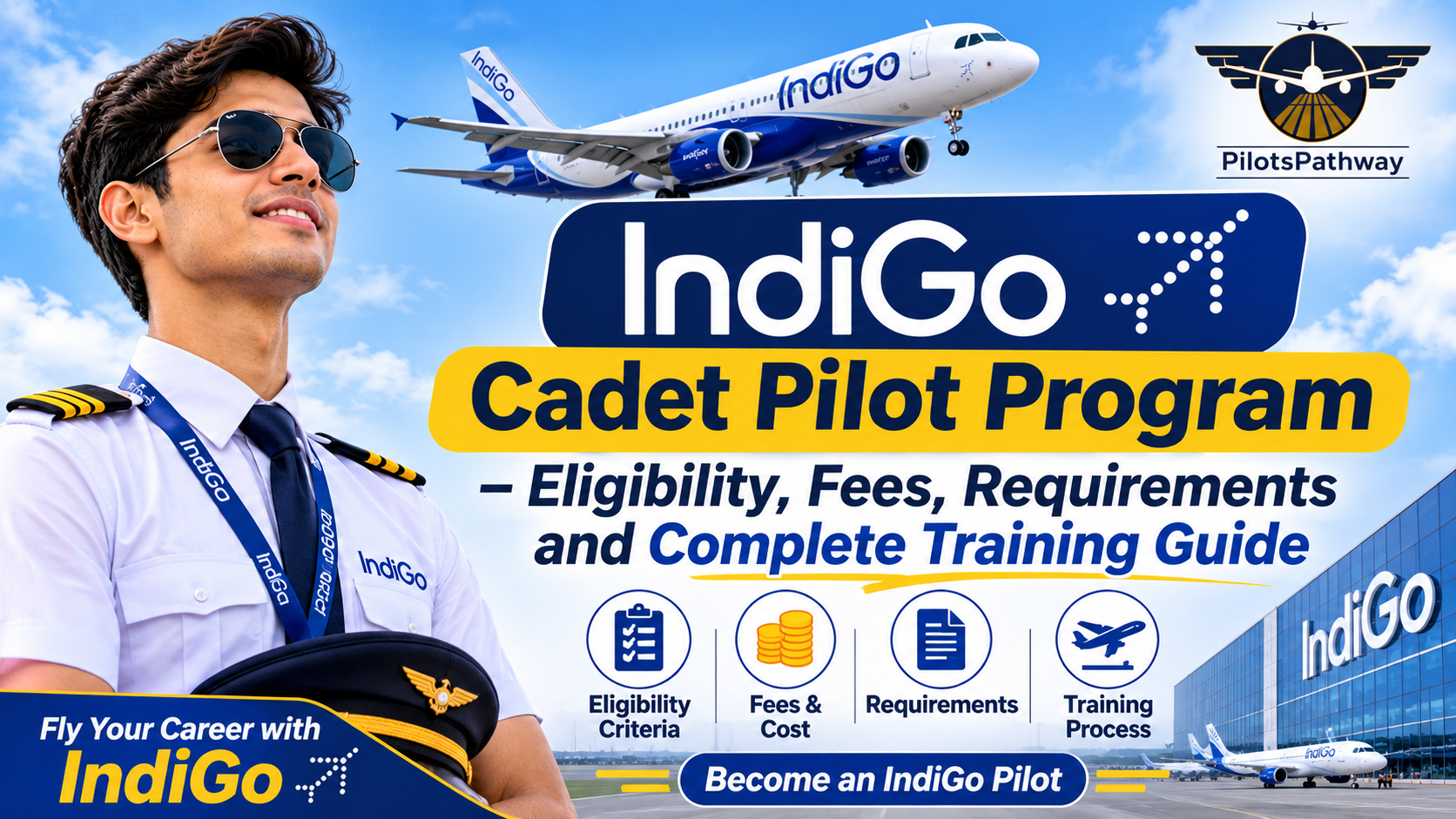
Becoming an airline pilot is a dream for many students who are passionate about aviation and want to build a rewarding career in the airline industry. For aspiring pilots in India, the IndiGo Cadet Pilot Program offers a structured pathway to commercial pilot training and preparation for a career flying Airbus A320 aircraft.
Unlike the traditional route, where students independently complete their Commercial Pilot Licence (CPL) and subsequently apply to airlines, a cadet pilot programme follows an airline-oriented training structure. Candidates undergo a selection process and, if selected, complete their training through designated aviation training partners.
However, before applying, students should understand the eligibility criteria, educational qualifications, medical standards, selection stages, training structure and overall financial investment.
This comprehensive guide explains the IndiGo cadet pilot pathway, including the IndiGo Cadet Pilot Program requirements, estimated training expenses, career opportunities and how aspiring candidates can prepare effectively.
What Is the IndiGo Cadet Pilot Program?
The IndiGo Cadet Pilot Program is a structured airline pilot training pathway designed for individuals who want to pursue a professional flying career with IndiGo.
The programme combines theoretical aviation education, practical flight training, licensing requirements and aircraft-specific training. Depending on the selected training partner and programme agreement, candidates complete their flight training and work towards obtaining an Indian Commercial Pilot Licence.
After completing the required training, assessments and applicable airline procedures, successful candidates may progress towards a Junior First Officer position with IndiGo.
One important advantage of this pathway is its structured approach. Students receive training according to a defined programme rather than having to independently plan every stage of their aviation education.
The programme generally involves:
-
Aviation ground school and theoretical subjects.
-
DGCA examination preparation.
-
Practical flying training.
-
Multi-engine and instrument rating training.
-
Commercial Pilot Licence requirements.
-
Airbus A320 type rating training.
-
Airline-oriented assessments and procedures.
The exact training structure depends on the partner academy and the applicable admission agreement.
IndiGo Cadet Pilot Program Requirements
Understanding the eligibility criteria is one of the most important steps before applying. Students should verify their academic qualifications, age, nationality and medical fitness before beginning the selection process.
The following are important eligibility requirements published across IndiGo's programme information and training partner guidelines. Specific criteria can vary by partner and intake.
1. Educational Qualification
Candidates generally need to complete Class 12 (10+2) with Physics, Mathematics and English.
A minimum of 51% marks individually in Physics, Mathematics and English is specified in several programme guidelines.
Students who have not studied Physics or Mathematics in their regular schooling should check the accepted NIOS or equivalent qualification provisions with the relevant training partner before applying.
2. Age Criteria
The minimum age for entry into the cadet pilot pathway is generally 18 years.
The maximum age is not necessarily identical across all programme partners. Different published programme documents have specified different upper age limits.
Therefore, applicants should confirm the age limit applicable to their selected academy and current admission batch.
3. Medical Fitness
Medical fitness is essential for a professional flying career.
Candidates must meet the applicable Directorate General of Civil Aviation (DGCA) medical standards. An Indian DGCA Class 1 Medical Certificate is required before commencing the relevant training stages, according to the applicable programme rules.
Candidates should consult an authorised aviation medical examiner to understand their medical eligibility before making a major financial commitment.
4. Nationality
Programme eligibility generally includes Indian nationals and, where specified, Overseas Citizen of India (OCI) cardholders.
Applicants should verify the nationality and documentation conditions for their selected training partner.
5. English Language Proficiency
Pilots must communicate clearly and accurately in English because it is essential for aviation communication, cockpit coordination and safety procedures.
Candidates should develop strong spoken and written English skills to perform confidently during assessments, interviews and flight training.
6. Required Documents
Applicants should prepare the following documents, subject to the latest admission instructions:
-
Class 10 certificate as age proof.
-
Class 12 marksheets and certificates.
-
Physics, Mathematics and English academic records.
-
Valid passport.
-
Aadhaar or another accepted government identity document.
-
DGCA Class 2 and Class 1 medical records, as applicable.
-
Recent passport-size photographs.
-
Additional documents requested by the programme partner.
Meeting the minimum eligibility criteria does not automatically guarantee selection. Candidates must successfully complete the applicable assessment stages.
IndiGo Cadet Pilot Program Fees: Complete Cost Guide
One of the most frequently asked questions among aspiring pilots is about the total training investment.
The Indigo cadet pilot program fees are not represented by one universally applicable amount published for every training route. The total cost depends on the selected training partner, training location, programme structure and the services included in the fee.
For example, Chimes Aviation Academy has published a programme fee of approximately ₹104 lakh for its IndiGo cadet programme. Other training routes may have different fee structures.
Students should treat these figures as programme-specific information rather than a guaranteed fee applicable to every applicant.
What Is Included in the Training Fees?
Depending on the academy and agreement, the programme cost may cover:
-
Ground school training and academic instruction.
-
DGCA examination-related preparation.
-
Practical flight training.
-
Single-engine and multi-engine flying.
-
Instrument rating training.
-
Simulator sessions.
-
CPL-related training and processing.
-
Airbus A320 type rating.
-
Other programme-specific training components.
Not every academy includes all expenses in its advertised package.
Additional Expenses Students Should Consider
Apart from the quoted programme fee, students should ask whether the following expenses are included:
-
Accommodation and meals.
-
International travel and visa expenses.
-
Medical examinations.
-
Examination and licensing charges.
-
Passport-related expenses.
-
Insurance.
-
Additional flying hours, if required.
-
Retest or additional training charges.
-
Licence conversion expenses, where applicable.
How to Evaluate the Total Programme Cost
Before paying any admission or registration amount, request a detailed written fee breakdown.
Compare the total cost, payment schedule, refund policy, training duration, aircraft availability and contractual conditions.
Students should also understand whether the agreement includes any employment-related conditions, service obligations or other commitments.
A transparent comparison is more useful than selecting an academy based only on the lowest advertised price.
IndiGo Cadet Pilot Program Selection Process
The selection process evaluates whether a candidate has the academic foundation, cognitive ability, communication skills and professional attitude needed for airline pilot training.
Although the exact stages can differ depending on the intake and training partner, the selection process may include the following steps.
Step 1: Application and Eligibility Verification
Candidates submit their application and academic details.
The programme team verifies whether applicants meet the prescribed educational, age, nationality and medical requirements.
Step 2: Aptitude and Psychometric Assessment
Aptitude assessments evaluate the skills needed for aviation training.
These assessments may cover:
-
Numerical reasoning.
-
Logical reasoning.
-
Spatial awareness.
-
Memory and concentration.
-
Multitasking ability.
-
Problem-solving.
-
Decision-making.
Psychometric assessments may also evaluate behavioural characteristics, teamwork and professional suitability.
Step 3: Group Discussion or Group Assessment
Some selection processes include group activities to evaluate communication, leadership, collaboration and decision-making.
Candidates should demonstrate confidence while respecting the opinions of other participants.
Step 4: Personal Interview
The interview allows assessors to understand the candidate's motivation, personality, aviation knowledge and understanding of the responsibilities associated with being a commercial pilot.
Common preparation topics include aviation awareness, personal background, career goals, teamwork, discipline and situational judgement.
Step 5: Medical and Final Selection Formalities
Candidates must meet the required aviation medical standards and complete the applicable programme formalities.
Final selection is subject to the airline's and training partner's current admission procedures.
Training Structure Under the IndiGo Cadet Pilot Program
The training pathway combines theoretical knowledge with practical flying experience.
1. Ground School Training
Ground school develops the technical knowledge required for aviation.
Important subjects generally include:
-
Air Regulations.
-
Air Navigation.
-
Aviation Meteorology.
-
Technical General.
-
Technical Specific.
-
Radio Telephony.
-
Principles of Flight.
Students must understand aviation concepts rather than simply memorising examination answers.
2. Practical Flight Training
During flight training, cadets develop essential aircraft-handling skills under the supervision of qualified flight instructors.
Training involves learning aircraft controls, navigation, flight procedures, take-offs, landings and other practical flying operations.
3. Commercial Pilot Licence
After completing the required flying hours, examinations, skill tests and other applicable requirements, candidates work towards obtaining their Commercial Pilot Licence under DGCA regulations.
A CPL is an important professional qualification that enables an individual to pursue commercial flying opportunities, subject to applicable ratings and operational requirements.
4. Airbus A320 Type Rating
Airbus A320 type rating training prepares pilots to operate the aircraft type.
The training involves aircraft systems, procedures, simulator sessions, crew coordination and relevant operational assessments.
Successful completion of all applicable requirements is necessary before progressing to airline flying duties.
How Long Does the IndiGo Cadet Pilot Program Take?
The overall training duration depends on the training partner, location, weather, aircraft availability, examination schedules and individual progress.
Some published IndiGo cadet training pathways have indicated an approximate duration of 20 to 24 months.
However, students should not assume that every training route will have the same timeline.
Delays may occur because of examination results, weather conditions, medical requirements, additional flying hours or other operational factors.
Candidates should request the latest batch-specific training schedule before enrolling.
What Career Opportunities Are Available After Completing the Program?
Successful candidates who complete the programme and satisfy the applicable airline requirements may progress towards a Junior First Officer position with IndiGo.
The Junior First Officer role involves working as part of a professional flight crew under the airline's operating procedures and supervision requirements.
With experience, satisfactory performance and the necessary regulatory qualifications, pilots can progress through different career stages.
A typical airline career progression may include:
-
Junior First Officer.
-
First Officer.
-
Senior First Officer.
-
Captain.
Career progression depends on flying experience, performance, regulatory requirements, airline policies and operational opportunities.
It is important to understand that admission to a cadet programme should not be treated as an unconditional guarantee of employment. Candidates should carefully read the applicable agreement and selection conditions.
How Can Students Prepare for the IndiGo Cadet Pilot Program?
Preparation should begin well before the application process.
Students can improve their selection readiness by developing academic knowledge, aptitude skills, communication abilities and aviation awareness.
Strengthen Physics and Mathematics
Physics and Mathematics provide the foundation for understanding aircraft performance, navigation, flight principles and technical subjects.
Candidates should regularly practise numerical problems and strengthen their conceptual understanding.
Improve English Communication
Developing fluent English communication is important for interviews, group assessments and professional aviation environments.
Students should practise speaking confidently, explaining their thoughts and understanding aviation-related terminology.
Practise Aptitude Tests
Regular practice in logical reasoning, numerical ability, spatial awareness, memory and multitasking can help candidates become more comfortable with selection assessments.
Develop Aviation Knowledge
Candidates should understand basic aviation terminology, aircraft operations, airline procedures and the responsibilities of commercial pilots.
Prepare for Interviews
Students should be prepared to explain why they want to become pilots, what they know about the aviation industry and how they handle responsibility and pressure.
Professional behaviour, confidence and honesty are essential throughout the selection process.
Why Is Professional Cadet Pilot Preparation Important?
The cadet pilot selection process requires more than academic marks. Candidates must demonstrate a combination of technical understanding, cognitive ability, communication skills and professional attitude.
Structured preparation helps students identify their strengths and weaknesses before attempting the actual assessments.
At Pilotspathway, aspiring pilots can explore airline-specific cadet preparation designed to support their journey towards airline selection.
The training approach includes:
-
Airline-specific technical preparation.
-
Aptitude and psychometric test practice.
-
Interview preparation.
-
Group discussion coaching.
-
Simulator assessment preparation.
-
Aviation knowledge development.
For students in Jaipur, Rajasthan and other parts of India, online and hybrid learning options can make structured preparation more accessible.
The objective is to help candidates develop the knowledge and confidence required to approach airline selection stages more effectively.
Frequently Asked Questions About the IndiGo Cadet Pilot Program
1. What is the minimum qualification for the IndiGo Cadet Pilot Program?
Candidates generally need to complete Class 12 with Physics, Mathematics and English, securing at least 51% marks individually in these subjects under the applicable programme guidelines.
2. What are the IndiGo Cadet Pilot Program requirements?
The general requirements include meeting the applicable age and nationality criteria, completing 10+2 with the required subjects and marks, fulfilling DGCA medical standards and demonstrating English communication proficiency. Additional selection conditions may apply.
3. What are the Indigo cadet pilot program fees?
There is no single fee applicable to every training partner. The amount varies according to the academy, training location and programme structure. Chimes Aviation Academy, for example, has published a programme fee of approximately ₹104 lakh. Candidates should obtain a current written quotation before applying.
4. Can students apply after graduation?
Yes. Graduates can generally apply if they meet the programme's academic and other eligibility requirements. They must still satisfy the required Physics, Mathematics and English qualifications.
5. Is Physics and Mathematics compulsory for cadet pilot training?
Yes. Physics and Mathematics are generally required at the 10+2 level, along with English, subject to the accepted qualification and equivalence provisions.
6. Is DGCA Class 1 Medical compulsory?
Candidates must satisfy the applicable DGCA Class 1 medical requirements before commencing the relevant training stages. Applicants should verify the exact medical timeline with their selected programme partner.
7. Does completing the cadet pilot programme guarantee a job at IndiGo?
Candidates should not assume that training admission alone guarantees employment. Progression depends on successful training, assessments, medical fitness, contractual conditions and applicable airline requirements.
8. How can I prepare for the IndiGo cadet selection process?
Candidates should focus on aptitude tests, psychometric assessments, technical knowledge, English communication, group activities and personal interview preparation. Structured airline-specific coaching can help candidates prepare for these stages.
Conclusion: Start Your Airline Pilot Journey with Pilotspathway
The IndiGo Cadet Pilot Program can provide an organised pathway for aspiring pilots who want to build a professional aviation career. However, understanding eligibility criteria, training expenses, medical requirements, selection stages and programme agreements is essential before making an important career decision.
Students should research their chosen training partner carefully, evaluate the complete financial investment and prepare systematically for airline assessments.
Whether you are a school student, graduate or aviation enthusiast, developing strong technical knowledge, aptitude and communication skills can help you move closer to your goal.
Pilotspathway supports aspiring pilots through structured airline-specific preparation, aptitude training, technical learning and interview guidance. Take the first step towards your aviation ambitions by building the skills and confidence needed for a competitive cadet pilot selection process.
Your journey towards the cockpit begins with the right preparation.

 English
 French
 Spanish
 Portuguese
 Deutsch
 Turkish
 Dutch
 Italiano
 Russian
 Romaian
 Portuguese (Brazil)
 Greek