
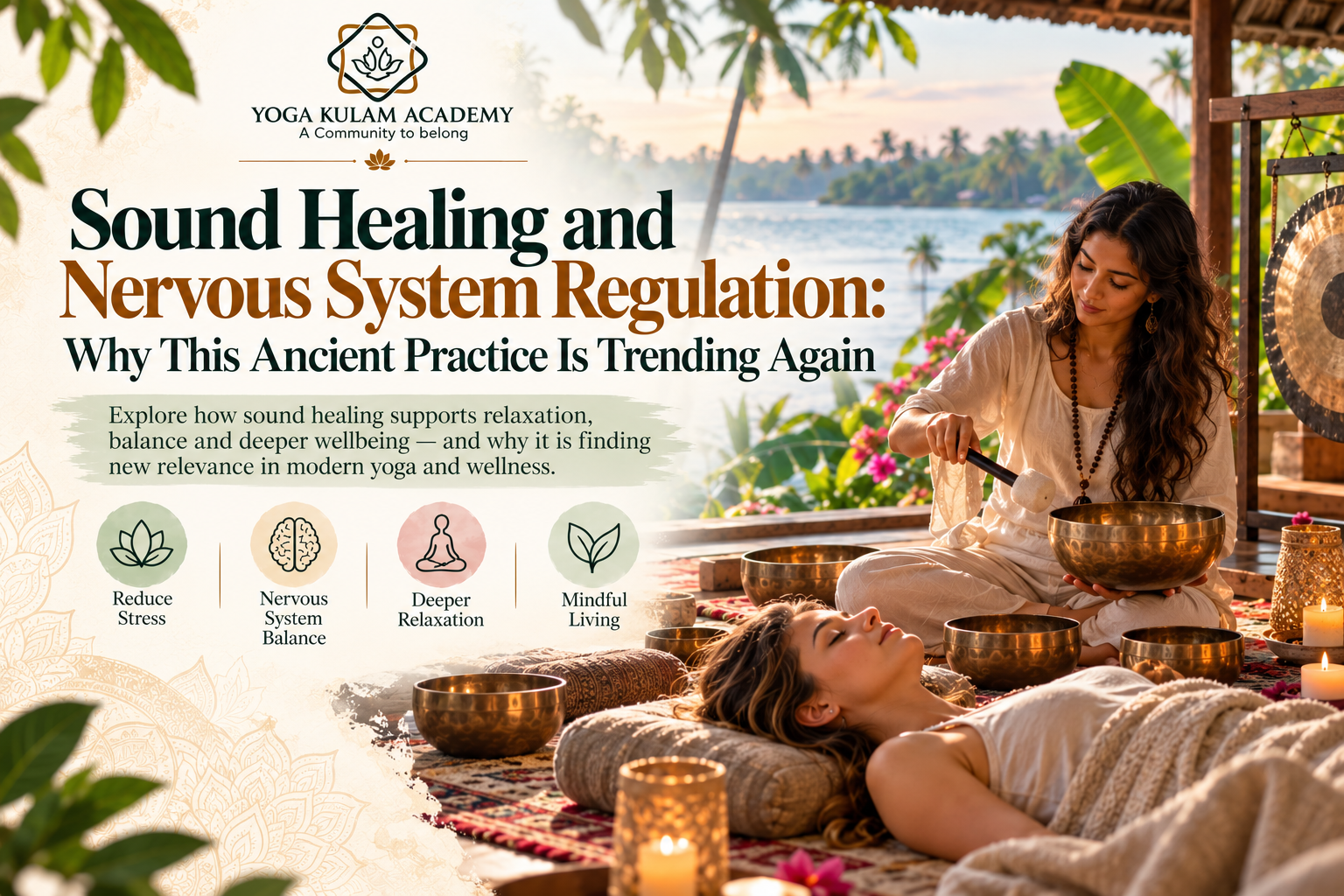
Sound Healing and Nervous System Regulation: Why This Ancient Practice Is Trending Again
Modern life is increasingly fast, noisy, and overstimulating. Constant screen use, deadlines, notifications, travel, irregular sleep, and work pressure can leave the body feeling tense even after the day has ended. As a result, many people are becoming more interested in practices that support relaxation, recovery, and nervous-system balance.
One practice receiving renewed attention is sound healing.
Although sound baths, singing bowls, gongs, chanting, and vibrational practices may feel like modern wellness trends, the use of sound in meditation and spiritual practice has existed in different cultures for centuries. Today, sound healing is being explored alongside yoga, meditation, pranayama, and restorative practices as a way to create deeper relaxation and greater body awareness.
This renewed interest also fits naturally with the broader yoga and wellness culture in India, including students who travel for yoga teacher training kerala india and want to experience traditional practices beyond physical asana.
What Is Sound Healing?
Sound healing is a wellness practice that uses instruments, voice, rhythm, tone, and vibration to create an immersive listening experience.
Common instruments include:
-
Tibetan singing bowls
-
Crystal singing bowls
-
Gongs
-
Bells
-
Chimes
-
Tuning forks
-
Drums
-
Mantra and chanting
During a session, participants usually lie or sit comfortably while a facilitator plays different sounds in a gradual sequence.
The intention is generally not to “cure” a medical condition. Instead, sound is used to support relaxation, meditation, focus, and a sense of calm.
The experience can feel different from ordinary music because sound healing often emphasizes sustained tones, resonance, vibration, repetition, and silence.
How the Nervous System Responds to Stress
To understand why sound healing is attracting attention, it helps to understand the nervous system.
The autonomic nervous system helps regulate processes such as breathing, heart rate, digestion, and stress responses.
When we perceive pressure or threat, the body may shift into a more activated state. This is useful when quick action is needed.
The problem arises when the body stays activated for long periods without enough recovery.
Modern stress is often continuous. Emails, traffic, digital communication, and information overload can keep the mind alert even when there is no immediate physical danger.
This is why many wellness practices now focus on regulation rather than simply “relaxation.”
Students in a 100 hour yoga teacher training kerala program may encounter similar ideas through breath awareness, meditation, and mindful movement.
Why Sound Can Feel Calming
Sound can act as a focus point for attention.
For people who find silent meditation difficult, listening to a singing bowl or gong may make it easier to stay present.
Instead of following every thought, the mind has something simple to observe.
The slow repetition of sound may also create a sense of predictability.
This matters because predictable sensory input can feel less demanding than the constant variety of digital stimulation.
A sound bath often includes periods of quiet between tones.
These pauses can be just as important as the instruments themselves because they give participants time to notice how the body feels.
The experience becomes less about “doing” something and more about receiving, listening, and slowing down.
The Role of Breathing
Breathing is one of the strongest links between yoga, meditation, and nervous-system regulation.
When people feel stressed, breathing often becomes faster and more shallow.
During sound meditation, participants are usually encouraged to lie still and breathe naturally.
This can make it easier to notice breathing patterns.
Some sessions also begin with pranayama or slow breathing before the instruments are introduced.
Students completing a 200 hour yoga teacher training kerala course may study breathwork in more depth and learn how pranayama can be incorporated into meditation or relaxation sessions.
When sound and breathing are combined thoughtfully, they can create a more immersive experience.
Why Sound Healing Fits So Well With Yoga
Yoga is much broader than postures.
Traditional yoga also includes pranayama, concentration, meditation, mantra, and self-observation.
Sound naturally fits into this wider system.
A yoga teacher might use a singing bowl at the beginning of class to create focus.
During Savasana, gentle sound can support relaxation.
In meditation, chanting or mantra may be used to anchor attention.
Sound can also be used in Yoga Nidra, restorative sessions, or retreat environments.
This is why some students looking for the Best yoga teacher training kerala are increasingly interested in programs that include meditation, sound, breathwork, and relaxation practices alongside asana.
What Makes Sound Healing Different From Music?
Sound healing and music can overlap, but their purpose is usually different.
Music is often structured around melody, rhythm, harmony, and entertainment.
Sound healing tends to focus more on sustained tones, resonance, vibration, sensory awareness, and silence.
There is often no need to “follow” the sound intellectually.
Participants are encouraged to notice what they hear and how the body responds.
The facilitator may gradually introduce different instruments, increase intensity, and then reduce the sound again.
This creates a beginning, middle, and end to the experience.
Why Silence Matters
One of the most important elements in sound healing is silence.
If instruments are played continuously, the experience can become overstimulating.
Silence gives the nervous system a pause.
It also allows participants to notice subtle sensations and shifts in attention.
Experienced facilitators often use silence deliberately rather than treating it as empty space.
This is similar to meditation, where stillness is not the absence of practice but an important part of it.
Students taking a 300 hour yoga teacher training kerala course may explore more advanced teaching skills and learn how to create balanced sessions that include both effort and rest.
Why Sound Healing Is Trending Again
The renewed interest in sound healing is closely connected with wider changes in wellness culture.
People are becoming less interested in practices that focus only on performance.
There is growing demand for recovery, nervous-system regulation, deep rest, mindfulness, and digital disconnection.
Sound healing fits this shift because it does not require physical strength, flexibility, or complex technique.
Participants can simply lie down, listen, and experience the session.
This makes it accessible to many people.
It can also be combined with yoga retreats, meditation programs, teacher training, and wellness travel.
Sound Healing and Retreat Experiences
Retreat environments are especially well suited to sound healing.
Participants are already stepping away from their normal routines.
They may be practising yoga, eating more mindfully, spending time in nature, and reducing screen use.
Adding sound meditation can deepen the sense of rest and reflection.
Many people who travel for yoga teacher training kerala india are also interested in experiencing traditional and modern wellness practices within the same journey.
Kerala is particularly appealing because its natural environment, slower pace, and wellness culture create a setting that encourages rest.
Sound healing can complement that environment without replacing the core yoga practice.
Is Sound Healing Suitable for Everyone?
Sound healing is generally gentle, but it should still be approached responsibly.
Not everyone responds to sound in the same way.
Some people may find strong gongs or high-volume frequencies uncomfortable.
Others may prefer softer singing bowls or shorter sessions.
A good facilitator should explain what to expect and make it clear that participants can move, sit up, or leave if they feel uncomfortable.
Sound healing should also not be presented as a replacement for medical treatment.
It is best understood as a complementary wellness practice.
How Yoga Teachers Can Use Sound Responsibly
Yoga teachers increasingly use sound in classes, retreats, and meditation sessions.
But effective sound facilitation requires more than simply owning instruments.
Teachers should learn how to control volume, pacing, sequencing, and transitions.
They should also understand how different environments affect sound.
A small room may amplify a gong much more than an open studio.
Students completing a 200 hour yoga teacher training kerala program may begin by learning basic meditation and relaxation techniques before adding specialized sound practices later.
This gradual approach can help teachers build confidence without overcomplicating their sessions.
Sound Healing as Part of Advanced Yoga Study
More experienced yoga students may explore sound within advanced teacher training.
A 300 hour yoga teacher training kerala program may provide additional space for deeper meditation, philosophy, advanced pranayama, and teaching methodology.
Sound can then be incorporated as one tool within a broader understanding of yoga.
The key is integration.
Sound healing should support the purpose of the session rather than become a distraction.
A well-timed singing bowl can enhance a meditation.
Too many instruments played without intention can do the opposite.
Why Kerala Is a Natural Setting for Wellness Learning
Kerala has long been associated with wellness travel, Ayurveda, nature, and slower living.
Its coastal landscapes, greenery, and traditional wellness culture make it attractive to students seeking both study and restoration.
This is why people searching for the Best yoga teacher training kerala often look for programs that combine structured learning with a calm environment.
The setting matters.
When students feel less rushed, they often have more space to notice their breath, posture, energy, and mental state.
That same environment can make sound meditation feel more immersive.
Final Thoughts
Sound healing is trending again because modern wellness is shifting toward recovery, regulation, and deeper rest.
People are increasingly looking for practices that help them step away from overstimulation and reconnect with the body.
Sound healing offers a simple but powerful experience built around vibration, listening, silence, and awareness.
When combined with yoga, meditation, and breathwork, it can become a meaningful part of a broader wellness practice.
Whether someone joins a 100 hour yoga teacher training kerala, commits to a 200-hour course, or explores advanced study, the same principle remains important: yoga is not only about movement.
It is also about learning when to slow down, listen, breathe, and create space for recovery.
That is why sound healing continues to find a natural place within modern yoga and wellness practice.

 English
 Arabic
 Spanish
 Portuguese
 Deutsch
 Turkish
 Dutch
 Italiano
 Russian
 Romaian
 Portuguese (Brazil)
 Greek