
Data Center Semiconductor Market Size: AI Pushes Demand Beyond Processors
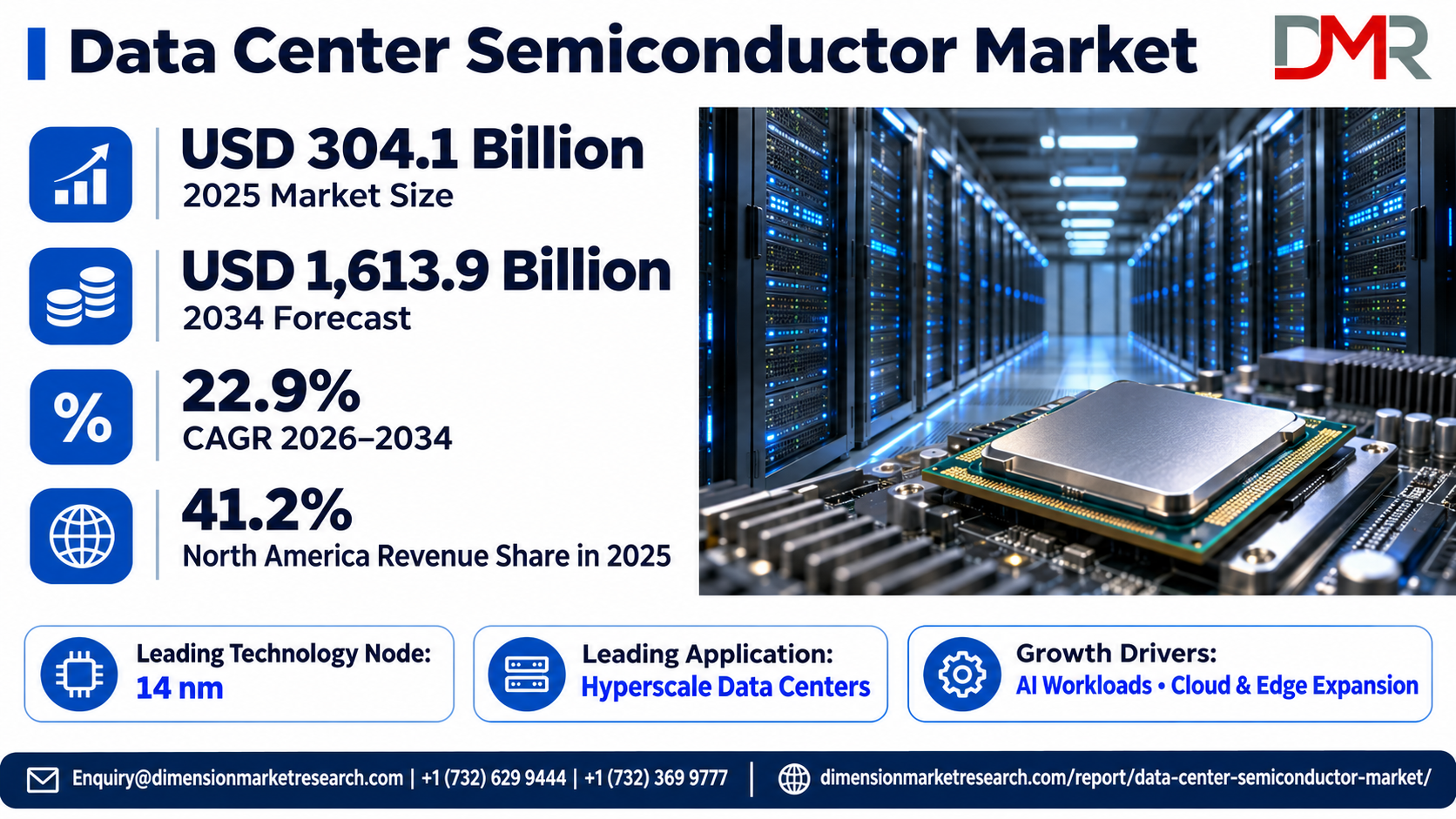
The Data Center Semiconductor Market Size reflects a change in how operators build computing capacity. Adding AI accelerators is only one part of the investment. Memory must feed data to those chips, network silicon must move it between servers, and power management devices must support the hardware within the facility’s electrical and cooling limits. That makes the design of the whole system increasingly important to semiconductor buyers.
According to Dimension Market Research, the global market was estimated at USD 252.2 billion in 2025 and is projected to reach USD 1,613.9 billion by 2034, at a CAGR of 22.9%. Demand comes from AI, cloud computing, analytics, and distributed infrastructure. The AI Data Center Market, Green Data Center Market, and Edge Data Center Market add three perspectives on that demand: how operators scale compute, manage power, and place workloads closer to users and devices.
What does the Data Center Semiconductor Market cover?
The market includes processors, memory, storage controllers, networking chips, and power and analog semiconductors deployed in data centers. CPUs handle general-purpose workloads, while GPUs and specialized chips support parallel or application-specific tasks. Memory and storage supply the data those processors use. Network chips move data between servers, and power management chips help deliver electricity to the hardware. Each component affects what a server or rack can deliver in practice.
Which segments lead, and where is demand growing fastest?
● Processors led by component, with an estimated 43.5% share in 2025. Their role spans general-purpose cloud services, virtualization, AI training, and inference.
● Compute led by function, with an estimated 46.2% share in 2025. Networking was identified as the fastest-growing function as distributed workloads increased demand for faster interconnects.
● The 14 nm node led by technology, with an estimated 41.8% share in 2025. Sub-7 nm nodes were identified as the fastest-growing technology segment, supported by demand for advanced accelerators and custom chips.
Get a Free Customized Sample of This or Any Other Market Research Report
https://dimensionmarketresearch.com/request-sample/data-center-semiconductor-market/
Why do AI data centers need more than accelerators?
A cluster can have powerful accelerators and still lose time waiting for data. Memory bandwidth determines how quickly processors can access it, while networking determines how efficiently servers exchange it. The semiconductor report identifies memory as the fastest-growing component category. The AI Data Center Market report also projects that hyperscale and cloud facilities will lead its deployment breakdown with a 48.2% share in 2026. For procurement teams, the combination makes memory and network capability part of the accelerator decision from the outset.
How do energy efficiency and edge deployment shape chip selection?
The Green Data Center Market highlights investment in more efficient power and cooling systems. At the chip level, performance per watt affects how much useful work a rack can support within its power and cooling limits. For an operator planning a hardware refresh, comparing processors on peak speed alone can miss a cost that shows up at facility scale. Power delivery chips and the thermal design of the server also influence which configurations can be deployed.
The Edge Data Center Market reflects a different placement decision. Processing closer to devices can reduce latency for workloads such as factory automation or real-time analytics. Smaller distributed sites can also have tighter space and power constraints. That creates a reason to evaluate compact computing hardware alongside networking and power management. The right configuration depends on which workloads need an immediate local response and which can be handled at a larger facility.
Where is semiconductor demand concentrated?
North America led the 2025 estimate with 41.2% of global revenue, supported by hyperscale cloud investment and an established semiconductor industry. Asia-Pacific is identified as the fastest-growing region as countries including China, India, South Korea, and Singapore expand cloud and data infrastructure. The report covers companies including NVIDIA, AMD, Intel, Broadcom, Micron, SK hynix, and TSMC, reflecting the roles of chip designers, memory suppliers, and foundries.
Explore the Complete Data Center Semiconductor Market Analysis
https://dimensionmarketresearch.com/checkout/data-center-semiconductor-market/
Frequently Asked Questions
What was the estimated Data Center Semiconductor Market Size in 2025?
The global market was estimated at USD 252.2 billion.
How large is the market projected to be by 2034?
It is projected to reach USD 1,613.9 billion, at a CAGR of 22.9% from 2025 to 2034.
Which component held the largest share?
Processors led with an estimated 43.5% share in 2025.
Which region led the market in 2025?
North America led with an estimated 41.2% of global revenue.
Which semiconductor function is growing fastest?
The report identifies networking as the fastest-growing function, supported by demand for faster data movement across distributed systems.
Conclusion
AI investment is increasing demand across processors, memory, networking, and power management. Advanced nodes support newer accelerators, while mature nodes remain important for many mainstream server components. For operators, the practical measure of an upgrade is how much work the complete system can deliver within its bandwidth, power, and cooling limits.
Related Data Center Research
The AI Data Center Market Size is estimated at USD 445.4 billion in 2026 and projected to reach USD 4,250.1 billion by 2035, at a CAGR of 28.5%. The study covers infrastructure for AI training and inference.
The Green Data Center Market Share report examines the technologies used to improve facility efficiency. It projects the market to rise from USD 46.4 billion in 2026 to USD 426.9 billion by 2035.
The Edge Data Center Market Growth forecast puts the market at USD 51.2 billion by 2034, up from an estimated USD 11.0 billion in 2025, at a CAGR of 18.7%. Low-latency computing and distributed data processing support demand.

 English
 Arabic
 Spanish
 Portuguese
 Deutsch
 Turkish
 Dutch
 Italiano
 Russian
 Romaian
 Portuguese (Brazil)
 Greek