
Trade Management Market to Reach USD 2.63 Billion by 2034: AI and Automation Transform Global Trade Operations
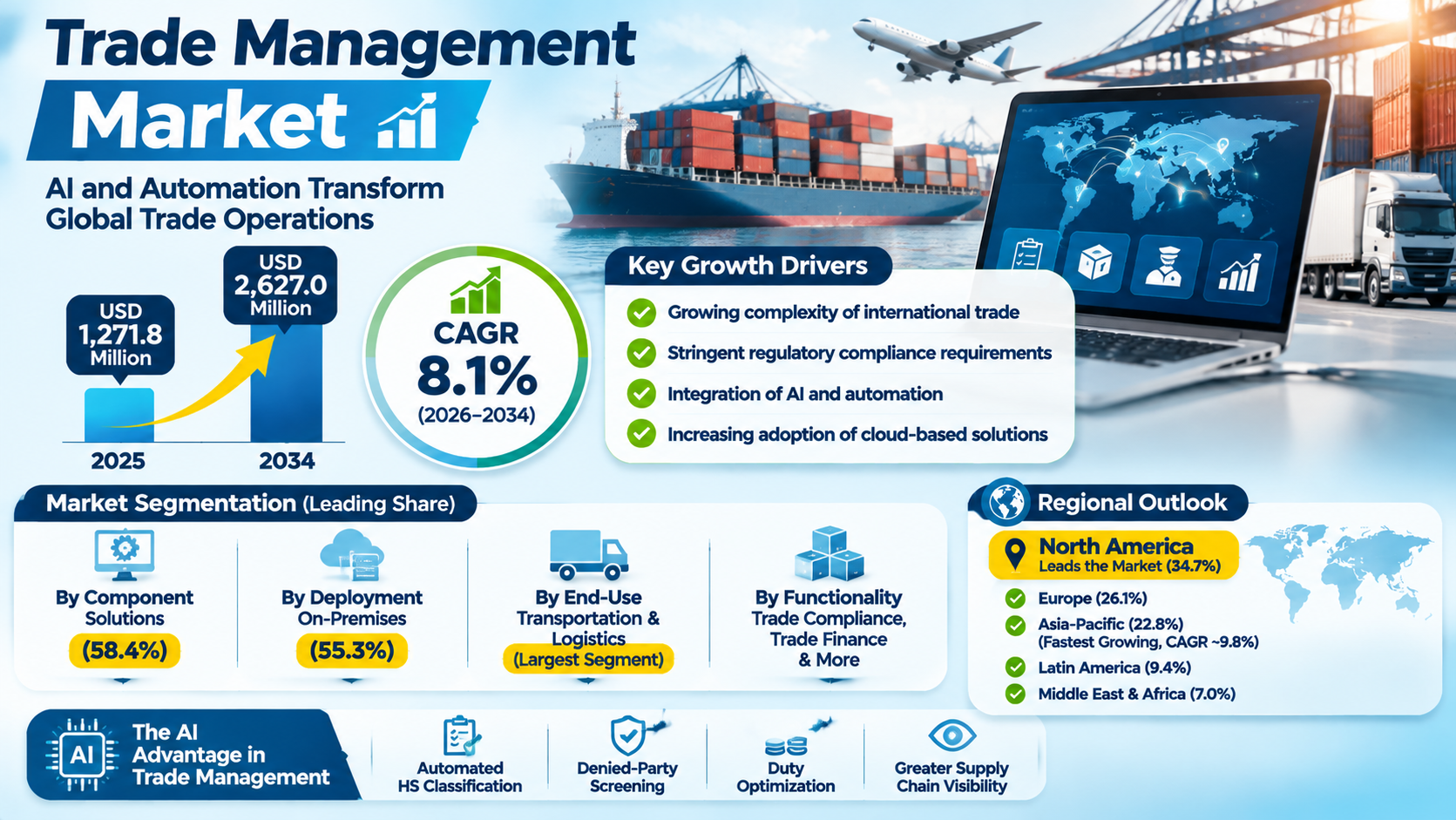
The global trade management market size reached USD 1,271.8 million in 2025 and is projected to reach USD 2,627.0 million by 2034, growing at a CAGR of 8.1% during 2026–2034. The market has expanded from USD 861.8 million in 2020, reflecting the increasing importance of digital solutions in international trade operations.
As businesses expand across borders, managing customs procedures, regulatory requirements, tariffs and international supply chains is becoming increasingly complex. Trade management solutions are helping enterprises streamline import-export operations, improve regulatory compliance and gain better visibility across global supply networks.
Technology is also changing the industry. Artificial intelligence, cloud computing, blockchain and automation are creating new opportunities for companies to simplify trade processes and improve operational efficiency.
What Is Driving the Growth
Four major forces explain most of the momentum:
-
Increasing complexity of international trade. Globalization has expanded cross-border supply chains, requiring businesses to manage suppliers, customers and regulatory requirements across multiple countries. Trade management platforms help enterprises handle tariffs, customs regulations, trade agreements and import-export documentation more efficiently.
-
Stringent regulatory compliance requirements. Governments and customs authorities are strengthening import-export monitoring and documentation requirements. Enterprises are increasingly adopting specialized solutions to manage customs declarations, trade restrictions, export controls and regulatory obligations across different jurisdictions.
-
Integration of AI and automation. Artificial intelligence is transforming trade management by automating product classification, denied-party screening and duty optimization. These technologies help businesses reduce manual errors, improve compliance processes and accelerate customs-related workflows.
-
Growing adoption of cloud-based solutions. Cloud-native trade management platforms provide real-time visibility, faster regulatory updates and improved collaboration with international logistics partners. Subscription-based solutions are also helping businesses reduce technology infrastructure costs and simplify deployment.
Want the segment-level numbers behind this? Get a free sample of the report.
Where the Market Stands Today
By component, the market is divided into solutions and services. Solutions account for the largest share, representing 58.4% of the global market in 2025. Their dominance reflects growing enterprise adoption of integrated platforms covering customs compliance, import-export documentation, tariff classification, trade analytics and free trade agreement management. Services account for the remaining 41.6%, supported by demand for consulting, implementation and managed trade compliance services.
By functionality, the market includes trade function, trade compliance, trade finance, trade consulting and others. These functionalities help businesses manage international transactions, regulatory requirements, financial processes and trade-related advisory activities.
By deployment type, the market is categorized into cloud-based and on-premises solutions. On-premises deployment leads with a 55.3% market share in 2025. Businesses operating in regulated industries, including aerospace and defense, healthcare and government contracting, continue to rely on these systems to maintain control over sensitive trade information and meet data governance requirements. Meanwhile, cloud-based deployment is the fastest-growing category, projected to expand at approximately 9.7% CAGR during 2026–2034.
By enterprise size, the market is divided into small and medium-sized enterprises (SMEs) and large enterprises. Both groups are increasingly adopting trade management technologies to streamline international operations, manage compliance obligations and improve supply chain visibility.
By end-use sector, the market covers retail and consumer goods, transportation and logistics, aerospace and defense, healthcare, manufacturing and others. Transportation and logistics represents the leading end-use sector, reflecting the importance of customs documentation, shipment visibility and regulatory coordination in international freight operations.
Our Take: AI Is Becoming the New Competitive Advantage
International trade involves numerous processes, from product classification and customs declarations to tariff calculations, sanctions screening and trade documentation. Managing these activities manually can create operational inefficiencies and increase the risk of compliance errors.
Artificial intelligence and automation are changing this landscape. AI-powered systems can automate Harmonized System (HS) code classification, identify potential compliance risks and support duty optimization. Machine learning also helps improve denied-party screening and reduce unnecessary manual reviews.
Cloud computing is another important development. Businesses increasingly require platforms that can provide real-time regulatory updates and integrate with enterprise resource planning systems, freight management solutions and customs authorities. Blockchain technology is also creating opportunities in trade finance, particularly in letter of credit management and origin certification.
Several developments highlighted in the report illustrate how established technology providers are strengthening their trade management capabilities. In 2025, SAP introduced its S/4HANA 2025 Cloud Private Edition with enhanced trade management capabilities, allowing organizations to improve output management, automation and transparency in global trade operations. During the same year, Oracle announced new trade management features in its Fusion Cloud Supply Chain and Manufacturing solution to enhance automation, shipment visibility and decision-making across international supply chains.
Our view is that the competitive advantage will increasingly belong to companies that combine regulatory expertise with AI-powered automation, cloud-native architecture and integrated supply chain visibility. As international trade regulations continue to evolve, the ability to deliver timely compliance updates and reliable trade intelligence will become increasingly important.
Regional Outlook
-
North America holds the largest market share, accounting for 34.7% of global revenue in 2025. The region benefits from stringent customs enforcement, USMCA compliance requirements, substantial enterprise technology adoption and complex import-export regulations in the United States.
-
Europe accounts for 26.1% of the global market. Its demand is supported by the European Union's customs framework, post-Brexit trade restructuring, Carbon Border Adjustment Mechanism (CBAM) requirements and regulatory compliance across member countries.
-
Asia-Pacific represents 22.8% of the market and is the fastest-growing region, with an expected CAGR of approximately 9.8% during the forecast period. Regional trade expansion, cross-border e-commerce, RCEP implementation and digitalization initiatives in India are supporting demand.
-
Latin America accounts for 9.4% of the global market. Customs modernization in Brazil, nearshoring activities in Mexico and evolving regional trade compliance requirements are contributing to market development.
-
Middle East and Africa represent 7.0% of the market. Trade facilitation initiatives, GCC digitalization mandates, Saudi Vision 2030 and the African Continental Free Trade Area are creating opportunities for trade management technology providers.
Who Is Competing
The global trade management market features established enterprise software companies alongside specialized trade compliance and supply chain technology providers. Competition revolves around regulatory content coverage, AI-powered automation, ERP integration, customs management capabilities and international market reach.
The report profiles SAP SE, Oracle, e2open, LLC., The Descartes Systems Group Inc., Kinaxis Inc., LSEG and MIC Datenverarbeitung GmbH.
SAP and Oracle maintain strong positions through their enterprise software ecosystems and integrated trade management platforms. E2open focuses on combining global trade compliance with supply chain visibility, while Descartes emphasizes customs filing and logistics integration. Kinaxis provides supply chain planning and risk management capabilities, LSEG offers trade content and sanctions screening solutions, and MIC specializes in European customs management.
Competition is moderately concentrated, with the five leading vendors collectively accounting for approximately 55–60% of global market revenue in 2025. High switching costs associated with ERP integration and long-term enterprise software agreements support the position of established providers. However, specialized vendors continue to serve regional and industry-specific requirements.
Opportunities and Challenges
Opportunities. AI-driven trade compliance automation represents a significant growth opportunity. Automated HS classification, sanctions screening, duty optimization and free trade agreement utilization can help enterprises simplify complex international trade processes.
Cloud-based deployment is another important opportunity, particularly among SMEs seeking affordable subscription-based platforms. With cloud-based solutions projected to grow at approximately 9.7% CAGR during 2026–2034, providers have opportunities to expand their customer base through scalable software offerings.
The Asia-Pacific SME segment also presents considerable potential as businesses increasingly participate in cross-border trade. Similarly, the implementation of the African Continental Free Trade Area is creating demand for trade agreement management, origin certification and customs automation.
Blockchain-based trade finance integration and real-time supply chain risk intelligence are additional areas attracting investment and technological development.
Challenges. Data security and sovereignty concerns remain important barriers to adoption, particularly in regulated industries handling sensitive shipment information and export-controlled data. Businesses must also address the high implementation and integration costs associated with connecting trade management platforms to existing ERP systems, customs portals and freight management solutions.
Geopolitical trade policy volatility presents another challenge. Frequent changes in tariffs, export controls, trade restrictions and sanctions lists require providers to continuously update their regulatory databases and compliance systems. The fragmented nature of international customs regulations also increases the complexity of maintaining accurate trade intelligence across multiple countries.
What This Means for You
-
If you are an investor, look at companies developing AI-powered compliance automation, cloud-native trade platforms and integrated trade finance solutions. These areas represent important growth opportunities through 2034.
-
If you are an enterprise, evaluate trade management solutions that can improve customs compliance, automate documentation and provide better visibility across international supply chains.
-
If you are a technology provider, cloud-based deployment, AI-driven classification and regulatory intelligence offer opportunities to expand your product capabilities and customer base.
-
If you work in transportation and logistics, integrated trade management platforms can help streamline customs procedures, improve shipment visibility and support international regulatory compliance.
Trade Management Market FAQs
How big is the global trade management market? According to IMARC Group, the global trade management market reached USD 1,271.8 million in 2025.
What is the future outlook for the trade management market? The market is projected to reach USD 2,627.0 million by 2034, growing at a CAGR of 8.1% during 2026–2034.
What is driving the trade management market? Increasing complexity in international trade, stringent regulatory compliance requirements, AI and automation integration, and growing adoption of cloud-based platforms are the major growth drivers.
Which component leads the trade management market? Solutions represent the largest component, accounting for 58.4% of market revenue in 2025.
Which deployment type dominates the market? On-premises deployment leads with a 55.3% market share in 2025. However, cloud-based deployment is the fastest-growing category, with an expected CAGR of approximately 9.7%.
Which region holds the largest market share? North America leads the global trade management market, accounting for 34.7% of revenue in 2025.
Which region is growing the fastest? Asia-Pacific is the fastest-growing region, with a projected CAGR of approximately 9.8% through 2034.
Who are the key companies in the trade management market? Major players include SAP SE, Oracle, e2open, LLC., The Descartes Systems Group Inc., Kinaxis Inc., LSEG and MIC Datenverarbeitung GmbH.
How is AI transforming trade management? AI is automating HS code classification, denied-party screening, duty optimization and compliance documentation, helping enterprises reduce manual workloads and improve trade operations.
What opportunities exist in the trade management market? Major opportunities include cloud-native platforms for SMEs, AI-driven compliance automation, blockchain-enabled trade finance and expanding demand across emerging markets.
Conclusion
The global trade management market is expected to more than double between 2025 and 2034, supported by increasing international trade complexity, stricter regulatory requirements and the growing adoption of digital technologies. Solutions currently dominate the component segment, while on-premises deployment maintains the leading position despite faster growth in cloud-based platforms. North America remains the largest regional market, whereas Asia-Pacific is expected to record the fastest growth.
Looking ahead, AI-powered compliance automation, blockchain-based trade finance and real-time supply chain visibility are expected to reshape the competitive landscape. Companies that combine technological innovation with comprehensive regulatory intelligence and integrated enterprise capabilities will be better positioned to capture opportunities in the expanding global trade management market.
The full report covers historical trends from 2020, uses 2025 as the base year and provides forecasts through 2034, including analysis across component, functionality, deployment type, enterprise size, end-use sector and region.
Need the numbers behind this analysis? Speak to an analyst.
This article is for informational purposes only.
About the Author
IMARC Group is a leading global market research company providing data-driven insights and expert consulting services to businesses seeking to achieve their strategic objectives. With a multi-disciplinary team of industry experts, IMARC delivers thorough, reliable market intelligence across sectors including Healthcare, Food and Beverages, Chemicals and Materials, Consumer Goods, and more.
Media & Sales Contact
IMARC Group
United States: +1-201-971-6302
India: +91-120-433-0800
United Kingdom: +44-753-714-6104

 English
 Arabic
 French
 Spanish
 Portuguese
 Deutsch
 Turkish
 Dutch
 Russian
 Romaian
 Portuguese (Brazil)
 Greek