
United States Supply Chain Analytics Market Size Projected to Reach USD 14,650.7 Million by 2034 with a CAGR of 20.14%
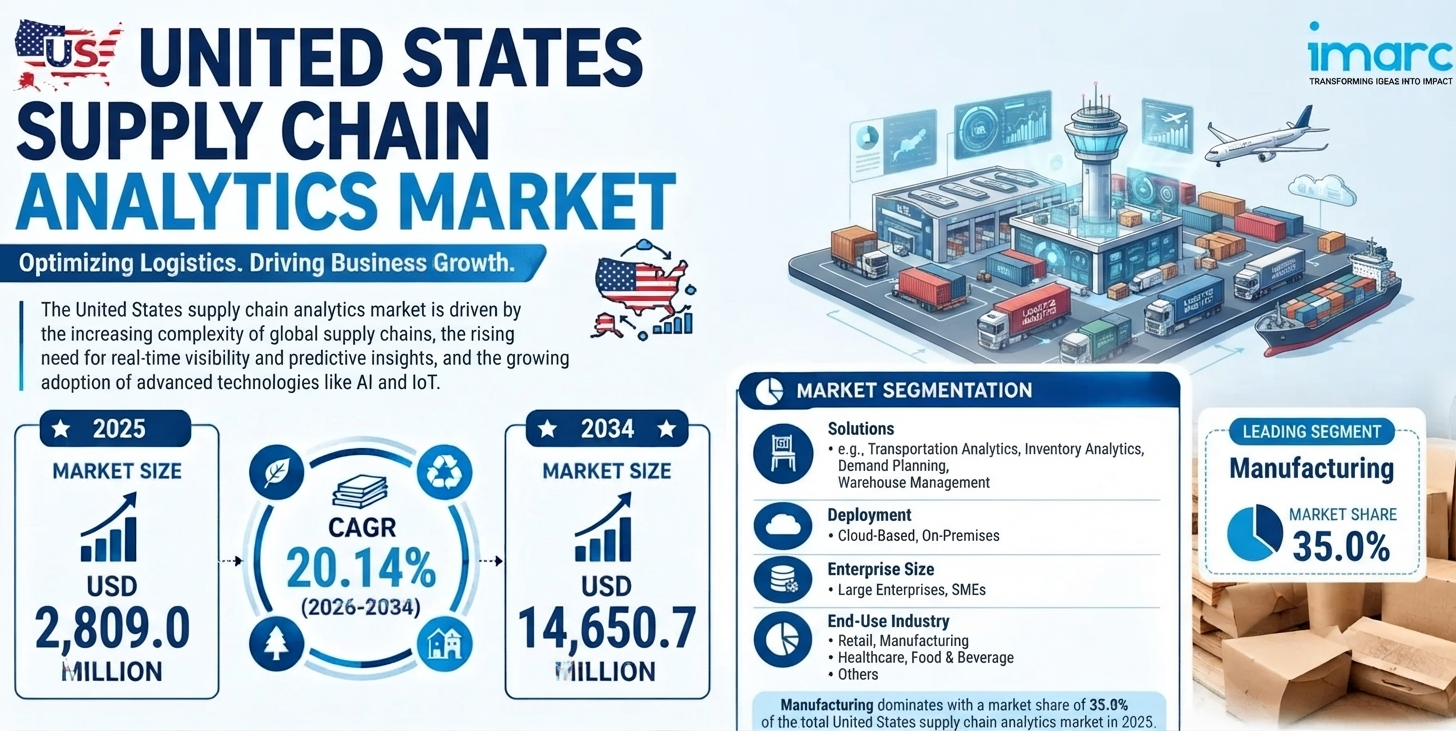
IMARC Group has recently released a new research study titled “United States Supply Chain Analytics Market Report by Component, Deployment Mode, Enterprise Size, Industry Vertical, and Region, 2026-2034,” that offers a detailed analysis of the market drivers, segmentation, growth opportunities, trends and competitive landscape to understand the current and future market scenarios.
United States Supply Chain Analytics Market Size, Growth, and Forecast (2026-2034)
The united states supply chain analytics market size reached USD 2,809.0 Million in 2025 and is projected to reach USD 14,650.7 Million by 2034, growing at a CAGR of 20.14% during 2026-2034. The integration of artificial intelligence (AI) and machine learning (ML) technologies, which enables more accurate demand forecasting, predictive maintenance and process optimization, is the primary factor driving the us supply chain analytics market.
Supply chain analytics involves the use of data analysis and technological tools to improve the efficiency and performance of supply chain processes. It covers the collection, interpretation and application of data across areas such as inventory management, demand forecasting and logistics, using advanced analytics, machine learning and statistical modeling.
By turning supply chain data into insight, organizations can minimize costs, reduce risks, improve customer satisfaction and adapt to dynamic market conditions. Transportation and logistics analytics, including forecasting arrival times and flagging disruptions, is a growing focus area within the us transportation predictive analytics market.
Explore Growth Opportunities in the United States Supply Chain Analytics Market - Grab Your Sample Report for Evaluation: https://www.imarcgroup.com/united-states-supply-chain-analytics-market/requestsample
Key Trends Driving the United States Supply Chain Analytics Market
-
Integration of AI and machine learning: AI and ML technologies are propelling demand for analytics solutions by helping organizations draw actionable insights from vast datasets. They enable more accurate demand forecasting, predictive maintenance and optimization of processes across the supply chain.
-
Rising supply chain complexity and data-driven decision-making: The increasing complexity of regional supply chains is necessitating advanced analytics tools to manage intricate networks. The growing prevalence of data-driven decision-making is further underscoring the importance of analytics in optimizing performance.
-
Focus on cost reduction and resource optimization: Companies are adopting supply chain analytics to identify areas for improvement, streamline processes and make better use of resources, which is steadily lifting the us supply chain analytics market.
-
Predictive analytics and real-time visibility: Growing awareness of the value of predictive analytics in forecasting demand and mitigating risks, along with the need for real-time visibility into supply chain performance, is driving adoption. This also supports the us transportation predictive analytics market, where businesses seek to anticipate delays and address challenges proactively.
United States Supply Chain Analytics Market Report Segmentation:
The United States Supply Chain Analytics Market report provides a detailed segmentation analysis to help businesses identify key growth segments and evolving industry dynamics. The market is categorized based on component, deployment mode, enterprise size, industry vertical, and region, offering comprehensive insights across the us supply chain analytics market.
Component Insights:
-
Software: Software, covering demand analysis and forecasting, supplier performance analytics, spend and procurement analytics, inventory analytics, and transportation and logistics analytics, provides the core analytical capabilities used to plan, monitor and optimize supply chain activity.
-
Services: Services, including professional services and support and maintenance, help organizations implement, integrate and operate analytics platforms and sustain their performance over time.
Deployment Mode Insights:
-
On-premises: On-premises deployments give organizations direct control over data, security and system configuration, and remain relevant for enterprises with strict governance or legacy infrastructure requirements.
-
Cloud-based: Cloud-based deployments offer scalability, faster implementation and easier access to advanced analytics, supporting real-time visibility and collaboration across supply chain partners.
Enterprise Size Insights:
-
Large Enterprises: Large enterprises operate complex, multi-tier supply chains and are early adopters of advanced analytics for forecasting, risk management and cost optimization.
-
Small and Medium-sized Enterprises: Small and medium-sized enterprises are increasingly adopting analytics as cloud-based, scalable solutions make advanced capabilities more accessible and affordable.
Industry Vertical Insights:
-
Automotive, Manufacturing, and Transportation and Logistics: These sectors use analytics to manage supplier networks, production planning, inventory and freight movements, where timing and visibility are critical.
-
Food and Beverages, Healthcare and Pharmaceuticals, Retail and Consumer Goods, and Others: These sectors rely on analytics for demand forecasting, inventory accuracy, traceability and responsive fulfillment across fast-moving and time-sensitive products.
Regional Insights:
-
Northeast: The Northeast is home to dense commercial activity, major ports and a concentration of enterprises that rely on analytics to manage complex distribution networks.
-
Midwest: The Midwest is a central manufacturing and logistics corridor, where analytics supports production planning, inventory control and freight coordination.
-
South: The South benefits from expanding logistics hubs, ports and growing consumer demand, supporting adoption of analytics across distribution and transportation.
-
West: The West combines technology-led enterprises with major trade gateways, creating strong demand for advanced and AI-enabled supply chain analytics.
United States Supply Chain Analytics Market: Recent News and Developments
-
April 2026: project44 acquired LunaPath.ai in an all-cash transaction to accelerate AI agent orchestration across global supply chains, embedding execution-focused agents into its logistics data graph to turn predictive insights into autonomous action.
-
June 2026: Blue Yonder reported 30 new customer logos in the first quarter of 2026 and expanded AI functions for manufacturing planning and transportation management, including issue detection, active load monitoring, weather-linked alerts and backhaul identification.
Challenges Impacting the United States Supply Chain Analytics Market
Supply chain data often sits across disconnected systems such as enterprise resource planning, transportation management, visibility and e-commerce platforms. Integrating and cleaning this data is a persistent hurdle for organizations seeking reliable analytics.
Confidence in supply chain readiness is also tempering adoption plans. Blue Yonder's 2026 Supply Chain Compass study found that 66% of leaders believe they are ready for the future, down from 73% in the previous report, pointing to gaps in skills, processes and technology maturity.
Investment Opportunities in the United States Supply Chain Analytics Market
The us supply chain analytics market presents compelling investment opportunities supported by its projected growth from USD 2,809.0 Million in 2025 to USD 14,650.7 Million by 2034. AI-powered demand forecasting, inventory analytics and supplier performance analytics represent high-value opportunities as organizations seek more accurate and automated decision-making.
The us transportation predictive analytics market offers a growing investment frontier, spanning predictive arrival times, disruption forecasting and logistics orchestration. Cloud-based platforms and services that help enterprises integrate and operationalize analytics can build strong competitive positions in this expanding market.
Outlook of the United States Supply Chain Analytics Market (2026-2034)
The outlook for the us supply chain analytics market is positive, supported by the integration of AI and ML, rising supply chain complexity and the need for real-time visibility. The market is projected to grow from USD 2,809.0 Million in 2025 to USD 14,650.7 Million by 2034 at a CAGR of 20.14% during 2026-2034.
Continued adoption of predictive analytics, growth in cloud-based deployments and deeper use of AI across planning and transportation will be the defining trends shaping the us supply chain analytics market through 2034.
Key Players in the United States Supply Chain Analytics Market
The us supply chain analytics market is served by a mix of global supply chain software providers and specialized analytics platforms competing on the basis of AI capabilities, platform breadth and network connectivity.
- Blue Yonder: A supply chain software provider serving more than 3,000 retailers, manufacturers and logistics service providers, Blue Yonder expanded AI-driven planning and transportation management capabilities in 2026 and has built out its portfolio through acquisitions, including One Network Enterprises for approximately USD 839 million.
- project44: A decision intelligence platform for supply chains, project44 connects over 1.5 billion shipments annually for more than 1,000 brands and acquired LunaPath.ai in April 2026 to strengthen AI agent orchestration, reinforcing its position in predictive ETAs and transportation analytics.
Frequently Asked Questions (FAQs): United States Supply Chain Analytics Market
1. What is the current united states supply chain analytics market size?
The united states supply chain analytics market size reached USD 2,809.0 Million in 2025 and is projected to reach USD 14,650.7 Million by 2034, growing at a CAGR of 20.14% during 2026-2034.
2. What is supply chain analytics?
Supply chain analytics is the use of data analysis and technological tools to improve the efficiency and performance of supply chain processes, covering areas such as inventory management, demand forecasting and logistics.
3. What are the key drivers of the us supply chain analytics market?
Key drivers include the integration of AI and machine learning, the increasing complexity of supply chains, data-driven decision-making, cost reduction and resource optimization, and the need for predictive analytics and real-time visibility.
4. What segments are covered in the us supply chain analytics market and the us transportation predictive analytics market?
The report segments the market by component (software and services), deployment mode (on-premises and cloud-based), enterprise size, industry vertical and region. Transportation and logistics analytics is one of the software solutions covered.
5. Who are the key players in the us supply chain analytics market?
Key players in the us supply chain analytics market include Blue Yonder and project44, alongside other global software providers and specialized analytics platforms.
Author IMARC Group
IMARC Group is a global management consulting firm that helps the world's most ambitious changemakers to create a lasting impact. The company provide a comprehensive suite of market entry and expansion services. IMARC offerings include thorough market assessment, feasibility studies, company incorporation assistance, factory setup support, regulatory approvals and licensing navigation, branding, marketing and sales strategies, competitive landscape and benchmarking analyses, pricing and cost research, and procurement research.
Contact Us
IMARC Group,
134 N 4th St. Brooklyn, NY 11249, USA,
Email: [email protected],
United States: +1-201971-6302

 English
 Arabic
 French
 Spanish
 Portuguese
 Deutsch
 Turkish
 Dutch
 Italiano
 Russian
 Romaian
 Portuguese (Brazil)