
Why Website Architecture Matters for Long-Term Search Visibility
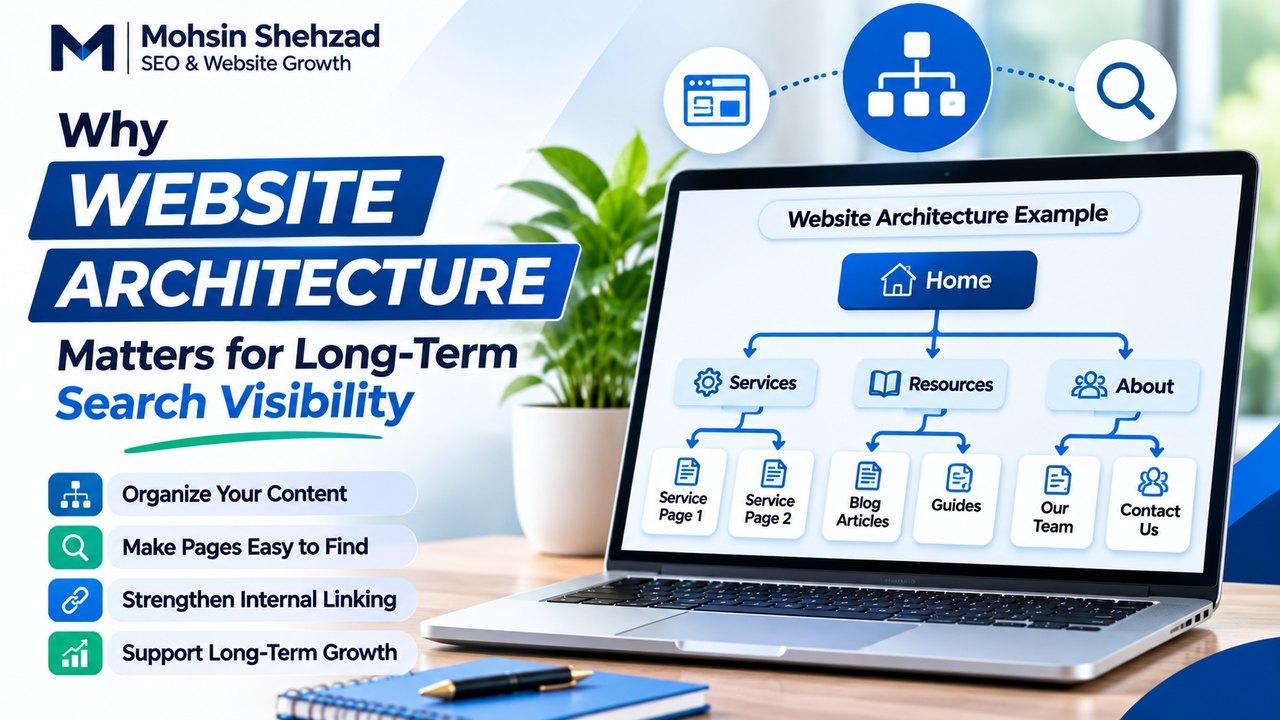
A website can publish valuable content and still struggle to achieve consistent organic search visibility. One common reason is poor website architecture. When important pages are difficult to find, categories overlap, or internal links lack direction, both visitors and search engines may struggle to understand the website.
Website architecture refers to how pages, categories, navigation menus, and internal links are organized. A logical structure makes information easier to discover and helps businesses manage their websites as they grow.
For long-term SEO, website architecture is not simply a technical consideration. It influences content accessibility, user experience, and the relationships between important pages.
What Is Website Architecture in SEO?
Website architecture is the organizational framework connecting different sections and pages of a website.
It includes navigation menus, category structures, internal links, URL organization, and the pathways visitors use to find information.
For example, a service website might organize its content into primary services, individual service pages, educational resources, and contact information.
These sections should connect logically rather than exist as isolated collections of URLs.
Flat and Deep Website Structures
A relatively flat structure allows important pages to be reached through a manageable number of navigation steps.
A deeply nested structure may require visitors to move through several categories before reaching useful information.
Neither approach should be judged by an arbitrary click-depth rule. The objective is to make important content accessible and navigation understandable.
How Website Structure Supports Search Engine Crawling
Search engines discover website content partly by following links between pages.
When important pages are connected through crawlable navigation and contextual links, search engines have clearer pathways for discovering them.
Poorly connected pages may be harder to find, particularly on larger websites.
Understanding Orphan Pages
An orphan page has no discoverable internal links pointing to it.
Although search engines might encounter such a page through a sitemap or external reference, relying on those methods alone is not ideal.
Important pages should generally be connected to relevant areas of the website.
Supporting Indexing Without Guarantees
Clear architecture can improve content discovery, but indexing depends on additional factors.
Page quality, technical accessibility, canonical settings, and search engine decisions also matter.
A well-organized website does not automatically receive higher rankings or guaranteed indexing.
Building a Logical Website Hierarchy
An effective hierarchy groups related information according to the needs of visitors.
Primary navigation should highlight important sections, while supporting pages provide more detailed information.
Businesses planning a website restructure may benefit from professional SEO website optimization guidance when evaluating navigation, internal linking, and the relationship between service pages and supporting content.
Organizing Service Pages
A professional services website can use a main services section to introduce its offerings.
Individual service pages can then explain specific solutions, processes, and relevant customer questions.
This approach gives each page a distinct purpose while maintaining clear connections between related services.
Creating Useful Content Categories
Blog categories should represent meaningful subjects rather than every possible keyword variation.
For example, technical SEO, content strategy, and website analytics may be useful categories for an SEO-focused website.
Avoid creating unnecessary categories containing only repetitive or unrelated articles.
Why Internal Linking Matters for Website Architecture
Internal links connect pages within the same website and help establish relationships between topics.
They also provide visitors with convenient access to additional information.
A service page might link to a relevant educational guide, while that guide may help readers discover the corresponding service.
Using Descriptive Anchor Text
Anchor text should explain the destination page naturally.
A link labelled "technical SEO audit guide" provides clearer context than a generic instruction such as "click here."
However, repeating exact-match keyword anchors excessively can make content unnatural.
Internal links should support navigation and understanding rather than exist solely for keyword targeting.
Creating Clear and Descriptive URL Structures
URLs help visitors recognize the subject of a page and understand its location within a website.
Descriptive addresses are generally easier to interpret than URLs containing unclear identifiers.
For example, a URL ending in /services/technical-seo/ communicates its subject more clearly than one ending in a random string.
However, URL structure alone does not determine how Google understands a website's hierarchy.
Internal links and navigation remain important.
Businesses should also avoid changing established URLs without a genuine reason, because unnecessary migrations can introduce redirects, broken links, and temporary search disruption.
Improving Navigation for Mobile Visitors
Website architecture should work across desktop and mobile devices.
Visitors using smaller screens need accessible menus, readable category labels, and clear pathways to important information.
Complicated navigation can make it difficult to locate services or educational resources.
Mobile navigation should preserve access to essential pages rather than hide important content behind unreliable interactions.
Testing navigation on different devices helps identify practical usability problems before they affect visitors.
Using XML Sitemaps and Breadcrumbs Effectively
XML sitemaps provide search engines with information about URLs a website considers important.
They can support discovery, particularly for larger websites, but do not replace internal linking or guarantee indexing.
Breadcrumb navigation shows visitors where a page fits within the website.
For example, a breadcrumb trail might connect the homepage, services section, and an individual service page.
This can improve orientation and make it easier to return to broader categories.
Both features should reflect the website's actual organization.
Maintaining Website Architecture as Content Grows
A structure that works for a small website may become confusing as new services, articles, and categories are added.
Businesses should periodically review navigation, broken links, overlapping pages, and outdated sections.
Google Search Console and website crawling tools can help identify technical problems requiring investigation.
New content should be assigned to appropriate categories and connected to relevant existing pages.
Regular maintenance helps prevent isolated content and unnecessary structural complexity.
Conclusion
Website architecture plays an important role in long-term search visibility by connecting content, improving navigation, and supporting search engine discovery.
A logical hierarchy helps visitors find information while making relationships between website pages easier to understand.
Businesses should focus on accessible navigation, descriptive URLs, relevant internal links, and sustainable content organization.
Rather than frequently rebuilding their websites, they should maintain a structure that supports both current visitors and future growth.
Frequently Asked Questions
1. What is website architecture in SEO?
Website architecture describes how pages, categories, navigation menus, URLs, and internal links are organized within a website.
2. Does website architecture affect Google rankings?
Website structure can influence content discovery, navigation, and search engine understanding, but no particular architecture guarantees higher rankings.
3. What is an orphan page?
An orphan page is a page without discoverable internal links pointing to it, making it harder for visitors and search engines to find through normal navigation.
4. Are XML sitemaps enough for website indexing?
No. XML sitemaps can support URL discovery, but they do not guarantee indexing or replace accessible internal navigation.
5. How often should website architecture be reviewed?
Businesses should review their structure periodically, especially after adding major content sections, changing services, or identifying navigation and crawling problems.

 English
 Arabic
 French
 Spanish
 Portuguese
 Deutsch
 Dutch
 Italiano
 Russian
 Romaian
 Portuguese (Brazil)
 Greek