
Supplier Sustainability Assessments: How to Build One From Scratch
For most companies, the largest share of environmental and social risk sits outside their own gates, in the suppliers that provide materials, components and services. Customers, lenders and regulators increasingly expect a company to know how its suppliers perform, yet many procurement teams begin with nothing more than a generic questionnaire sent to everyone. The result is a pile of unread forms and no real insight.
This guide explains how to build a supplier sustainability assessment from scratch: what it is, how to design the criteria and questionnaire, how to score and tier suppliers, which established frameworks to borrow from, and how to treat smaller suppliers fairly. It uses the Malaysian context, where reporting rules and buyer requirements are pushing supplier data higher on the agenda, and presents differing views on how demanding an assessment should be.
What Is a Supplier Sustainability Assessment, and Why Do Companies Need One?
A supplier sustainability assessment is a structured way of collecting and evaluating information on how suppliers manage environmental, social and governance matters, so that a buyer can identify risks, set expectations and track improvement. Companies need one because their own emissions, compliance duties and reputation depend on what happens in the supply chain.
Why Do Supplier Assessments Matter for Emissions Reporting?
They matter because supplier activity often makes up most of a company's Scope 3 emissions, and Scope 3 disclosure is being phased in under the National Sustainability Reporting Framework. According to adviser summaries of the framework, first Scope 3 disclosures fall at around 2027 for the largest listed group, 2028 for other Main Market issuers and 2030 for the last group. A buyer that holds supplier data is better placed to meet these dates.
Why Do Social and Human Rights Risks Matter?
They matter because buyers face reputational and, in some markets, legal exposure for forced labour, unsafe conditions or illegal sourcing in their supply chains. Assessments help to identify these risks early, particularly in sectors with migrant labour, raw material sourcing or long subcontracting chains.
What Are the Main Purposes of an Assessment?
The main purposes are to screen new suppliers, rank existing suppliers by risk, gather data for reporting, set a basis for improvement plans and document due diligence. A good assessment serves several purposes at once, which is why it should be designed before any questionnaire is sent.
Is a Supplier Assessment the Same as a Supplier Audit?
No. An assessment is usually a desk-based review of self-reported information and documents, while an audit is a verification visit or independent check. Many companies use assessments to decide which suppliers need an audit, so the two work together.
How Do You Build a Supplier Sustainability Assessment From Scratch?
A supplier sustainability assessment is built in eight steps: set objectives, map suppliers, tier them by risk, define criteria, design the questionnaire, collect and verify evidence, score and tier results, and agree corrective actions. Starting with objectives and risk, rather than with a template, keeps the effort proportionate and useful.
1. Define the objectives, such as emissions data, legal compliance, customer requirements or human rights due diligence.
2. Map suppliers by spend, category, country and criticality.
3. Tier suppliers by sustainability risk and business importance.
4. Set the criteria and minimum expectations in a supplier code of conduct.
5. Design a questionnaire that matches each tier.
6. Collect responses and supporting evidence, and verify a sample.
7. Score results, assign suppliers to tiers and identify gaps.
8. Agree corrective action plans, follow up and review the assessment each year.
Why Start With Objectives?
Objectives determine what to ask and of whom. A company that needs Scope 3 data will ask different questions from one concerned about labour practices, and a buyer trying to answer a single customer's requirements will design a lighter assessment than one preparing a full due diligence process. Writing objectives first avoids long questionnaires that serve no clear purpose.
How Should Suppliers Be Mapped?
Suppliers should be listed with their spend, product or service, location, and how hard they would be to replace. This list is often the first time a company sees its supply base in one place. A simple spreadsheet is sufficient, and procurement and finance data usually provide most of what is needed.
Where Should the Process Begin: With All Suppliers or a Few?
It should begin with a limited group, often the highest-risk and highest-spend suppliers, not the whole base. A pilot with perhaps twenty to fifty suppliers reveals which questions work, how suppliers respond and how much follow-up effort is needed before scaling up.
What Should Be Documented?
The company should document the objectives, criteria, scoring method, responses received and actions agreed. This record shows regulators, customers and auditors that the process is deliberate and consistent, and it makes the next annual cycle faster.
What Should a Supplier Sustainability Assessment Questionnaire Cover?
A supplier sustainability assessment questionnaire should cover climate and energy, environmental management, labour and human rights, health and safety, business ethics and management systems, with questions matched to the supplier's tier and size. Keeping it short and evidence-based produces better answers than a long form that suppliers rush through.
|
Category |
Example questions |
Evidence to request |
|
Climate and energy |
Does the supplier measure Scope 1 and 2 emissions? Has it set reduction targets? |
Emissions calculation, energy bills, target statement |
|
Environmental management |
Does it hold environmental permits and manage waste and water? |
Licences, certificates such as ISO 14001, waste records |
|
Labour and human rights |
Are there policies against forced and child labour? How are workers recruited and paid? |
Policies, contracts, recruitment fee practices, payroll samples |
|
Health and safety |
Are incidents recorded and investigated? |
Incident log, safety training records |
|
Business ethics |
Is there an anti-corruption policy and a way to report concerns? |
Policy, training records, whistleblowing channel |
|
Management systems |
Who is responsible for sustainability? Are subcontractors checked? |
Organisation chart, supplier code, subcontractor list |
How Long Should the Questionnaire Be?
It should be as short as the objectives allow, ideally fewer than thirty questions for most suppliers, with a longer version only for high-risk tiers. Suppliers often receive questionnaires from many customers, so short, clear and well-targeted requests are answered more completely and more quickly.
Should Questions Be Open or Closed?
A mix works best: closed questions, such as yes or no and numerical data, for scoring, and a few open questions for context. Each important answer should be tied to a request for evidence, because unverified self-declarations can overstate performance.
What Should a Supplier Code of Conduct Say?
A supplier code of conduct should state the minimum expectations on labour rights, environmental compliance, ethics, health and safety and data sharing, and explain how compliance will be checked and what happens in case of breach. It gives the assessment a clear standard to measure against.
How Can Assessments Reuse Existing Standards?
They can reuse standards by accepting recognised certificates or completed assessments from other platforms, instead of asking suppliers to repeat information. Accepting an ISO 14001 certificate or an existing rating, with a check on scope and validity, reduces the burden and speeds up the process.
How Should Suppliers Be Scored, Tiered and Followed Up?
Suppliers should be tiered first by risk and importance, scored against the criteria with a simple, transparent method, and followed up with corrective action plans rather than automatic exclusion. Tiering focuses effort where risk and business dependence are highest.
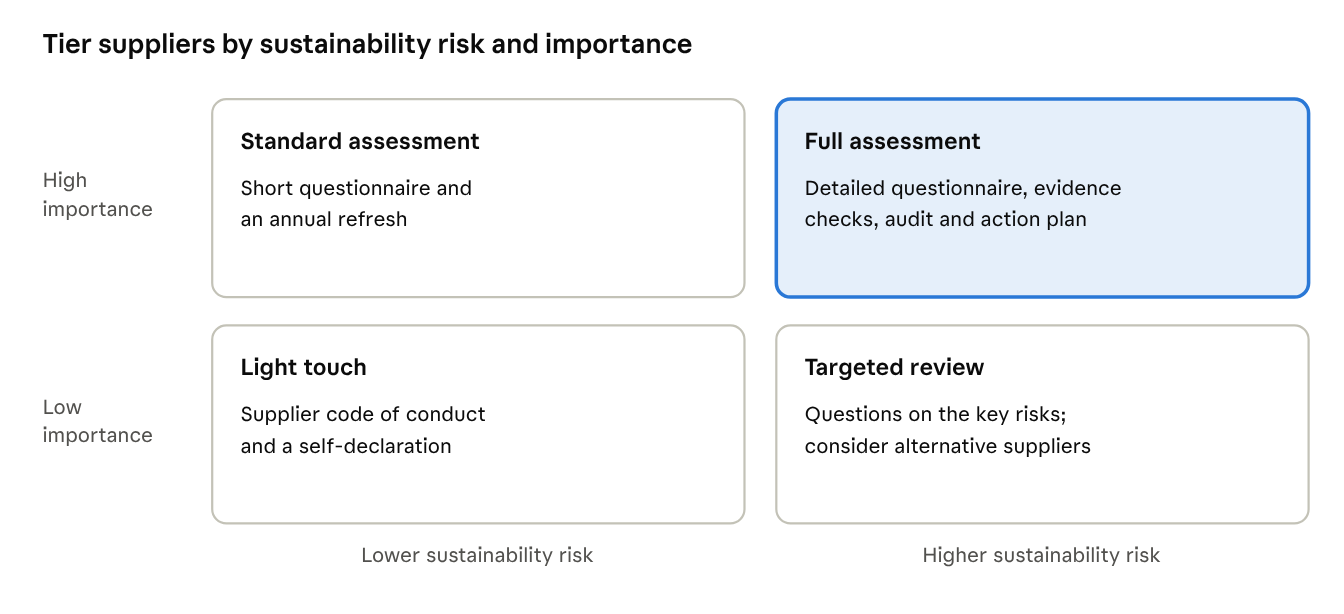
Supplier tiering matrix · 4 quadrants
The matrix gives each group a different level of effort, so the full process is reserved for the suppliers that need it.
How Should Risk Be Assessed?
Risk can be assessed by combining the supplier's country, sector, product, size and the nature of its operations, using publicly available indicators and the company's own experience. A supplier in a labour-intensive sector with long subcontracting chains, for example, will usually carry higher social risk than a small office-based service provider.
How Should Responses Be Scored?
Responses can be scored by assigning points to each answer and weighting categories by importance, producing a result such as a percentage or a rating band. The method should be simple enough to explain to suppliers, and critical issues, such as forced labour indicators, should trigger an automatic escalation regardless of the overall score.
How Is Evidence Verified?
Evidence is verified by reviewing documents, comparing answers with external information and, for higher tiers, carrying out on-site audits or using independent audit reports. Verifying a sample from each tier is a practical way to test whether self-declared answers can be trusted.
What Should Happen When a Supplier Scores Poorly?
The company should agree a corrective action plan with deadlines and support, and reserve termination for serious or uncorrected breaches. According to the OECD's Due Diligence Guidance for Responsible Business Conduct, companies are expected to prevent, mitigate and track adverse impacts, which in practice means working with suppliers to improve rather than simply walking away.
Which Existing Frameworks Can Be Used for a Supplier Sustainability Assessment?
A company building a supplier sustainability assessment can borrow from the OECD Due Diligence Guidance for Responsible Business Conduct, the ISO 20400 guidance on sustainable procurement, industry codes and shared assessment platforms. Using established frameworks saves design effort and makes the assessment more familiar to suppliers.
|
Framework |
What it offers |
Best used for |
|
OECD Due Diligence Guidance for Responsible Business Conduct |
A six-step due diligence process covering policy, risk identification, mitigation, tracking, communication and remediation |
Structuring the overall approach |
|
ISO 20400 |
Guidance on integrating sustainability into procurement, not a certifiable standard |
Building procurement policy and governance |
|
Industry codes, such as the Responsible Business Alliance Code of Conduct |
Sector-specific expectations on labour, health and safety, environment and ethics |
Setting criteria in electronics and similar sectors |
|
Shared platforms, such as Sedex, EcoVadis and CDP supply chain |
Standard questionnaires, ratings or climate data requests shared across many buyers |
Reducing duplicate requests and benchmarking |
How Does the OECD Guidance Help?
The OECD guidance gives a practical sequence that a company can follow. According to the OECD, the process involves embedding responsible conduct into policies and management systems, identifying and assessing adverse impacts, stopping or mitigating them, tracking results, communicating how impacts are addressed and providing for remediation where appropriate. It is widely used as the reference model for supply chain due diligence.
When Should a Shared Platform Be Used?
A shared platform makes sense when many suppliers already use it, when the buyer wants benchmarking or when resources to design and run a bespoke assessment are limited. The trade-off is less control over the questions and a subscription cost, so some companies use a platform for broad coverage and a custom questionnaire for specific risks.
Can the EU Rules Influence the Design?
They can, if the company supplies or buys from the European market. According to the Omnibus I Directive (EU) 2026/470, in force from 18 March 2026, suppliers with fewer than 1,000 employees in a reporting company's value chain may decline requests that go beyond the voluntary sustainability reporting standard for SMEs (VSME). Buyers designing assessments for smaller suppliers can therefore align their questions with the VSME, which also reduces duplication.
Should the Assessment Follow One Framework or Several?
It is usually practical to anchor on one framework, such as the OECD steps, and borrow questions from others where needed. Mixing too many can create inconsistent criteria, so the company should document which framework drives each part of the assessment.
How Can a Supplier Sustainability Assessment Be Fair to Small Suppliers and Avoid Common Mistakes?
An assessment is fair to small suppliers when it is proportionate to their size and risk, uses plain language, accepts existing evidence and offers help to improve. The most common mistakes are sending long generic questionnaires, treating a low score as a reason to exclude, and collecting data that nobody uses.
Why Does Proportionality Matter for Malaysian SMEs?
It matters because most suppliers in many supply chains are small firms with limited staff and data systems. According to Bank Negara Malaysia, SMEs support 8 million jobs and contribute nearly 40% of GDP, so a heavy-handed assessment can overwhelm the very suppliers a buyer depends on. Proportionate requests produce more honest answers and stronger relationships.
What Support Can Buyers Offer?
Buyers can offer templates, short training sessions, access to free calculators and clear guidance on what good looks like. According to the Malaysian Green Technology and Climate Change Corporation, its low-carbon calculator for organisations applies Malaysia's grid emission factors, which suppliers can use for a first carbon footprint at no cost. Some buyers also run supplier development programmes or offer longer timelines to those starting from scratch.
What Mistakes Should Be Avoided?
The most common mistakes are asking for too much too soon, using unclear scoring, never giving feedback, treating every supplier the same, and punishing honesty. Suppliers who admit gaps and present an improvement plan should be treated better than those who conceal problems, otherwise honest answers will dry up.
How Should Results Be Used and Shared?
Results should feed procurement decisions, supplier development plans and the buyer's own reporting, and each supplier should receive feedback on its score and next steps. Aggregated results can also inform emissions and risk disclosures, which links the assessment to the buyer's wider reporting obligations.
What Differing Views Exist on Supplier Sustainability Assessments?
The main disagreement is how demanding assessments should be and whether they build or burden supplier capability. Buyers tend to stress risk and compliance, while suppliers stress workload and fairness, and many practitioners look for a middle path.
What Do Buyers and Advocates Argue?
Buyers and advocates argue that detailed assessments are needed to manage legal and reputational risk, to gather emissions data and to prevent serious harms such as forced labour or illegal sourcing. They also note that suppliers who engage early often find efficiency savings and gain a commercial advantage with customers who value transparency.
What Do Suppliers and Critics Argue?
Suppliers and critics argue that overlapping questionnaires, inconsistent formats and one-way demands create burden without improving conditions. Some researchers and civil society groups also argue that self-reported assessments can miss real problems, which is why verification and worker voice matter as much as paperwork.
Do Assessments Improve Performance or Only Shift Risk?
The evidence is mixed, and the answer depends on how the assessment is used. Assessments that lead to feedback, support and long-term relationships tend to improve performance, while those used only to screen out suppliers may push problems elsewhere without solving them.
When Should a Company Use a Sustainability Consultancy to Build a Supplier Sustainability Assessment?
A company should use a strategic sustainability consultancy such as Wellkinetics when it lacks the capacity to design criteria, risk-tier a large supplier base or collect and verify data across many suppliers. A sustainability consultancy can set up the framework and run the first cycle, while companies with strong procurement and compliance teams may only need help with specific tasks.
What Does a Sustainability Consultancy Add?
A sustainability consultancy can design the risk-tiering method, draft the code of conduct and questionnaire, benchmark against frameworks, analyse results and support supplier engagement. It can also advise on how to align the assessment with Scope 3 reporting and with buyer or regulatory requirements.
What Are the Limits of Using a Sustainability Consultancy?
The main limits are cost and ownership. Supplier relationships belong to procurement, and an assessment that procurement does not own will struggle to influence buying decisions. The consultancy should build internal capability and hand over the tools and templates it creates.
How Should a Company Choose a Sustainability Consultancy for Supply Chain Work?
A company should look for experience in its sector and supply chain geography, familiarity with the OECD guidance and Malaysian reporting rules, practical supplier engagement experience and clear handover. References from procurement teams, not only sustainability teams, are a useful test of real-world fit.
What Are the Most Common Questions About Supplier Sustainability Assessments?
The questions below cover the points most often raised by companies building a supplier sustainability assessment.
Where Should a Company Start When Building a Supplier Assessment?
With clear objectives and a supplier map. Decide what the assessment is for, list suppliers by spend and risk, and pilot with a limited group before scaling up.
How Many Suppliers Should Be Assessed at First?
A small group, often the highest-risk and highest-spend suppliers, perhaps twenty to fifty. A pilot reveals what works before the full supply base is approached.
How Long Should the Questionnaire Be?
As short as the objectives allow, ideally under thirty questions for most suppliers, with longer versions for high-risk tiers and requests for evidence on key answers.
Should Suppliers Be Dropped for a Low Score?
Usually not at first. Corrective action plans with deadlines and support are generally preferred, with termination reserved for serious or uncorrected breaches.
Are Suppliers Legally Required to Answer?
Not by a general law. Requests are normally contractual or commercial, although regulation on the buyer's side may create the need for the information. According to the EU's Omnibus I Directive, smaller suppliers in a reporting company's value chain can decline requests beyond the VSME standard for sustainability reporting purposes.
How Often Should Assessments Be Repeated?
Annually for higher tiers and every two to three years for lower tiers, with a refresh whenever a supplier changes materially or an incident occurs.
Can a Sustainability Consultancy Run the Assessment?
Yes, a sustainability consultancy can design and run the first cycle, but procurement should own supplier relationships and decisions over time.
So, What Is the Best Way to Build a Supplier Sustainability Assessment From Scratch?
The best way is to start with clear objectives, map and risk-tier suppliers, define criteria in a supplier code of conduct, send short, evidence-based questionnaires matched to each tier, verify a sample and follow up with corrective action plans and support. Borrowing from established frameworks such as the OECD due diligence guidance saves effort, and proportionate requests keep smaller suppliers engaged. With Scope 3 disclosure being phased in under the National Sustainability Reporting Framework and EU rules limiting open-ended demands on smaller suppliers, a well-designed assessment gives buyers the data they need without overburdening those who provide it. Where internal capacity is thin, a sustainability consultant in Malaysia can design and run the first cycle, provided procurement keeps ownership of the relationships and decisions.

 Arabic
 French
 Spanish
 Portuguese
 Deutsch
 Turkish
 Dutch
 Italiano
 Russian
 Romaian
 Portuguese (Brazil)
 Greek