
United States Data Catalog Market Size Projected to Reach USD 2,008.2 Million by 2034 with a CAGR of 19.81%
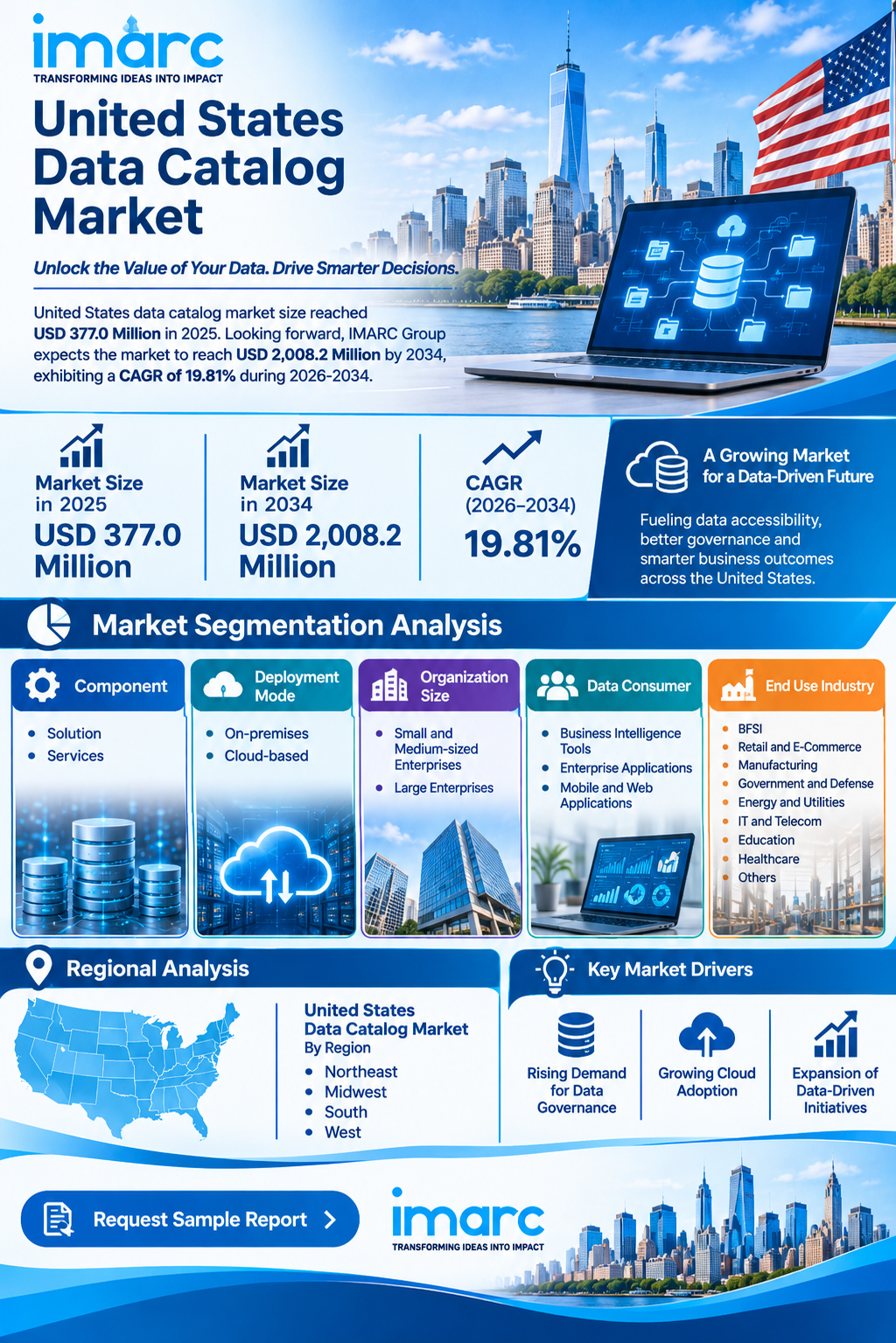
IMARC Group has recently released a new research study titled “United States Data Catalog Market Report by Component, Deployment Mode, Organization Size, Data Consumer, End Use Industry, and Region, 2026-2034,” which offers a detailed analysis of the market drivers, segmentation, growth opportunities, trends and competitive landscape to understand the current and future market scenarios.
United States Data Catalog Market Size, Growth, and Forecast (2026-2034)
The united states data catalog market size reached USD 377.0 Million in 2025 and is projected to reach USD 2,008.2 Million by 2034, growing at a CAGR of 19.81% during 2026-2034. The growth of business intelligence and analytics initiatives, which has increased demand for tools that streamline the discovery and use of data, is the primary factor driving the us data catalog market.
A data catalog is a centralized repository that organizes and manages metadata about an organization's data assets. It indexes and classifies data sources, databases, and datasets, and documents their structure, lineage, quality, and usage to support discovery, governance, and collaboration.
Through a searchable interface, data catalogs help organizations improve data transparency, enhance data quality, and meet regulatory requirements. They also support data stewardship by letting professionals document, annotate, and update metadata so that data assets stay accurate and relevant.
Explore Growth Opportunities in the United States Data Catalog Market - Grab Your Sample Report for Evaluation: https://www.imarcgroup.com/united-states-data-catalog-market/requestsample
Key Trends Driving the United States Data Catalog Market
- Exponential growth of data volumes and sources: Data now arrives in diverse formats from many sources, creating a pressing need to organize, classify, and add metadata to disparate datasets. Data catalogs give organizations a single place to find and understand these assets.
- Cloud adoption and the need for data governance: As businesses adopt cloud-based services, streamlined data governance and metadata management have become more important. This is especially evident in finance, healthcare, and e-commerce, where compliance and data security concerns are paramount.
- Rising prominence of data-driven decision-making: Intuitive catalog platforms connect disparate datasets so teams can derive meaningful insights and strengthen business intelligence. Demand for these platforms grows with analytics and BI initiatives across industries.
- AI and agent-ready metadata: Vendors are repositioning catalogs for AI use. For instance, Informatica announced MCP servers and CLAIRE Agent APIs in May 2026, and Alation introduced AIOS in July 2026 to bring agents, context, data, and governance together.
United States Data Catalog Market Report Segmentation:
The United States Data Catalog Market report provides a detailed segmentation analysis to help businesses identify key growth segments and evolving industry dynamics. The market is categorized based on component, deployment mode, organization size, data consumer, end use industry, and region, offering comprehensive insights across the us data catalog market.
Component Insights:
- Solution: Solutions include the catalog software itself, covering metadata harvesting, search and discovery, lineage, business glossaries, and collaboration features.
- Services: Services such as implementation, integration, training, and support help organizations deploy catalogs and drive adoption across data teams.
Deployment Mode Insights:
- On-premises: On-premises deployments serve organizations with strict data residency, security, or regulatory requirements that favor control over their own infrastructure.
- Cloud-based: Cloud-based deployments are gaining traction as organizations move data to cloud platforms and seek scalable, quickly deployable governance and metadata management.
Organization Size and Data Consumer Insights:
- Small and Medium-sized Enterprises, and Large Enterprises: Large enterprises manage vast, distributed data estates and need catalogs for governance at scale, while small and medium-sized enterprises are adopting easier, cloud-delivered tools to organize growing data.
- Business Intelligence Tools, Enterprise Applications, and Mobile and Web Applications: Business intelligence tools, enterprise applications, and mobile and web applications consume cataloged data, relying on trusted metadata to find and use the right datasets.
End Use Industry Insights:
- BFSI, Healthcare, and Government and Defense: These sectors face stringent compliance and security requirements, which makes lineage, access control, and data governance capabilities especially valuable.
- Retail and E-Commerce, Manufacturing, Energy and Utilities, IT and Telecom, Education, and Others: These industries use data catalogs to unify data from many systems, support analytics, and improve data quality across operations.
Regional Insights:
- Northeast, Midwest, South, and West: The report analyzes all four major US regional markets, offering a regional view of adoption as organizations across the country invest in data governance and analytics.
United States Data Catalog Market: Recent News and Developments
- May 2026: Informatica announced MCP servers and CLAIRE Agent APIs, extending access to its data management and governance capabilities to AI agents.
- July 2026: Alation announced AIOS, the Alation Intelligence Operating System, which brings together agents, context, data, governance, and feedback loops on its Agentic Data Intelligence Platform.
Challenges Impacting the United States Data Catalog Market
Connecting a catalog to many fragmented data sources, BI tools, and applications can be complex and time-consuming. Driving adoption also requires ongoing data stewardship, as catalogs lose value when metadata is not kept accurate and current.
Competition from platform-native catalogs, such as Databricks Unity Catalog, Google's catalog offerings, and Microsoft Purview, pressures independent vendors. Organizations must weigh a multi-platform catalog against consolidating on a single platform.
Investment Opportunities in the United States Data Catalog Market
The united states data catalog market presents compelling investment opportunities supported by its projected growth from USD 377.0 Million in 2025 to USD 2,008.2 Million by 2034. AI-ready catalogs that supply agents with definitions, lineage, quality, and policy context represent a high-value opportunity as enterprises scale AI initiatives.
Cloud-based governance platforms and automated metadata management are growing investment frontiers. Vendors that pair broad connector coverage with strong governance and services support can build strong positions in the us data catalog market.
Outlook of the United States Data Catalog Market (2026-2034)
The outlook for the united states data catalog market is positive, supported by growing data volumes, cloud adoption, compliance needs, and data-driven decision-making. The market is projected to grow from USD 377.0 Million in 2025 to USD 2,008.2 Million by 2034 at a CAGR of 19.81%.
AI-enabled metadata management, cloud-based deployment, and deeper integration with analytics and governance workflows will be the defining trends shaping the us data catalog market through 2034.
Key Players in the United States Data Catalog Market
The united states data catalog market is served by dedicated data intelligence vendors and large platform providers, competing on connector coverage, governance depth, and AI capabilities. Prominent participants include Alation, Collibra, Informatica, Atlan, Microsoft, and Databricks.
- Alation: A pioneer of the data catalog category, Alation sells its Agentic Data Intelligence Platform, offers 120+ connectors, and introduced AIOS in July 2026 to extend its catalog to AI agents and governance workflows.
- Informatica: Informatica offers catalog and governance capabilities through its Intelligent Data Management Cloud and announced MCP servers and CLAIRE Agent APIs in May 2026. It is in the process of being acquired by Salesforce.
Frequently Asked Questions (FAQs): United States Data Catalog Market
1. What is the current United States data catalog market size?
The united states data catalog market size reached USD 377.0 Million in 2025 and is projected to reach USD 2,008.2 Million by 2034, growing at a CAGR of 19.81% during 2026-2034.
2. What is a data catalog?
A data catalog is a centralized repository that organizes and manages metadata about an organization's data assets, supporting data discovery, governance, quality, and collaboration.
3. What are the key drivers of the us data catalog market?
Key drivers include growing business intelligence and analytics initiatives, exponential data growth, cloud adoption, compliance and governance needs, and the rise of data-driven decision-making.
4. How is the us data catalog market segmented?
The market is segmented by component, deployment mode, organization size, data consumer, end use industry, and region, including Northeast, Midwest, South, and West.
5. Who are the key players in the united states data catalog market?
Key players include Alation, Collibra, Informatica, Atlan, Microsoft, and Databricks, alongside other data intelligence and governance providers.
Author IMARC Group
IMARC Group is a global management consulting firm that helps the world's most ambitious changemakers to create a lasting impact. The company provide a comprehensive suite of market entry and expansion services. IMARC offerings include thorough market assessment, feasibility studies, company incorporation assistance, factory setup support, regulatory approvals and licensing navigation, branding, marketing and sales strategies, competitive landscape and benchmarking analyses, pricing and cost research, and procurement research.
Contact Us
IMARC Group,
134 N 4th St. Brooklyn, NY 11249, USA,
Email: [email protected],
United States: +1-201971-6302

 English
 Arabic
 French
 Spanish
 Portuguese
 Deutsch
 Turkish
 Dutch
 Russian
 Romaian
 Portuguese (Brazil)
 Greek