
What Does It Really Cost to Build a WageTap-Style App in Australia?
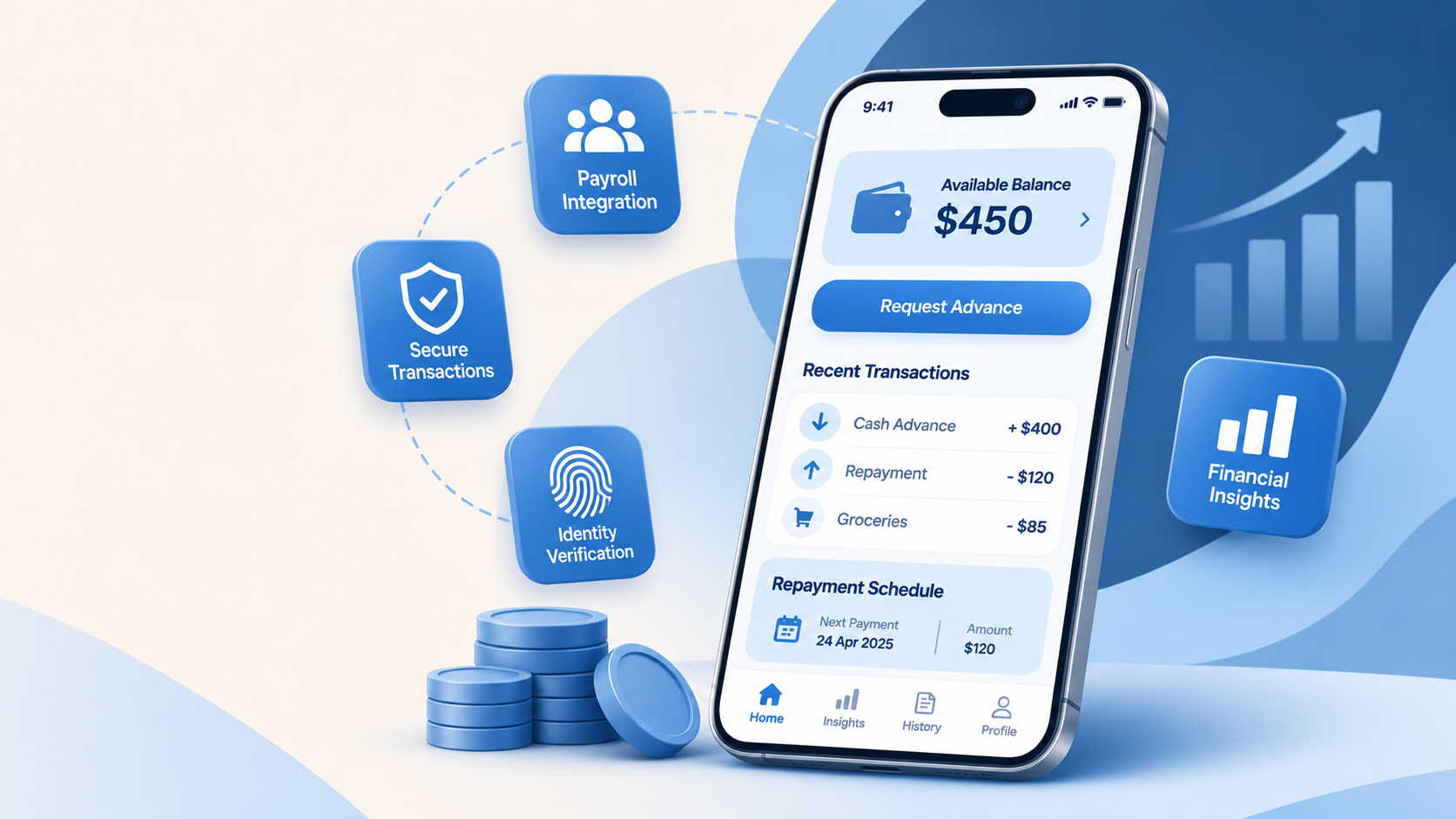
Quick summary
- Most Australian founders spend between AU$70,000 and AU$140,000 on a first working version of a cash advance app.
- Payroll integrations and compliance, not app screens, decide whether the budget doubles.
- A full platform with its own risk engine can reach AU$450,000.
- Yearly running costs usually land at 15 to 20 percent of the original build.
- Funding the project in three phases protects you from paying for features nobody uses.
If you are asking what a cash advance app like Wagetap costs to build, the short answer is a wide range. A narrow MVP can come in near AU$70,000. A product with deep payroll connections, a custom credit model and an admin console can pass AU$400,000. The gap comes from decisions you make before anyone writes code.
What you are actually building
A cash advance app, often called earned wage access, lets an employee draw part of their pay before payday. The app checks what the person has earned, releases a portion, and recovers the money when the employer pays wages.
The interface is the easy bit. Underneath, you need identity verification, a way to read pay data, a payments connection and a repayment process that does not fail on pay day. Each of those is its own piece of work, and each one carries a price.
Fintech app development cost by stage
These are estimates in Australian dollars, based on typical local agency rates. Treat them as planning ranges, not quotes.
Stage one: a focused MVP at AU$70,000 to AU$140,000
The MVP handles sign-up, identity checks, a bank link, a simple advance limit and repayment. It takes about four to six months. You launch with one or two employers and learn how workers actually use it.
Stage two: a growth product at AU$140,000 to AU$280,000
Here you add an employer dashboard, direct links to payroll systems like Xero, MYOB or Employment Hero, notifications and fraud rules. Expect six to nine months. Most funded startups end up in this band.
Stage three: a full platform at AU$280,000 to AU$450,000
This version has a custom risk engine, detailed reporting, support for many employers and a properly tested API. It takes nine to twelve months, sometimes longer.
What drives the bill in fintech app development
Founders often assume design is the big line item. It is usually about one tenth of the budget. For a growth-stage product, spending tends to split roughly like this:
- Backend and APIs: 30 to 35 percent
- iOS and Android apps: 20 to 25 percent
- Payroll, banking and payment integrations: 15 to 20 percent
- Security and compliance: 10 to 15 percent
- Design and user testing: 8 to 10 percent
- Testing and quality assurance: 8 to 10 percent
Integrations are where schedules slip. A payroll connection that looks like two weeks of work can take six, because every provider formats data differently and some need partner approval first.
Open banking and payroll data costs
Many Australian apps read transaction data through providers such as Basiq or Frollo. Pricing is normally per connected user or per call. That means the cost grows with your customer base, so put it into your margin calculations early.
Payroll links behave the same way. Each needs build time, test time and sometimes a monthly fee.
Compliance: the cost founders miss
Which rules apply depends on how you structure the product. If an advance counts as credit, the National Consumer Credit Protection Act comes into play, and you may need an Australian Credit Licence. ASIC oversees credit and financial services more broadly. AUSTRAC sets anti-money laundering obligations, and the Privacy Act 1988 covers how you store worker data.
Legal advice on structure alone often costs AU$10,000 to AU$30,000. Licence applications, compliance staff and audits come on top. Speak to a fintech lawyer before you finalise the product design, because a structural change after launch is far more expensive than one made on paper.
A fintech app development guide to phased budgeting
The safest way to spend is in three steps: discovery, MVP, then expansion. Each step has to prove itself before the next one gets funded.
If you want a deeper look at numbers for this exact product, the fintech app development guide from 7Pillars breaks down a Wagetap-style build in detail.
Discovery is the cheap, useful start. It runs two to four weeks and costs AU$8,000 to AU$20,000. You walk away with a feature list, wireframes and a technical plan that several agencies can quote against on equal terms.
Team and timeline
A growth-stage build usually needs seven to nine people. That means a project manager, a business analyst, one or two backend developers, two mobile developers (or one cross-platform developer), a designer, a tester and a part-time DevOps engineer.
Australian agencies charge roughly AU$120 to AU$220 per hour. Offshore or mixed teams cost less per hour. The saving shrinks once you count time zone delays and the extra effort of explaining local compliance rules.
Experience matters more than the hourly rate. A team that has already completed fintech app development work will know how to handle bank data, payment security and audit trails, which cuts rework.
What you pay after launch
The build invoice is not the last one. Budget for these ongoing items:
- Cloud hosting and monitoring: AU$1,500 to AU$6,000 a month
- Bank and payroll data fees that rise with users
- Payment processing on every advance and repayment
- Security testing once or twice a year
- Customer support and collections
- Updates for new iOS and Android releases
Maintenance typically takes 15 to 20 percent of the build cost each year. On a AU$150,000 product, that is AU$22,000 to AU$30,000 a year.
Practical ways to spend less
Start with one industry where pay cycles are regular, such as hospitality or retail. Build the first version in Flutter or React Native so one codebase covers both phones. Buy identity checks and payments from established providers instead of writing your own.
Keep the credit logic plain at the start. A rule that caps each advance at a set share of earned wages is cheap to build and easy to explain to a regulator. Move to machine learning after you have a year of repayment history to train it on.
Your next step
Write down the three things the app must do on day one and drop the rest. Send that list to two or three Australian teams and ask each for a phased quote that starts with discovery. Compare what each quote covers, not just the total, and ask who handles which compliance tasks.
Frequently asked questions
How much does it cost to build a cash advance app like Wagetap?
A focused MVP costs AU$70,000 to AU$140,000. A growth-stage product with payroll integrations costs AU$140,000 to AU$280,000. A full platform can reach AU$450,000.
How long does development take?
An MVP takes four to six months. A full platform takes nine to twelve months or more, depending on integrations and compliance work.
Do I need a licence in Australia?
It depends on your structure. If advances count as credit, you may need an Australian Credit Licence. Get legal advice before you build.
How do these apps earn revenue?
Most charge a fee per advance, a monthly subscription, or a fee paid by the employer. Some combine two of these.
Can I start with a small budget?
Yes. Keep to one platform, one employer group, one payroll integration and a simple rules-based limit. That keeps the MVP near the low end of the range.

 English
 Arabic
 French
 Spanish
 Portuguese
 Turkish
 Dutch
 Italiano
 Russian
 Romaian
 Portuguese (Brazil)
 Greek