
What are the benefits of modular construction in IVF Lab Design Consultant?
INTRODUCTION
Modular construction offers a structured approach to creating modern fertility laboratory environments by combining prefabricated building components with carefully coordinated engineering systems. An IVF Lab Design Consultant can help fertility clinics evaluate how modular walls, ceilings, service routes, HVAC systems, filtration, and equipment layouts can work together to support laboratory operations. Because IVF laboratories handle sensitive reproductive cells and require reliable environmental control, modular construction must be planned around workflow, air quality, contamination prevention, equipment requirements, and applicable professional guidance. When designed and commissioned appropriately, modular construction can help improve project coordination, simplify maintenance access, support future modifications, and create a laboratory environment tailored to the clinic's clinical and operational needs.
Understanding Modular Construction in IVF Laboratories
Modular construction uses prefabricated or purpose-designed components that are assembled on-site to form laboratory rooms and supporting infrastructure. Depending on the project, these components may include wall panels, ceiling systems, sealed doors, flooring interfaces, service access panels, and integrated provisions for HVAC and utilities.
In IVF laboratories, modular construction is not simply a building method. It is an opportunity to coordinate the physical environment with the procedures performed inside it.
A well-planned project may include:
-
Dedicated areas for oocyte handling and embryo culture
-
Suitable locations for incubators and microscopes
-
Controlled access and defined staff movement
-
HVAC and filtration integration
-
Low-emission construction materials
-
Environmental monitoring provisions
-
Electrical and backup-power planning
-
Maintenance and service access
-
Areas for cryopreservation and storage, where required
The design should be based on the clinic's services, laboratory workflow, equipment list, environmental risks, and relevant guidance rather than on a standard modular layout alone.
1. Better Space Planning and Workflow Organization
One of the principal benefits of modular construction is the opportunity to plan laboratory space around actual IVF procedures.
An IVF laboratory may require areas for oocyte receipt, sperm preparation, insemination, intracytoplasmic sperm injection (ICSI), embryo culture, assessment, and cryopreservation. The arrangement must support appropriate movement of samples, staff, consumables, and equipment.
An IVF Lab Design Consultant can map these activities before construction begins and coordinate the placement of partitions, workstations, storage, and service connections.
Effective planning can help:
-
Reduce unnecessary movement between work areas
-
Provide suitable equipment clearances
-
Support sample identification and traceability
-
Keep work surfaces accessible for cleaning
-
Separate incompatible activities where required
-
Improve access for laboratory staff
The goal is to support a logical workflow while maintaining appropriate environmental conditions for each activity.
2. Coordination of HVAC and Filtration Systems
IVF laboratories need environmental systems suited to the sensitivity of reproductive cells and the procedures being performed. Modular construction provides an opportunity to coordinate wall and ceiling components with HVAC ducts, supply-air outlets, return-air locations, filter housings, and monitoring points.
Planning these systems together can help reduce conflicts between the building enclosure and mechanical services.
The design process should consider:
-
Temperature and humidity requirements
-
Air distribution and filtration
-
Outdoor air quality
-
VOC sources
-
Pressure relationships between rooms
-
Equipment heat loads
-
Maintenance access
-
Monitoring and alarm requirements
HEPA filtration can reduce airborne particles when correctly specified, installed, and maintained. It does not automatically remove all gaseous contaminants, including VOCs, so chemical-source control and gas-phase filtration may also need consideration.
ESHRE's 2026 recommendations and the Cairo Consensus on IVF laboratory air quality emphasize the importance of suitable ventilation, environmental control, material selection, and ongoing assessment in ART laboratories. [1][2]
3. Support for Contamination-Control Strategies
Modular panels and carefully sealed joints can help create smooth, maintainable surfaces that support cleaning and contamination-control procedures.
However, modular construction alone does not guarantee sterility or prevent every form of contamination. Its effectiveness depends on material selection, workmanship, HVAC performance, laboratory procedures, cleaning, and maintenance.
A properly planned laboratory should consider:
-
Sealed panel joints and service penetrations
-
Cleanable wall and ceiling surfaces
-
Appropriate door and access design
-
Controlled movement of personnel and materials
-
Separation of chemical-handling activities where necessary
-
Suitable cleaning and disinfection procedures
-
Verification of environmental conditions
A consultant can help identify potential contamination sources during the design stage and coordinate engineering measures with the laboratory's operational protocols.
4. Selection of Low-Emission Materials
Construction materials can influence the chemical environment inside an IVF laboratory. Paints, adhesives, sealants, flooring, furniture, and cleaning products may release VOCs or other compounds.
Some airborne chemicals may be harmful to sensitive reproductive cells at relevant exposure levels. Material selection should therefore be based on suitable technical information, intended use, and the laboratory's environmental risk assessment.
Modular construction can make it easier to specify components consistently across the project. The design team should evaluate:
-
Material emission information
-
Compatibility with cleaning agents
-
Durability and chemical resistance
-
Surface smoothness and cleanability
-
Sealing requirements
-
Curing and off-gassing periods
-
Maintenance and replacement needs
New materials should be allowed to cure and off-gas appropriately before sensitive laboratory activities begin. Environmental assessment may be needed before the laboratory is approved for use.
5. More Organized Project Coordination
IVF laboratory projects bring together architectural planning, modular construction, HVAC engineering, filtration, electrical systems, laboratory equipment, monitoring, and commissioning.
When these elements are planned separately, design conflicts can occur. For example, a duct may interfere with an incubator location, a service panel may become inaccessible, or an electrical point may be positioned incorrectly for the intended workstation.
An IVF Lab Design Consultant can coordinate the requirements of laboratory personnel, contractors, equipment suppliers, and engineering teams before installation.
This coordination helps establish:
-
Clear technical specifications
-
Equipment and utility schedules
-
Defined installation responsibilities
-
Service-access requirements
-
Project milestones
-
Testing and acceptance criteria
-
Handover documentation
Modular components may also allow some fabrication to take place before on-site assembly, although the overall project duration depends on procurement, site readiness, approvals, equipment delivery, and commissioning.
6. Potentially Faster Installation
Because some modular components can be prefabricated or prepared before they arrive on-site, modular construction may reduce certain on-site building activities compared with conventional construction.
This can be useful for fertility clinics seeking to manage disruption in an existing healthcare facility or coordinate laboratory installation with equipment procurement.
Potential advantages include:
-
More organized component installation
-
Reduced need for some wet construction activities
-
Better coordination of wall and ceiling systems
-
Earlier planning of utility routes
-
Clearer sequencing of installation tasks
These advantages are not guaranteed. Delays can still arise from building modifications, long-lead equipment, service connections, regulatory approvals, or failed commissioning tests. A realistic schedule should include testing, corrective work, environmental assessment, and staff preparation.
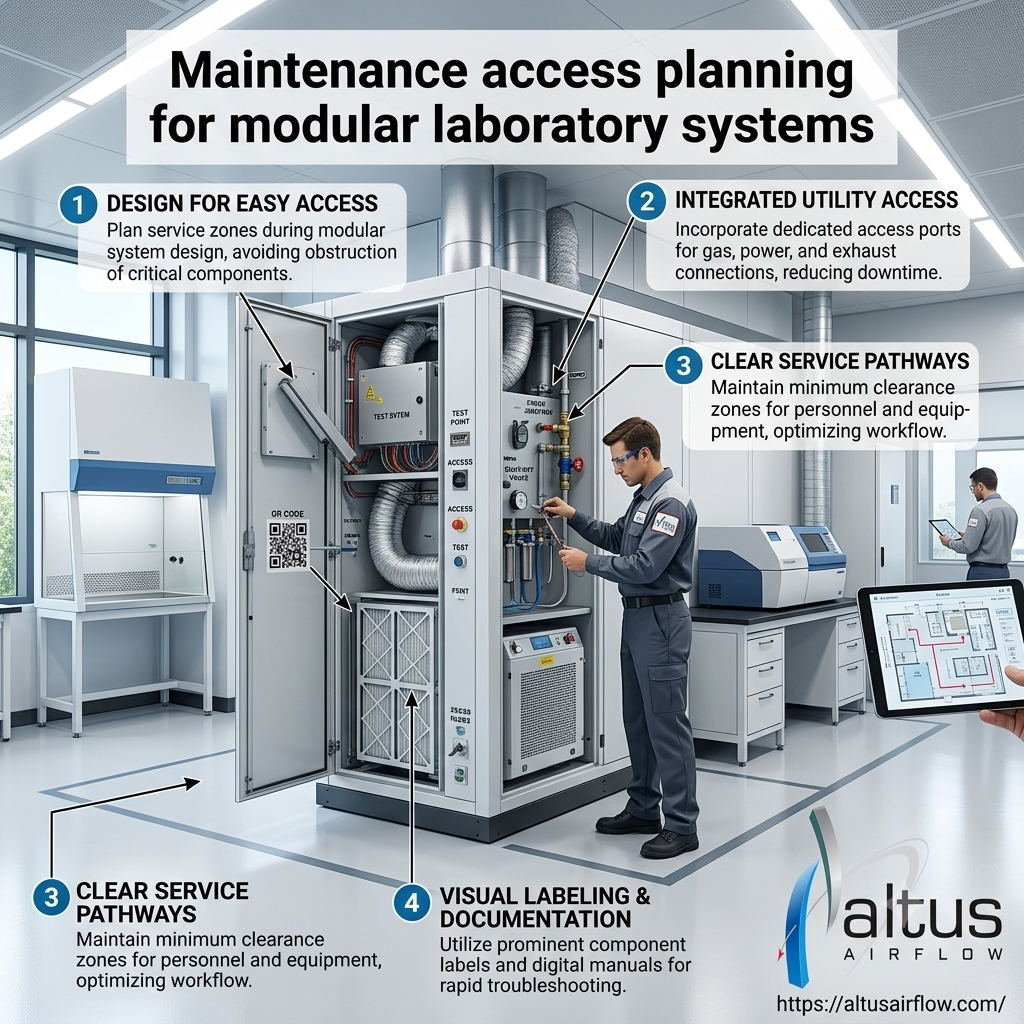
7. Improved Maintenance Access
Laboratory infrastructure must remain accessible for inspection and servicing after the facility becomes operational.
Modular construction can incorporate planned access panels and service routes for HVAC components, sensors, electrical connections, and other utilities. This may make selected maintenance activities easier than in a poorly coordinated conventional layout.
The design should consider access to:
-
HVAC ducts and control components
-
Filter housings
-
Sensors and monitoring devices
-
Electrical panels
-
Equipment connections
-
Seals and modular joints
-
Serviceable lighting and ceiling components
Maintenance should be scheduled to minimize disruption to laboratory operations and protect sensitive work areas. Any intervention that could affect air quality or environmental conditions should be assessed and followed by appropriate verification.
8. Greater Flexibility for Future Modifications
Fertility laboratories may need to change their equipment, workflow, or service capacity as clinical requirements evolve. A modular design can support selected changes when future needs are considered during initial planning.
Possible future changes include:
-
Repositioning selected workstations
-
Introducing new laboratory equipment
-
Updating monitoring systems
-
Modifying service routes
-
Expanding storage capacity
-
Upgrading HVAC controls
-
Adapting designated work areas
Not every modular component can be moved without consequences. Changes may affect airflow balance, room pressure, electrical capacity, material integrity, or the validated workflow. Any modification should therefore undergo technical review, risk assessment, and appropriate recommissioning or verification.
9. Better Integration of Laboratory Equipment
Equipment planning should begin before modular components are finalized. IVF laboratories may use incubators, microscopes, ICSI workstations, embryo assessment systems, refrigerators, freezers, cryostorage equipment, and other specialized devices.
The design should coordinate:
-
Equipment dimensions and clearances
-
Electrical supply and backup power
-
Heat output and HVAC capacity
-
Data and communication connections
-
Workstation lighting
-
Service and calibration access
-
Environmental monitoring
-
Emergency access
Modular construction can help organize service connections and workstation placement, but equipment manufacturers' specifications and the laboratory's validated procedures must guide the final installation.
10. Support for Environmental Monitoring and Validation
A modular laboratory should be tested before clinical operations begin. Commissioning helps verify whether the installed systems perform according to the approved design and acceptance criteria.
Depending on the project, verification may include:
-
Airflow measurements
-
HEPA filter integrity testing where applicable
-
Pressure-differential checks
-
Temperature and humidity assessment
-
Airflow visualization
-
Airborne particle measurements
-
VOC assessment where indicated
-
Alarm and control-system testing
-
Electrical and backup-power checks
Environmental monitoring should continue after commissioning according to the laboratory's risk assessment and applicable guidance.
Modular construction does not remove the need for testing. Instead, the design should make the relevant systems accessible, measurable, maintainable, and properly documented.
11. Efficient Use of Available Space
Clinics may need to fit specialized equipment and multiple laboratory functions into a limited footprint. Modular planning can help make use of the available area by coordinating room dimensions, circulation routes, equipment positions, and storage requirements.
Space efficiency should not come at the expense of safe working practices or required equipment clearances. The layout should preserve access to critical instruments and allow personnel to perform procedures without unnecessary interference.
An experienced consultant can compare layout options and assess how each arrangement affects workflow, utilities, environmental control, and future expansion.
12. Considering Costs and Long-Term Value
The financial benefits of modular construction depend on project scope, materials, local labor costs, building conditions, equipment, and maintenance requirements.
Potential cost advantages may come from more organized installation, reduced rework, coordinated procurement, and easier access to maintainable systems. However, specialized low-emission materials, advanced HVAC systems, environmental monitoring, and validation can add to the initial budget.
Clinics should evaluate the complete lifecycle cost, including:
-
Design and construction
-
HVAC and filtration
-
Laboratory equipment
-
Commissioning and validation
-
Maintenance and filter replacement
-
Sensor calibration
-
Energy use
-
Future modifications
A detailed scope and transparent quotation help clinics compare proposals based on equivalent technical requirements rather than initial price alone.
13. Choosing the Right IVF Lab Design Consultant
The success of modular construction depends on the quality of planning and the suitability of the engineering solution.
When selecting an IVF Lab Design Consultant, clinics should assess experience with fertility laboratories, knowledge of embryology workflows, HVAC coordination, low-emission materials, filtration, environmental monitoring, and commissioning.
The consultant should work closely with embryologists, the laboratory director, facilities personnel, equipment suppliers, and construction teams. This collaboration ensures that architectural and engineering decisions support the laboratory's actual procedures.
Clinics should also request a clear project scope, drawings, equipment schedules, testing criteria, maintenance provisions, and handover documentation.
Conclusion
Modular construction can offer practical benefits for IVF laboratories through coordinated space planning, integrated HVAC and filtration, suitable materials, organized installation, maintenance access, equipment coordination, and provisions for future changes. These advantages depend on project-specific engineering and do not automatically guarantee improved clinical outcomes or contamination prevention. Careful planning, collaboration with laboratory specialists, environmental assessment, and documented commissioning remain essential. For fertility clinics seeking tailored modular laboratory infrastructure and controlled-environment solutions, Altus Airflow provides engineering and turnkey services designed around project requirements and coordinated with the needs of clinical and laboratory teams.
Frequently Asked Questions
1. What are the benefits of modular construction in IVF Lab Design Consultant projects?
An IVF Lab Design Consultant can use modular construction to support organized workflows, coordinated HVAC and filtration, suitable material selection, planned maintenance access, and potential future modifications.
2. Can modular construction help improve IVF laboratory air quality?
An IVF Lab Design Consultant can coordinate modular enclosures with suitable HVAC, filtration, and environmental monitoring. Actual air quality depends on the complete system, material emissions, maintenance, and laboratory procedures.
3. Does modular construction reduce IVF laboratory installation time?
An IVF Lab Design Consultant may use prefabricated components to reduce some on-site construction activities. The overall schedule still depends on site readiness, procurement, equipment installation, approvals, and commissioning.
4. Which materials should be considered for modular IVF laboratories?
An IVF Lab Design Consultant should assess low-emission characteristics, cleanability, chemical compatibility, durability, sealed joints, and maintenance requirements when specifying modular laboratory materials.
5. Can modular IVF laboratories be expanded in the future?
An IVF Lab Design Consultant can plan selected future modifications by considering spare utility capacity, equipment clearances, service access, and adaptable layouts. Changes must still be assessed and verified before use.
Read Our Previous Blog------>How does Modular Ophthalmic OT Turnkey Project Company support separate areas for oocyte handling and embryo culture?

 English
 Arabic
 French
 Spanish
 Portuguese
 Deutsch
 Turkish
 Dutch
 Italiano
 Russian
 Romaian
 Greek