
One Misheard Medical Term Can Change the Meaning of an Entire Record
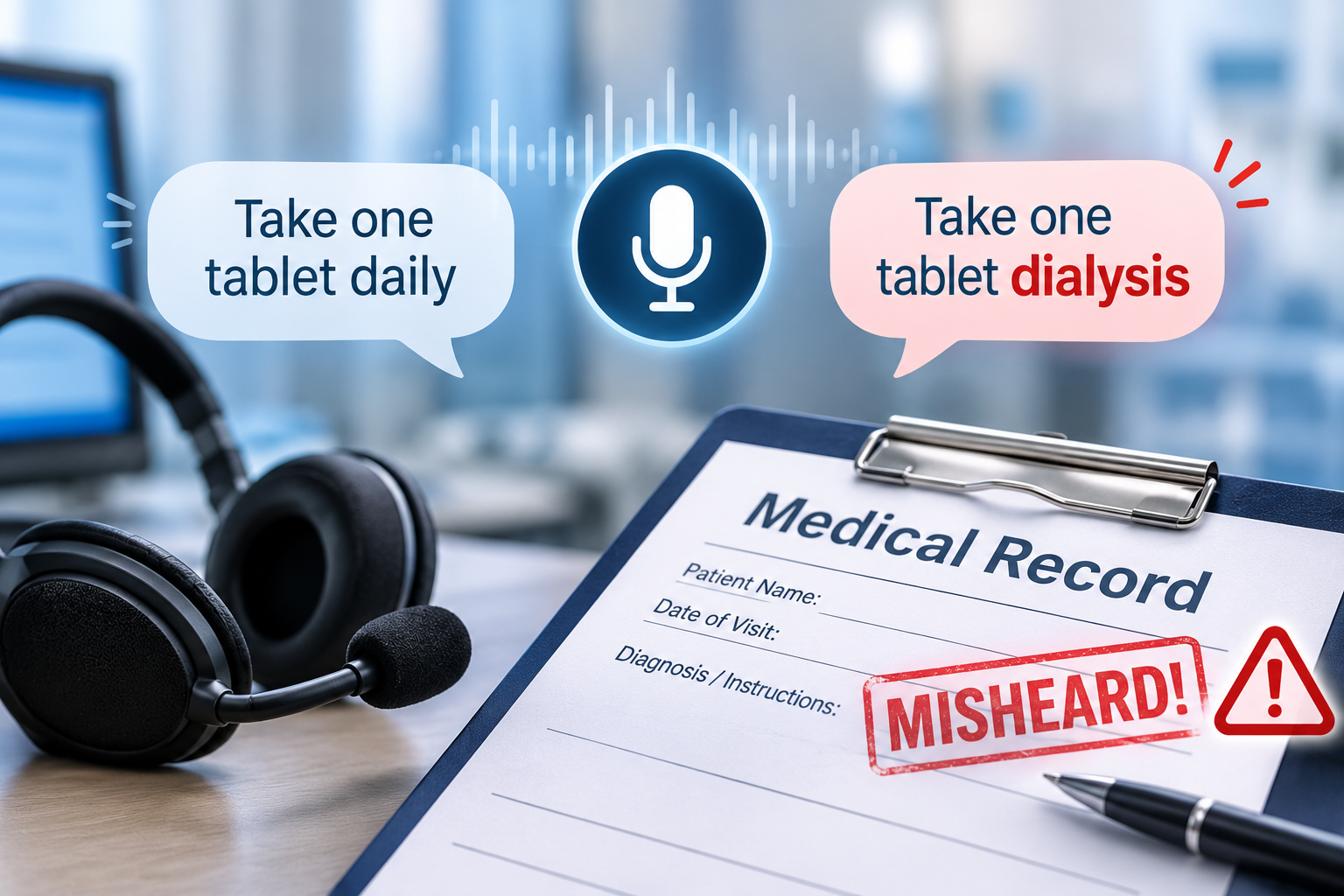
A patient is told to take hydroxyzine for itching. The chart says hydralazine, a blood pressure drug. The two names look alike on a page and sound alike across a noisy room, and one wrong letter changes what the record says the patient should be taking. Mistakes like this are rare, but they explain why medical records need careful handling between the spoken word and the finished note.
Here is how medical transcription works, where errors creep in, which quality controls reduce them, and what to ask before hiring Medical Transcription Services.
What Medical Transcription Involves
Clinicians often dictate their notes: office visits, operative reports, discharge summaries, consultations, imaging reads. A transcriptionist or an editor turns that audio into a written document and places it in the patient's record. Some practices still use fully human transcription. Many now run dictation through speech recognition software that produces a draft, which a trained person then reviews and corrects. This second model is often called medical speech recognition editing, or back-end editing.
Either way, the clinician stays responsible for the final note. A signed record is the clinician's own statement, so reading it before signing is part of the job, not an optional extra.
Where Errors Come From
Carelessness isn’t always the only cause. Most mistakes come from conditions that make speech hard to capture or hard to interpret.
Sound-alike terms are the classic trap. Pairs such as hypotension and hypertension, ileum and ilium, or aphasia and aphagia differ by a syllable or a letter, yet describe very different things. Drug names add to the risk, since so many are close in spelling and sound.
Audio quality matters just as much. Dictating in a busy corridor, mumbling, rushing, or using a poor microphone all raise the chance of a wrong word. Accents and unfamiliar dictation styles can trip up people and software alike, which is why a consistent audio setup helps.
Numbers and units are another weak spot. A dose of 15 mg heard as 50 mg, a left side recorded as right, or a lost decimal point can each change care. Laterality, meaning left versus right, needs extra attention in surgical and imaging notes.
Software has its own failure points. Speech recognition tools can swap a word for a similar-sounding common one, drop a negative such as "no" or "not," or insert text nobody said. A missing "no" can flip a finding from absent to present, and these errors read smoothly enough to slip past a quick glance.
Why It Matters Beyond the Note
A transcription error rarely stays in one place. Records are read by other clinicians, used for billing and coding, sent to insurers, and pulled up in legal and quality reviews. A wrong diagnosis term can change which code is billed. A wrong medication can travel from one provider to the next, each assuming the previous one got it right. Research on documentation errors suggests they are not unusual, which is a good reason to treat accuracy as a patient safety matter and not a clerical one.
The cost also lands on the practice. Corrections take time, claims can be delayed or denied over inconsistent records, and a disputed note is much harder to defend when it contains a mistake the clinician never caught.
Quality Controls That Help
Reliable services usually build several checks into the process:
- Trained medical language specialists. Transcriptionists who know anatomy, drugs and specialty vocabulary catch errors a general typist would miss.
- Second-level review. A different person checks flagged or high-risk reports.
- Reference tools. Current drug references, specialty glossaries and style guides help settle uncertain terms.
- Flagging unclear audio. A good transcriptionist marks inaudible or doubtful passages and asks for clarification instead of guessing.
- Accuracy measurement. Many vendors quote accuracy targets of 98% to 99% or higher, though how they measure it differs. Ask how the figure is calculated.
- Feedback loops. When clinicians correct errors, the service should learn from them.
A quoted accuracy rate can sound reassuring, but 98% still leaves room for mistakes. In a long report, that can mean several wrong words, so the real question is which words are wrong. A misspelled adjective is an annoyance. A wrong drug name or a missing "no" is a risk.
What Clinicians Can Do
Better dictation produces better records, and a few habits make a real difference:
- Dictate in a quiet space with a decent microphone
- Speak at an even pace and spell unusual names, drug names and rare terms
- State laterality clearly, such as "left knee" and not just "the knee"
- Say numbers and units carefully, and repeat critical doses
- Give punctuation or formatting instructions if the service expects them
- Review and correct every report before signing
Reading the finished note matters more than it seems. Many errors are obvious to the person who dictated and invisible to everyone else. A clinician who remembers what they meant to say will often read past a wrong word without noticing, so slow down on medications, doses, sides and negatives.
Privacy and Security
Transcription involves protected health information, so HIPAA applies. A vendor that handles patient audio or text is a business associate and should sign a business associate agreement. Ask how files are transferred and stored, whether data is encrypted, who can access it, and where the work is done. If the vendor uses subcontractors or sends work offshore, ask how privacy rules are applied in those cases.
Be careful with consumer apps and free tools. They generally do not offer a business associate agreement and should not be used for patient information, however convenient they look.
Costs and Turnaround
Pricing varies by vendor, specialty and turnaround time. Common models charge per line, per audio minute or per page. Rush jobs usually cost more, and complex specialties such as surgery or radiology may cost more than routine office visits. Compare the total cost per report, including editing and revisions, rather than the headline rate alone. A cheap rate that comes with heavy correction work is not a bargain.
Standard turnaround ranges from a few hours to a day or two. Confirm in writing what is promised, and ask what happens when a deadline is missed.
Final Words
A medical record is only as reliable as the path from speech to text. Sound-alike terms, poor audio, number slips and software mistakes can each change the meaning of a note, and one wrong word can follow a patient through many hands.
Good medical transcription services combine trained specialists, review steps, clear handling of doubtful audio and solid privacy practices. Clinicians play a part too, by dictating clearly and reading every report before signing.

 English
 Arabic
 French
 Spanish
 Portuguese
 Deutsch
 Turkish
 Dutch
 Italiano
 Romaian
 Portuguese (Brazil)
 Greek