
3D Printer Filament Guide: Choosing the Right Type, Storing It Well and Fixing Common Problems
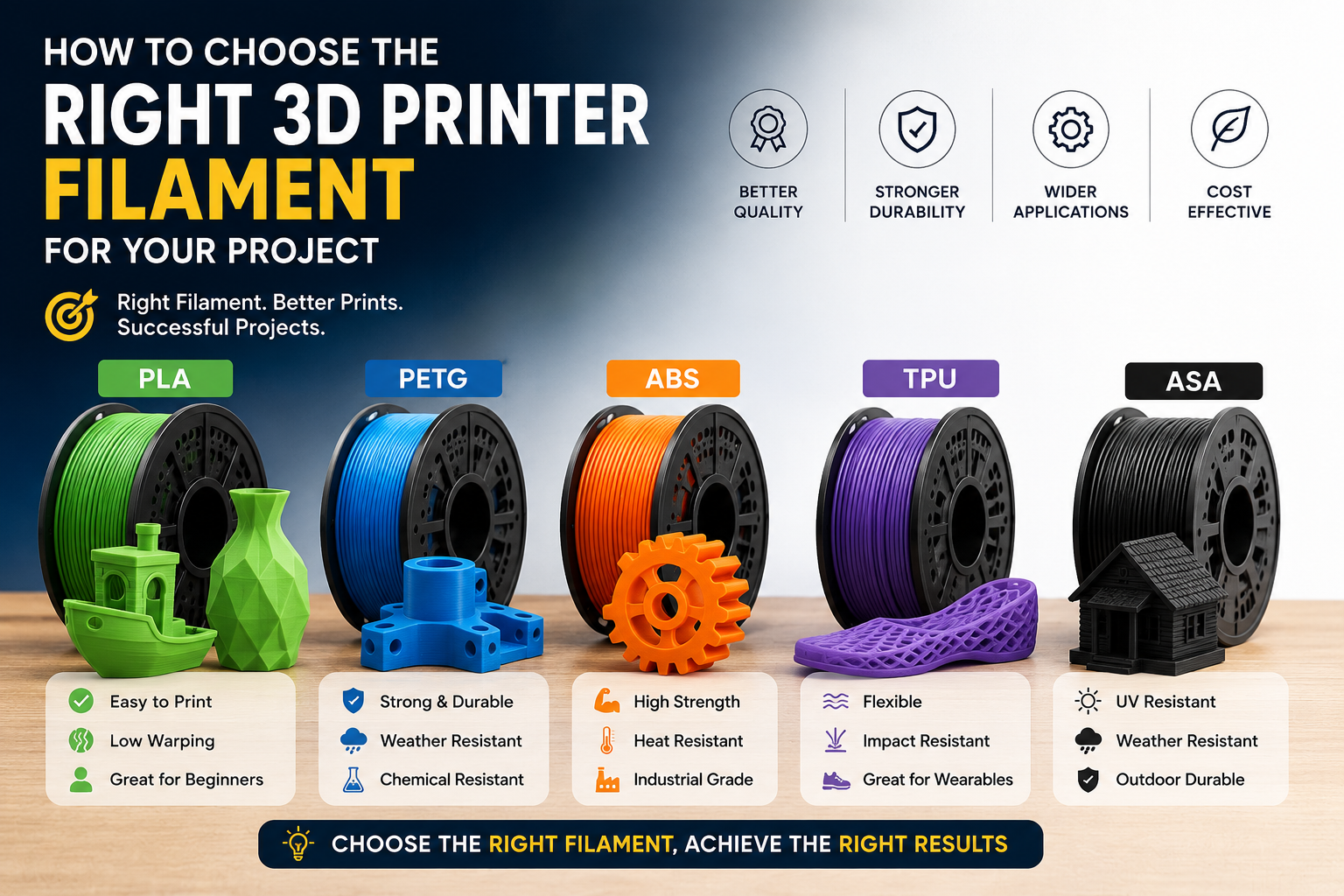
Most print failures that people blame on the machine actually start with the spool, so choosing the right 3D printer Filament is one of the quickest ways to improve your results. Two spools that look identical on a shelf can behave very differently once they are hot, damp or fed through a worn nozzle. Colour is the least important thing to check.
This guide covers the main material families, how to match them to projects, how to store them, and how to troubleshoot the problems that show up most often. Properties vary between brands, so always follow the guidance printed on your own spool. I haven't quoted prices, because they change with brand and availability.
What Filament Actually Is
Filament is a thermoplastic wire, usually wound on a spool, that is melted in a heated nozzle and laid down layer by layer. Two details matter before anything else: diameter (your printer expects a specific size, commonly 1.75 mm) and material type, which sets the temperature, speed and handling.
Consistent diameter and a clean winding are signs of a well-made spool. Variations in thickness cause under- or over-extrusion, and tangles can ruin a long print halfway through.
The Main Material Families
| Material | Known for | Watch out for | Good first project |
|---|---|---|---|
| PLA | Easy printing, wide colour range, low warping | Softens in heat, so poor for hot cars or sunny windows | Display models, desk organisers |
| PETG | Good balance of strength and ease, some flexibility | Can string, needs tuned settings | Functional parts, holders |
| ABS | Tough and heat-tolerant | Warps easily, needs ventilation and usually an enclosure | Durable enclosures, tool parts |
| ASA | Similar to ABS with better outdoor resistance | Also needs ventilation and an enclosure | Outdoor brackets |
| TPU | Flexible, rubber-like | Slow printing, needs suitable feeding | Grips, gaskets, phone cases |
| Nylon | Strong and wear-resistant | Absorbs moisture quickly, hard to print | Gears, hinges |
| Composite or filled | Stiffness, special looks such as wood-like or metallic finishes | Can wear standard nozzles | Decorative or rigid parts |
If you are new, start with PLA. It forgives mistakes, and what you learn about bed levelling and speed carries over to every other material.
Matching Material to Purpose
| What you are making | Likely material | Why |
|---|---|---|
| Prototypes and test fits | PLA | Fast, cheap to iterate |
| Parts that carry load | PETG, nylon | More strength and toughness |
| Items left in warm places | PETG, ABS, ASA | Better heat resistance than PLA |
| Outdoor use | ASA, PETG | Handle sunlight and weather better |
| Flexible parts | TPU | Bends without cracking |
| Decorative pieces | PLA, specialty blends | Colour and finish options |
| Classroom projects | PLA | Simple and low-fume for general use |
Check your printer's supported materials first. Some filaments need a hardened nozzle, a heated bed at a certain temperature or an enclosure.
What Makes a Spool Good
- Consistent diameter along the whole length.
- Neat, tight winding that unspools without knots.
- Dryness when it arrives, ideally in a sealed bag with a drying agent.
- Clear labelling of material, diameter, and suggested temperature range.
- Honest descriptions without vague claims.
- Spool compatibility with your holder and any dry box.
A very cheap spool that causes repeated failed prints is rarely a bargain. Compare the cost per successful print, not just the cost per kilogram.
Storing Filament Properly
Moisture is the biggest enemy. Many filaments absorb water from the air, and wet filament prints badly.
| Habit | Why it helps |
|---|---|
| Keep spools in sealed containers with a drying agent | Slows moisture absorption |
| Use the original bag with the sachet where possible | Cheap and effective |
| Keep away from heat and direct sunlight | Prevents softening and brittleness |
| Label opened spools with material and date | Avoids mix-ups |
| Store flat or on a spool holder | Prevents tangles |
| Dry spools that have been open for a long time | Restores print quality |
| Use older spools first | Reduces waste |
In humid weather, storage matters even more. Nylon and some flexible materials absorb moisture quickly, so many makers print them straight from a dry box.
Signs of Damp Filament
| Symptom | What you see or hear |
|---|---|
| Popping or hissing | Moisture turning to steam in the nozzle |
| Bubbles on the surface | Rough, pitted texture |
| Stringing | Thin hairs between parts |
| Weak layers | Parts that snap along layer lines |
| Dull finish | Less shine than normal |
If you see several of these, dry the filament following the manufacturer's guidance before blaming the printer.
Troubleshooting Guide
| Problem | Common causes | Things to try |
|---|---|---|
| Stringing | Damp filament, temperature too high, retraction too low | Dry the spool, lower the temperature, adjust retraction |
| Warping or curling corners | Poor bed adhesion, drafts, material needing an enclosure | Clean the bed, use a brim, block drafts, consider an enclosure |
| Poor first layer | Bed not level, nozzle too high or low | Re-level, adjust the first-layer height, clean the bed |
| Under-extrusion | Partial clog, wrong diameter setting, tangled spool | Check the nozzle, confirm diameter, free the spool |
| Blobs and zits | Pressure in the nozzle, settings | Tune retraction and speed |
| Rough or layered surface | Speed too high, vibration | Slow down, stabilise the machine |
| Weak or brittle parts | Damp or old filament, wrong temperature | Dry or replace, check temperature range |
| Nozzle clogs | Dust, burnt residue, material changes | Clean the nozzle, follow the recommended temperature when switching |
Change one thing at a time. If you change three settings together, you will never know which one fixed the problem.
Switching Materials Safely
When you move from one filament to another, residue can cause clogs and poor first layers. A simple routine helps.
- Heat the nozzle to the temperature of the higher-temperature material.
- Feed the new filament until the colour or texture runs clean.
- Adjust bed temperature and speed for the new material.
- Print a small test before starting a long job.
- Record the settings that worked.
Calibration Prints Worth Running
| Test | What it shows |
|---|---|
| Temperature tower | The best nozzle temperature for a particular spool |
| Retraction test | How well stringing is controlled |
| Single-wall cube | Whether extrusion is consistent |
| Bridging test | How well the filament spans gaps |
| Overhang test | How steep an angle you can print without supports |
Spend an hour on these when you start a new brand. It saves many hours of failed prints later.
Safety and Ventilation
Heating plastic releases fumes, and the amount varies by material. PLA is generally considered the gentlest for everyday use, while ABS and ASA benefit from good ventilation or an enclosure with filtration. Keep hot nozzles and beds out of reach of children, and never leave a printer running unattended without sensible precautions such as a smoke alarm nearby. Follow your printer maker's safety guidance.
Choosing Your Printer and Filament Together
Your material choices depend on what the machine can handle. If you are still deciding which 3D printer to buy, check its maximum nozzle and bed temperatures, whether it has an enclosure, and whether it comes with a hardened nozzle for filled filaments.
| Printer feature | What it allows |
|---|---|
| Heated bed | PETG, ABS and ASA printing, with better adhesion |
| High nozzle temperature | Nylon and other engineering materials |
| Enclosure | ABS and ASA with fewer warping problems |
| Hardened nozzle | Composite and filled filaments |
| Direct drive extruder | Easier handling of flexible filaments |
| Filament sensor | Pauses when filament runs out or jams |
Building a Small Starter Stock
A sensible starting set might be a spool of PLA in a plain colour for testing, a spool of PETG for functional parts, and a spare PLA in a different colour for projects. Add TPU or nylon later if your projects need them. Buy small spools when trying new materials, so you are not stuck with a kilogram of something that does not suit you.
Common Mistakes to Avoid
- Choosing by colour alone. Material and quality matter more.
- Leaving spools open. Moisture ruins prints.
- Changing many settings at once. You will lose track of what worked.
- Ignoring printer limits. Not every machine handles every material.
- Skipping calibration. Each brand and colour can behave differently.
- Buying huge quantities of an untested spool. Test first.
Key Takeaways
- Match the material to the job, and start with PLA if you are new.
- Check diameter, winding, dryness and labelling before buying.
- Store spools sealed and dry, away from heat and sunlight.
- Most print problems have simple causes, so change one setting at a time.
- Make sure your printer supports the materials you plan to use.
Frequently Asked Questions
1. Which filament is best for beginners?
PLA is the usual starting point because it prints easily, warps little and comes in many colours. Move to PETG or other materials once you are comfortable.
2. How do I know whether my filament is damp?
Popping sounds, bubbles, stringing, rough surfaces and weak layers are common signs. Drying and sealed storage usually help.
3. Can I mix different brands on one printer?
Yes, but settings may need adjusting for each brand. Run a short test and note what works.
4. Do I need an enclosure?
Often not for PLA and PETG. For ABS and ASA, an enclosure and ventilation are usually recommended.
5. How long does filament last?
Properly stored and dry, it can last a long time. Moisture and heat are the main causes of deterioration, so keep it sealed.
Conclusion
Good filament and good habits do more for print quality than most upgrades. Choose a material that matches the job, store it dry, calibrate when you change brands and change one variable at a time when something goes wrong. Your failed prints will drop quickly.
If you would like help choosing materials and equipment, you can explore the Hydrotech 3D Chennai range and ask the team which setup suits your projects.

 English
 Arabic
 French
 Spanish
 Portuguese
 Deutsch
 Dutch
 Italiano
 Russian
 Romaian
 Portuguese (Brazil)
 Greek