
Integrated Command and Control Centre: Connecting Smarter City Operations
Cities are becoming increasingly connected. Cameras, sensors, traffic systems, emergency services, public infrastructure and digital platforms continuously generate information about what is happening across an urban environment.
The challenge is turning this large volume of information into something that city teams can use effectively.
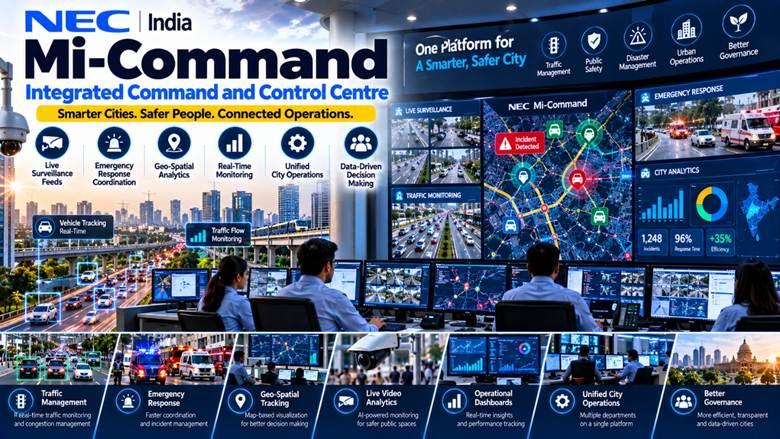
An Integrated Command and Control Centre provides a centralized environment for bringing together information from different applications, sensors and operational systems. NEC Corporation India’s Mi-Command is designed as a single, unified platform for city and business operations, supporting real-time situational awareness, incident management, live video, geospatial tracking, dashboards and analytics.
What Is an Integrated Command and Control Centre?
An Integrated Command and Control Centre, commonly referred to as an ICCC, is a centralized technology environment for monitoring and coordinating multiple operations.
Instead of viewing traffic information, surveillance feeds, sensor data and incident information through completely separate systems, an ICCC can bring relevant information together.
NEC describes Mi-Command as an operational hub that aggregates data from multiple applications and sensors and provides actionable insights through visualizations for decision-makers.
This makes the concept particularly relevant to cities where different departments need to coordinate around the same events.
Real-Time Situational Awareness
Situational awareness is critical when city authorities need to understand a developing event.
A traffic incident, security alert, infrastructure problem or natural disaster can involve multiple locations, departments and resources.
Mi-Command provides live dashboards, live video feeds, geospatial tracking, alert management and analytics capabilities that can help operators understand current conditions.
NEC also describes the platform's ability to aggregate real-time information from sources such as traffic cameras, weather stations and social media during emergency situations.
Centralized Incident Management
Managing an incident involves more than detecting it.
Once an event is identified, the appropriate people need to be informed, resources need to be coordinated and established procedures may need to be followed.
NEC Mi-Command includes Incident Management and escalation capabilities. Its supporting material describes the ability to define escalation matrices and coordinate resources and communication around incidents.
This can provide a more structured approach to handling events across different operational teams.
Alert Management
Alerts provide an important connection between detection and response.
Mi-Command can receive alarms and alerts from different systems and sensors in real time. NEC's documented examples include abandoned objects, intrusion detection, loitering and suspicious activities.
The platform can then support workflows for directing these alerts toward the appropriate users or departments.
Geospatial Tracking for City Operations
Knowing where an incident, vehicle, device or other asset is located can make operational information much easier to understand.
Mi-Command incorporates geospatial tracking and GIS-based visualization. NEC describes the use of geospatial information for applications including crime prevention, emergency management, disaster recovery, transportation, healthcare, urban planning and facility management.
Instead of looking at isolated data points, operators can view relevant information in a geographic context.
Live Video Feeds
Surveillance cameras can generate enormous amounts of video data, but monitoring every camera manually is difficult.
Mi-Command provides live video-feed capabilities that allow operators to access video information within the broader command environment. NEC describes applications including surveillance of areas without continuous human monitoring and identification of situations requiring operational attention.
This can complement other sources of information such as alerts and sensor data.
Live Dashboards for Decision-Making
A command centre needs to present information in a format that operators and decision-makers can understand quickly.
Mi-Command includes live dashboards designed to provide aggregated operational information for everyday management as well as crisis situations. NEC gives examples involving public lighting, weather or traffic conditions, fire detection and energy management.
Dashboards can therefore act as a common operational interface between large amounts of underlying data and the people responsible for decisions.
Analytics and Insights
Connected cities produce data from many sources.
Sensors, RFID systems, Bluetooth devices, cameras and other technologies can generate information that may reveal patterns and operational trends.
NEC Mi-Command includes Analytics & Insights capabilities for analysing information from different sources and supporting data-informed decisions.
This moves the command centre beyond simple monitoring toward a more analytical operating environment.
Standard Operating Procedures and Workflows
Every incident does not require the same response.
A fire alert, traffic incident, security event and infrastructure failure can involve different departments and procedures.
Mi-Command allows organizations to define business rules and Standard Operating Procedures. NEC's supporting material describes workflows that can involve multiple approval levels, departmental contacts and automated escalation paths.
This can help organizations create more consistent approaches to recurring operational scenarios.
Device Management
Smart-city environments may contain thousands of connected devices.
Managing these devices throughout their lifecycle is another requirement for a connected operational environment.
Mi-Command includes Device Management, with NEC describing applications involving connected sensors, lights and meters. These devices can provide data that supports applications such as parking guidance and monitoring of water and wastewater systems.
Supporting Emergency Coordination
During emergencies, different teams may need access to the same information.
NEC describes Mi-Command as a centralized point for collaboration, communication and coordination during disaster scenarios. The platform can aggregate information from different sources so responders can work with a shared operational picture.
The goal is to reduce fragmented information and support more coordinated responses.
Applications Across Urban Environments
The technology is not limited to one type of city operation.
NEC identifies Mi-Command use cases across:
- Smart cities and townships
- Disaster management
- Airport management
- Port management
- Hospital management
- Enterprise and building management
This flexibility comes from the platform's ability to integrate multiple applications, devices and data sources.
Smart City Operations and Public Safety
Public safety is closely connected with the ability to detect, understand and respond to incidents.
NEC's smart-city material describes Mi-Command as supporting incident management, smart security and monitoring, traffic management and emergency coordination.
The platform can therefore contribute to a broader operational ecosystem in which public safety information and city-management data can be viewed together.
A Scalable Platform for Connected Operations
Different organizations have different operational requirements.
A small enterprise may need to monitor a limited number of devices, while a large city may need to integrate thousands of cameras and sensors.
NEC describes Mi-Command as having a scalable architecture capable of supporting environments ranging from smaller enterprises to large cities. It is also described as customizable and data-agnostic, with open data and APIs and role-based access control.
From Disconnected Systems to Connected Intelligence
The key concept behind an ICCC is integration.
Traffic information can be viewed alongside incidents. Surveillance feeds can complement alerts. Geospatial information can provide location context. Sensor data can feed analytics. Standard operating procedures can define what happens after an event is detected.
When these elements are connected, city operations can move toward a more unified information environment.
NEC's Mi-Command portfolio reflects this model by combining alerts, incidents, SOPs, devices, geospatial information, live dashboards, video and analytics within one platform.
The Future of Intelligent City Management
As cities become more connected, the amount of operational data available to authorities will continue to increase.
The challenge will be making that information useful without creating additional fragmentation.
Integrated command platforms can provide one way of bringing different systems and information streams into a common operational environment.
NEC Mi-Command demonstrates this approach through its combination of real-time data, command-and-control capabilities, analytics, visualization and operational workflows.
Conclusion
An Integrated Command and Control Centre can serve as a central layer connecting different aspects of modern city operations.
From incident and alert management to geospatial tracking, live video, dashboards, device management and analytics, NEC Mi-Command brings multiple capabilities together within a unified operational platform.
For cities working toward more connected operations, the focus is increasingly on how different systems can share information and support coordinated action. An integrated command environment provides a technology foundation for that approach, helping city teams work with greater visibility across everyday operations and critical events.

 English
 Arabic
 French
 Spanish
 Portuguese
 Deutsch
 Turkish
 Dutch
 Russian
 Romaian
 Portuguese (Brazil)
 Greek