
United States Smart Glass Market Size Projected to Reach USD 6.53 Billion by 2035 with a CAGR of 12.17%
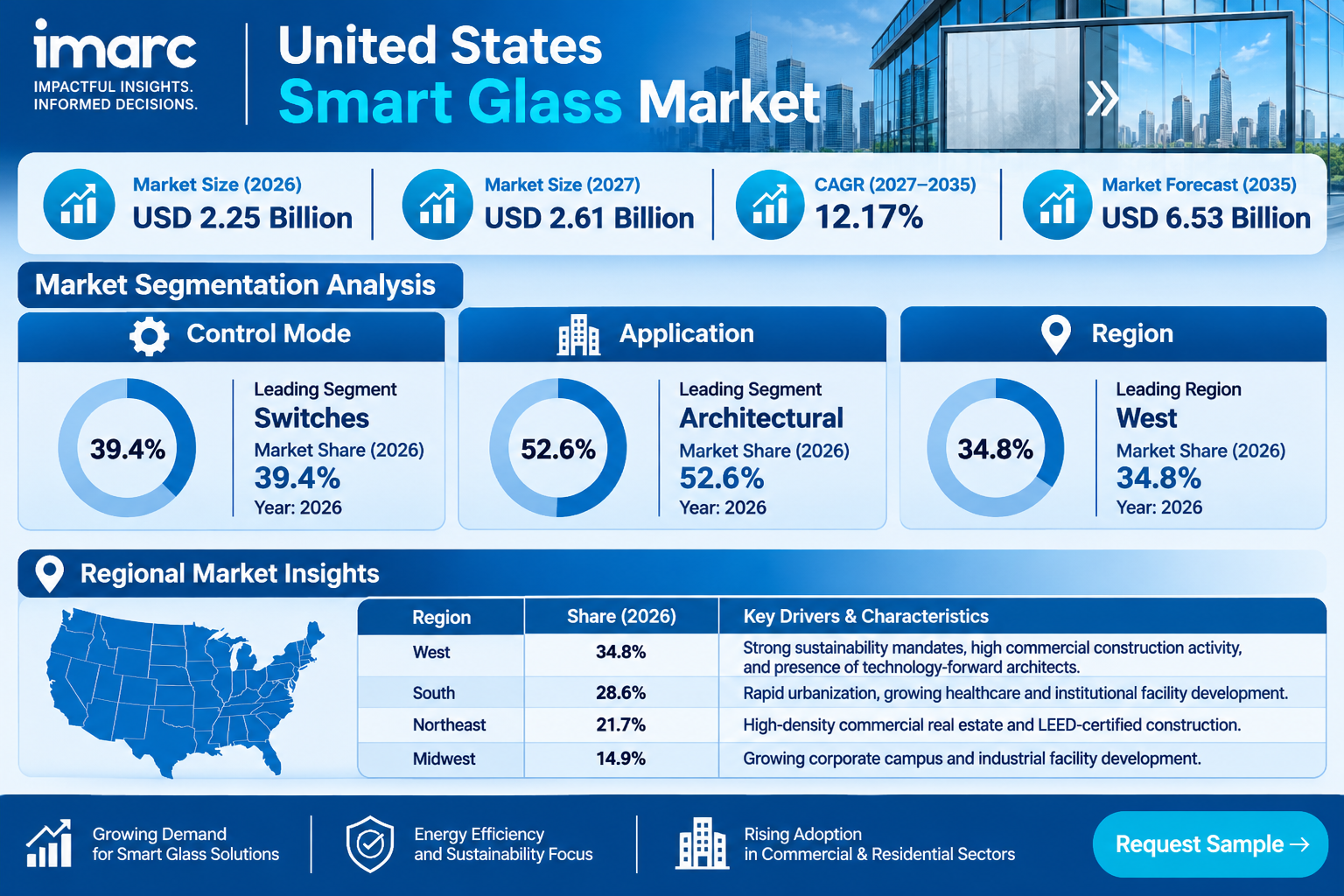
IMARC Group has recently released a new research study titled “United States Smart Glass Market Report by Technology, Control Mode, Application, and Region, 2027-2035,” which offers a detailed analysis of the market drivers, segmentation, growth opportunities, trends and competitive landscape to understand the current and future market scenarios.
United States Smart Glass Market Size, Growth, and Forecast (2027-2035)
The united states smart glass market size reached USD 2.25 Billion in 2026 and is projected to reach USD 6.53 Billion by 2035, growing at a CAGR of 12.17% during 2027-2035. Rising demand for energy-efficient glazing, green building regulations, and smart infrastructure investments are the primary factors driving the united states smart glass market.
Smart glass, also known as switchable or dynamic glazing, is a high-performance material that changes its light transmission in response to electrical signals, heat, or light. Built using electrochromic, polymer dispersed liquid crystal (PDLC), or suspended particle device (SPD) layers, it allows real-time control of privacy, glare, and solar heat gain across buildings, vehicles, displays, and solar panels.
Tightening building energy codes, growing commercial construction, and the national push toward net-zero buildings are encouraging architects and owners to specify dynamic glazing. As one of the fastest-growing categories in the us specialty glass market, the us dynamic glazing market is also benefiting from falling technology costs, building automation integration, and rising demand from electric vehicles and aerospace.
Explore Growth Opportunities in the United States Smart Glass Market - Grab Your Sample Report for Evaluation: https://www.imarcgroup.com/united-states-smart-glass-market/requestsample
Key Trends Driving the United States Smart Glass Market
- Stringent energy efficiency regulations and green building growth: Energy codes such as California’s Title 24, ASHRAE 90.1, and LEED v4.1 require lower building energy use, and smart glass helps manage solar heat gain and daylighting to meet them. It is increasingly specified in LEED Platinum and WELL-certified offices, healthcare facilities, and campuses.
- AI-driven control and smart building integration: AI-powered predictive tinting adjusts glass transparency using weather data, occupancy, and energy pricing, while IoT-connected platforms link glazing with HVAC and lighting systems. These capabilities improve building performance and are becoming a key purchase criterion for developers.
- Automotive and aerospace glazing expansion: Electric vehicle makers and premium automotive brands are adopting smart glass in sunroofs, side windows, and cabin dividers, while commercial aircraft are using electrochromic windows in place of traditional shades. This is creating a fast-growing transportation application alongside architectural demand.
United States Smart Glass Market Report Segmentation:
The United States Smart Glass Market report provides a detailed segmentation analysis to help businesses identify key growth segments and evolving industry dynamics. The market is categorized based on technology, control mode, application, and region, offering comprehensive insights across the united states smart glass market.
Technology Insights:
- Electrochromic: Electrochromic glass is the most advanced and fastest-growing technology at roughly 16.8% CAGR, offering precise, stepless control of light and solar heat for large commercial facades.
- Polymer Dispersed Liquid Crystal (PDLC): PDLC glass switches between opaque and transparent states in milliseconds and is widely used for privacy partitions in offices, healthcare, and hospitality.
- Suspended Particle Device (SPD): SPD glass offers a wide range of tint levels and is common in automotive sunroofs, aircraft windows, and architectural skylights.
- Thermochromic, Photochromic, and Others: Thermochromic and photochromic glass respond passively to heat and light, serving niche applications where no electrical control is required.
Control Mode Insights:
- Switches: Switches lead with a 39.4% share in 2026 as the most intuitive and cost-effective interface, widely used in commercial, healthcare, and hospitality projects.
- Remote Control: Remote control accounts for 31.8% and is expanding at roughly 14.5% CAGR with smartphone, smart home, and IoT integration.
- Dimmers: Dimmers hold 20.7% and are preferred in hospitality and premium corporate spaces that need nuanced light adjustment.
- Others: Other modes, including sensor-based and voice-activated systems, represent 8.1% and are gaining traction in premium residential and hospitality projects.
Application Insights:
- Architectural: Architectural applications dominate with a 52.6% share in 2026, covering facades, curtain walls, skylights, and interior partitions in commercial, healthcare, and institutional buildings.
- Transportation: Transportation holds 24.3% and is the fastest-growing application at roughly 15.2% CAGR, driven by automotive and aerospace demand.
- Consumer Electronics: Consumer electronics account for 14.7%, mainly in premium displays, privacy screens, and AR and VR interfaces.
- Power Generation: Power generation represents 8.4%, with smart glass used in building-integrated photovoltaic systems.
Regional Insights:
- West: The West leads with a 34.8% share in 2026, supported by California’s Title 24 energy codes, strong sustainability mandates, and high commercial construction activity.
- South: The South holds 28.6%, driven by rapid urbanization and commercial, healthcare, and institutional construction across Texas, Florida, and the Southeast.
- Northeast: The Northeast accounts for 21.7%, backed by dense commercial real estate, premium offices, and LEED-certified projects.
- Midwest: The Midwest represents 14.9%, supported by corporate campuses, industrial facilities, and growing energy efficiency awareness.
United States Smart Glass Market: Recent News and Developments
- January 2025: Gauzy Ltd. introduced the first Black SPD smart glass at CES 2025, targeting the aeronautics and premium automotive sectors.
- February 2025: SageGlass, a Saint-Gobain subsidiary, launched RealTone, an electrochromic glass designed to remove the blue hue commonly seen in tinted glass and deliver a more neutral appearance while maintaining glare control and thermal performance.
Challenges Impacting the United States Smart Glass Market
Smart glass carries a significant cost premium over conventional glazing, with electrochromic glass typically priced at USD 50 to 150 per square foot versus USD 5 to 15 for standard glass. Retrofitting also requires electrical upgrades and system compatibility checks, which raises costs and extends project timelines.
Maintaining color-neutral tinting and consistent optical performance remains a technical challenge, and building owners and insurers look for proof of durability over 20 to 30 year lifecycles. Limited awareness outside major metropolitan areas also leads smaller developers to default to conventional glass.
Investment Opportunities in the United States Smart Glass Market
The united states smart glass market presents compelling investment opportunities supported by its projected growth from USD 2.25 Billion in 2026 to USD 6.53 Billion by 2035. AI-integrated smart glass platforms that connect with building automation can deliver energy savings of 20% to 49% in commercial buildings, creating strong returns and recurring software revenue.
Electric vehicle and aerospace glazing supply chains, along with net-zero building retrofit programs supported by federal decarbonization funding, offer additional growth avenues. Manufacturers with retrofit-compatible systems and strong integration capabilities are well positioned in this expanding market.
Outlook of the United States Smart Glass Market (2027-2035)
The outlook for the united states smart glass market is positive, supported by net-zero building programs, the electrification of transportation, and the maturing of AI-connected building ecosystems. The market is estimated at USD 2.61 Billion in 2027, is expected to reach about USD 3.58 Billion by 2030, and is projected to reach USD 6.53 Billion by 2035 at a CAGR of 12.17%.
Continued electrochromic adoption, predictive AI tinting, EV smart glazing, and wider penetration into mid-tier commercial and residential projects will be the defining trends shaping the us dynamic glazing market and the broader us specialty glass market through 2035.
Key Players in the United States Smart Glass Market
The united states smart glass market is moderately concentrated, with global glass majors, specialized dynamic glazing companies, and technology-focused startups competing on technology differentiation, energy performance credentials, integration compatibility, and warranty assurance. AGC Inc. and Gentex Corporation also hold key positions.
- Saint-Gobain: A market leader through its SageGlass brand, Saint-Gobain holds the largest installed base of electrochromic windows in US commercial buildings, spanning healthcare, higher education, corporate office, and hospitality, and is focused on net-zero building projects and AI-driven building automation integration.
- View Inc.: A US-based smart building technology company, View designs and manufactures AI-powered electrochromic windows that adjust tint to outdoor conditions, occupancy, and time of day through a cloud-connected platform, with a focus on LEED and WELL-certified projects and growing healthcare and corporate office portfolios.
Frequently Asked Questions (FAQs): United States Smart Glass Market
1. What is the current United States smart glass market size?
The United States smart glass market size reached USD 2.25 Billion in 2026 and is projected to reach USD 6.53 Billion by 2035, growing at a CAGR of 12.17% during 2027-2035.
2. What is smart glass?
Smart glass, also called switchable or dynamic glazing, is glass that changes its light transmission in response to electrical signals, heat, or light, allowing control of glare, privacy, and solar heat gain.
3. What are the key drivers of the us dynamic glazing market?
Key drivers include stringent energy efficiency regulations, rising green construction activity, growing smart building and IoT integration, and strong architectural demand.
4. Which application and region lead the us specialty glass market for smart glass?
Architectural applications lead with a 52.6% share in 2026, while the West leads regionally with a 34.8% share.
5. Who are the key players in the united states smart glass market?
Key players in the united states smart glass market include Saint-Gobain, View Inc., AGC Inc., and Gentex Corporation, alongside specialized glazing technology providers.
Author IMARC Group
IMARC Group is a global management consulting firm that helps the world's most ambitious changemakers to create a lasting impact. The company provide a comprehensive suite of market entry and expansion services. IMARC offerings include thorough market assessment, feasibility studies, company incorporation assistance, factory setup support, regulatory approvals and licensing navigation, branding, marketing and sales strategies, competitive landscape and benchmarking analyses, pricing and cost research, and procurement research.
Contact Us
IMARC Group,
134 N 4th St. Brooklyn, NY 11249, USA,
Email: [email protected],
United States: +1-201971-6302

 Arabic
 French
 Spanish
 Portuguese
 Deutsch
 Turkish
 Dutch
 Italiano
 Russian
 Romaian
 Portuguese (Brazil)
 Greek