
Bakery Packaging Market Forecast to 2035: Growth, Trends, and Industry Opportunities
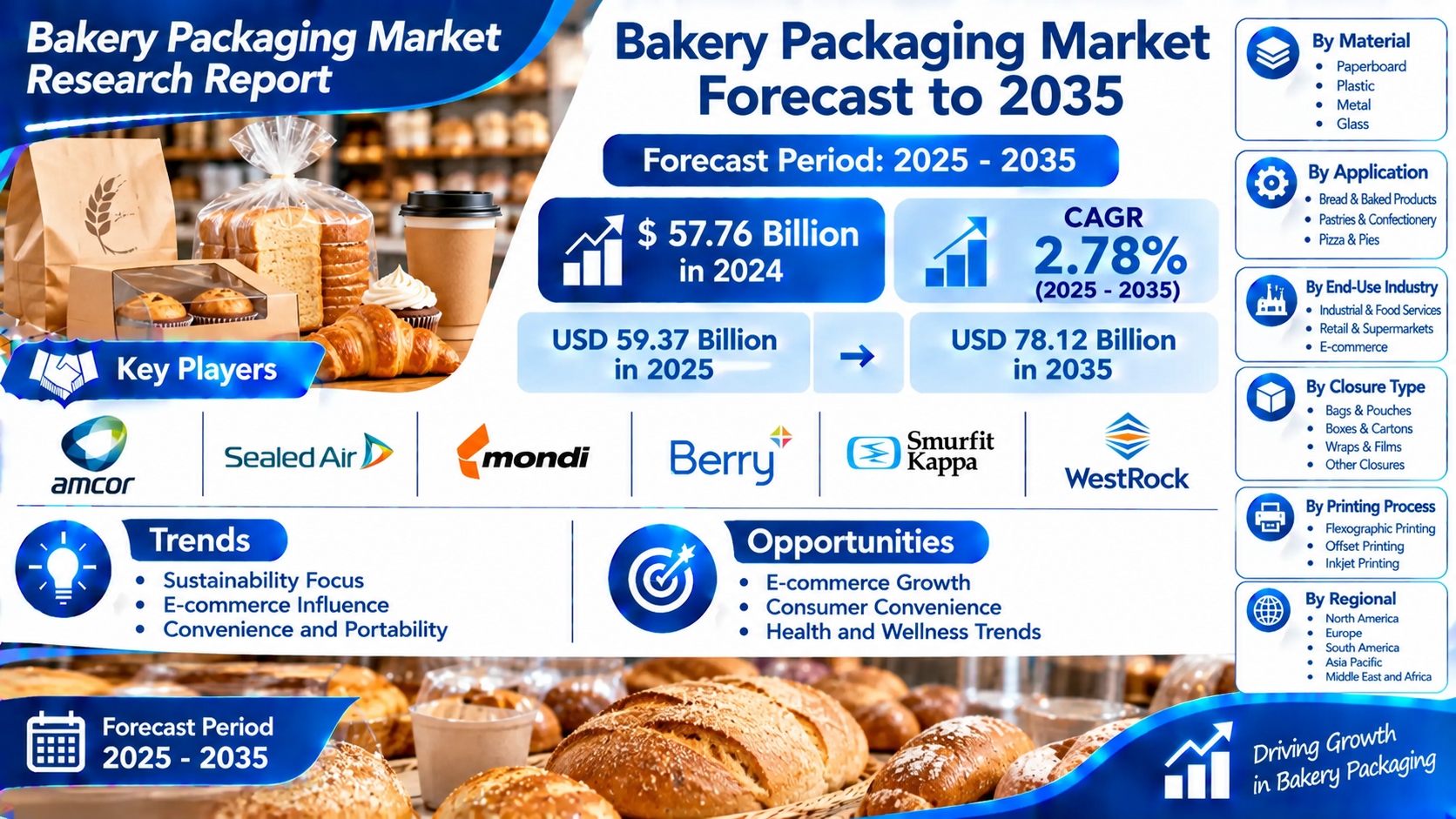
According to Market Research Future® (MRFR), the Bakery Packaging Market is projected to grow from USD 59.37 billion in 2025 to USD 78.12 billion by 2035, registering a compound annual growth rate (CAGR) of 2.78% during the forecast period from 2025 to 2035. The market was valued at USD 57.76 billion in 2024. Its development is influenced by demand for packaging across bread and baked products, pastries and confectionery, and pizza and pies. Sustainability, e-commerce activity, and consumer preference for convenient and portable packaging are among the trends shaping the industry's outlook.
Market Overview and Growth Outlook
Bakery packaging plays an important role in the distribution and presentation of baked goods across retail, food service, industrial, and online sales channels. Packaging formats and materials vary according to product characteristics, handling requirements, and the intended point of sale. The market therefore includes several material categories, closure types, and printing processes that serve different bakery products and commercial requirements.
The market's financial outlook indicates steady expansion over the forecast period. Its valuation of USD 57.76 billion in 2024 is expected to increase to USD 59.37 billion in 2025. By 2035, the market is projected to reach USD 78.12 billion, reflecting a CAGR of 2.78% from 2025 to 2035. This growth outlook is connected to the continued need for packaging across established bakery distribution channels and the influence of changing purchasing habits.
Material Segmentation and Packaging Choices
The market is segmented by material into paperboard, plastic, metal, and glass. These categories represent different packaging options available to bakery businesses and manufacturers.
Paperboard is one of the specified material segments and forms part of the market's packaging mix. Plastic is another major category, while metal and glass provide additional material options. The selection of packaging material can depend on the type of bakery product, the packaging format, and the requirements of the distribution channel.
The presence of several material categories gives the market a diverse structure. Packaging suppliers must consider the needs of bakery manufacturers, retailers, and food service businesses when developing and supplying solutions. Sustainability initiatives also make material selection an important area of industry attention, particularly as companies respond to changing expectations around packaging practices.
Applications Across Bakery Products
The application segmentation includes bread and baked products, pastries and confectionery, and pizza and pies. These categories cover a broad range of bakery items, each with different packaging and presentation requirements.
Bread and baked products represent a core application area. Packaging supports the movement of these products through retail and other distribution channels. Pastries and confectionery form another important category, bringing additional product formats into the market's scope. Pizza and pies complete the application segmentation and extend packaging demand to another group of prepared bakery products.
The diversity of applications means that packaging providers serve customers with different product and distribution needs. A format suitable for one bakery category may not be appropriate for another, making product-specific packaging solutions relevant to the market's development.
End-Use Industries and Distribution Channels
The market's end-use segmentation comprises industrial and food services, retail and supermarkets, and e-commerce. These channels represent the main commercial environments in which bakery packaging is used.
Industrial and food services cover packaging requirements associated with larger-scale production and food service operations. Retail and supermarkets represent another important channel, where packaging is connected with product handling, presentation, and consumer purchasing. E-commerce has become an increasingly relevant part of the market as online purchasing influences how bakery products are packaged and distributed.
The growing influence of online commerce is reflected in both the market's trend and opportunity categories. E-commerce influence is identified as a key trend, while e-commerce growth is listed as an opportunity. This overlap highlights the importance of packaging solutions that can accommodate changing distribution channels.
Closure Types and Printing Processes
Bakery packaging is segmented by closure type into bags and pouches, boxes and cartons, wraps and films, and other closures. These formats provide different ways to package bakery products across the market's application and end-use categories.
Bags and pouches form one part of the closure landscape, while boxes and cartons provide another packaging option. Wraps and films add further flexibility to the market's format mix. Other closures complete the segmentation, allowing the market assessment to cover additional packaging configurations.
Printing process is divided into flexographic printing, offset printing, and inkjet printing. These processes form part of the packaging production landscape and support the presentation and identification of packaged bakery products. The inclusion of multiple printing categories demonstrates that packaging demand extends beyond material and format selection to include how packaging is printed.
Key Trends Influencing Market Development
Sustainability focus is one of the major trends shaping the bakery packaging market. Environmental considerations are influencing packaging discussions across industries, making material choices and packaging practices important areas of attention for suppliers and customers.
E-commerce influence is another significant trend. As online channels become part of bakery product distribution, packaging requirements must account for the needs of these sales channels. The market's opportunity in e-commerce growth reflects the potential for packaging providers to respond to evolving distribution patterns.
Convenience and portability also influence market development. Consumers value packaging that is practical to handle and carry, while businesses require formats suited to their products and sales environments. This trend connects packaging design with consumer purchasing and usage preferences.
Opportunities and Competitive Landscape
The market's identified opportunities include e-commerce growth, consumer convenience, and health and wellness trends. E-commerce expansion may create additional demand for packaging suited to online distribution. Consumer convenience provides another opportunity for suppliers to develop formats that align with changing preferences for practical packaging.
Health and wellness trends also form part of the opportunity landscape. These trends can influence consumer expectations and purchasing patterns in the bakery sector, creating considerations for manufacturers and packaging suppliers.
The key players identified in the market are Amcor, Sealed Air, Mondi Group, Berry Global, Smurfit Kappa, and WestRock. These companies participate in the competitive packaging landscape. Competition is shaped by the ability to serve different material, application, closure, and printing requirements across industrial, retail, food service, and e-commerce channels.
Regional Market Outlook
The regional segmentation includes North America, Europe, South America, Asia Pacific, and the Middle East and Africa. These regions represent the geographic coverage of the market assessment. Demand across these markets is connected to bakery product distribution, packaging preferences, and the development of retail and online channels.
Future Outlook
The bakery packaging market is projected to reach USD 78.12 billion by 2035, growing at a CAGR of 2.78% from 2025 to 2035. Its broad material base, varied applications, and multiple end-use channels provide a foundation for continued demand. Sustainability focus, e-commerce influence, and convenience and portability are expected to remain important considerations for market participants. Opportunities linked to online sales, consumer convenience, and health and wellness trends may further shape packaging development over the forecast period.

 English
 Arabic
 French
 Spanish
 Portuguese
 Deutsch
 Turkish
 Dutch
 Italiano
 Russian
 Romaian
 Portuguese (Brazil)