
Elevator vs Luxator: Key Differences Every Dental Professional Should Know
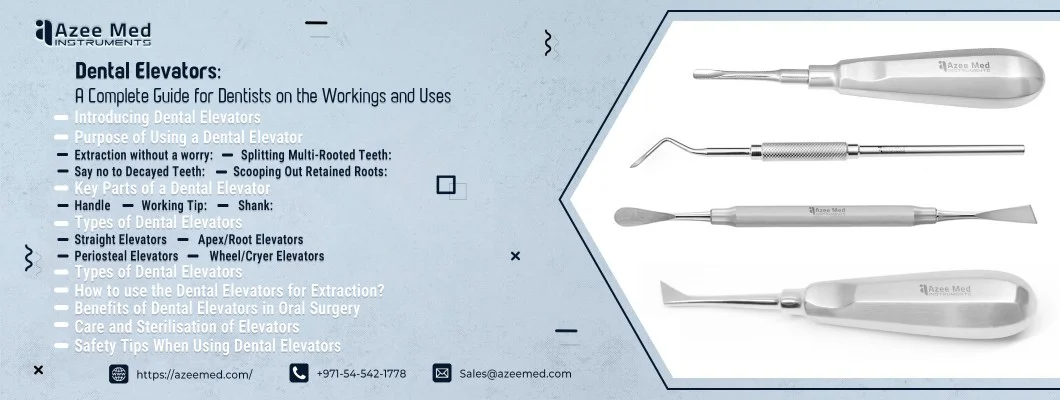
Picture two instruments lying side by side on a surgical tray. At a glance, they look almost identical, with a handle, a shank, and a slim working blade. Yet in a dental professional's hand, each one plays a very different role. Understanding the elevator vs luxator debate helps clinicians choose the right tool for each stage of a procedure.
What Is a Dental Elevator?
A dental elevator is a medical instrument used to loosen teeth and lift them from the socket. It usually has a sturdier, thicker blade that may be straight or curved, along with a solid handle that supports controlled leverage. Common styles include straight, Cryer, and Coupland elevators. Professionals often use elevators to apply gentle rotational or wedging force. This helps mobilize the tooth and prepare it for removal with forceps.
What Is a Luxator?
A luxator looks similar but is built for a more delicate job. Its blade is thinner, sharper, and more tapered, so it can slide into the narrow space between the tooth and the surrounding bone. Instead of acting as a lever, a luxator is designed to cut and stretch the periodontal ligament fibers that hold the tooth in place. This approach lets professionals work carefully around nearby tissue.
Elevator vs Luxator: Design and Purpose
When comparing elevator vs luxator design, the blade tells most of the story. Elevators have thicker blades that can handle leverage. Luxators have fine, sharp edges made for slicing through ligament fibers. Their purposes follow their shapes. An elevator mainly lifts and mobilizes, while a luxator mainly separates. Many clinicians use both in sequence, starting with a luxator and then moving to an elevator or forceps.
Handling and Precision
Handling is where the elevator vs luxator difference truly matters. Luxators call for a gentle push-and-wiggle motion along the root surface. If you use one as a lever, you risk bending or chipping its delicate tip. Elevators, on the other hand, are made to withstand controlled rotational force. In both cases, precision depends heavily on instrument quality. A well-balanced handle, an accurate tip, and durable steel give professionals the control they need in tight spaces.
Choosing the Right Instrument
So which one belongs on your tray? The honest answer to the debonding kit question is often both. Every case is unique, and the final choice always rests with the treating professional. What matters most is having reliable versions of each, made from surgical-grade stainless steel that holds its edge and stands up to repeated sterilization.
Conclusion
Elevators and luxators may look alike, yet they serve distinct roles in dental and oral surgery. Elevators lift and loosen with controlled leverage, while luxators gently separate ligament fibers with fine, sharp blades. Knowing the elevator vs luxator difference helps you use each tool as intended and extend its working life. Explore AzeeMed's dental collection today and equip your practice with instruments you can rely on, procedure after procedure.

 English
 Arabic
 French
 Spanish
 Deutsch
 Turkish
 Dutch
 Italiano
 Russian
 Romaian
 Portuguese (Brazil)
 Greek