
Which environmental controls are essential for maintaining sterility in Modular IVF OT Design?
Introduction
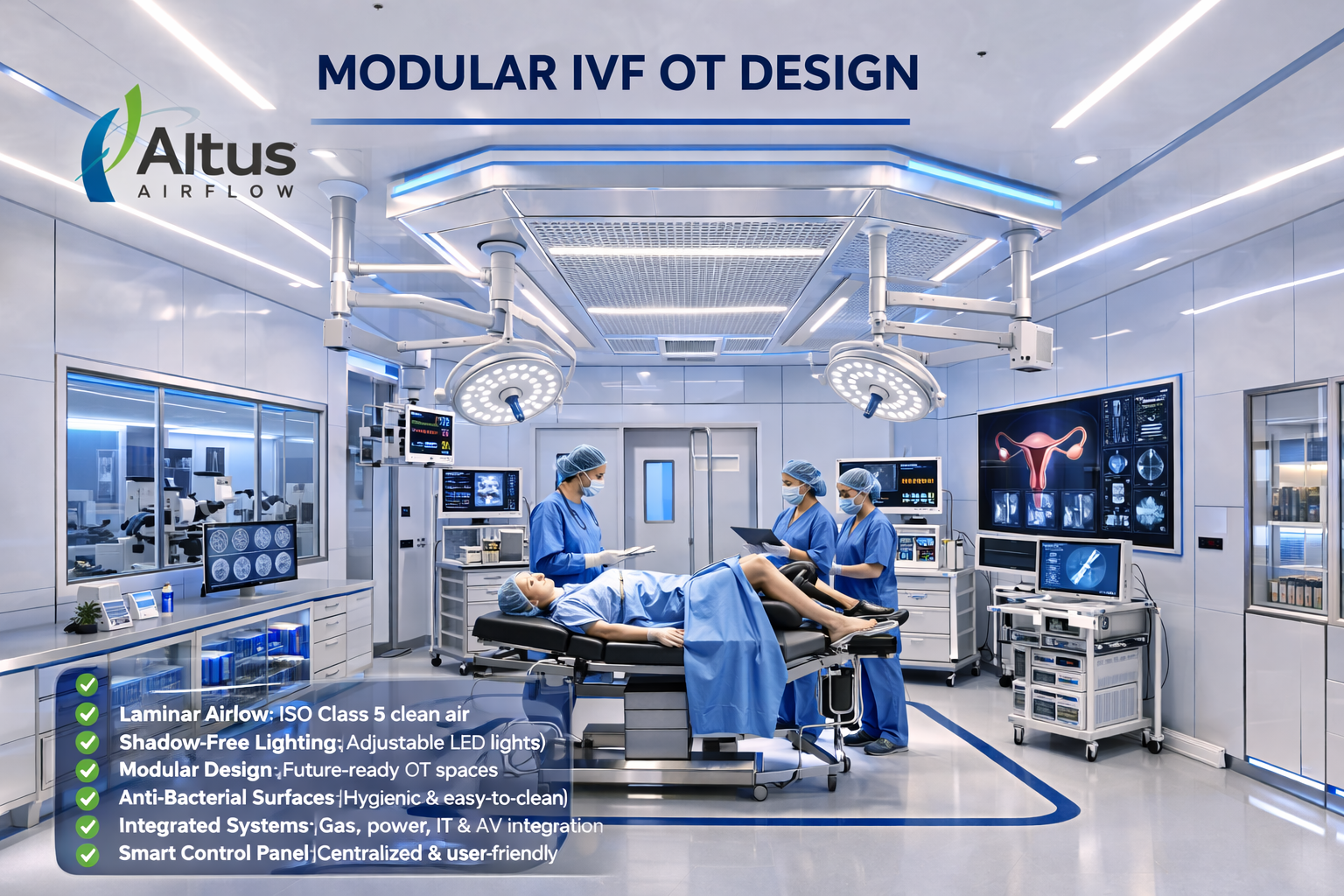
An IVF operating theatre requires carefully controlled environmental conditions to support surgical procedures, protect patients and maintain a hygienic clinical environment. Unlike a general operating theatre, an IVF facility may operate alongside specialised embryology and laboratory areas, making coordination between clinical spaces, ventilation systems and staff workflows particularly important. A well-planned Modular IVF OT Design considers these requirements through integrated environmental controls, suitable room finishes, equipment placement and coordinated building services.
Environmental management involves more than installing an air-conditioning system. It includes filtration, airflow direction, room pressure, temperature, humidity, cleaning arrangements, access control and the maintenance of critical equipment. Each element contributes to the overall operating environment and should be planned according to the intended clinical use of the room.
Hospitals should also distinguish between an IVF operating theatre and an embryology laboratory. Although these spaces may be part of the same IVF facility, they have different functions and may require different environmental specifications. Their layouts and engineering systems should therefore be planned separately while maintaining appropriate coordination between them.
1. HVAC Systems for Controlled Operating Conditions
The heating, ventilation and air-conditioning system is one of the most important environmental components of an IVF OT. It manages the supply and circulation of air while helping maintain suitable temperature, humidity and pressure conditions.
The HVAC design should consider the room's size, expected occupancy, equipment load, surgical activities and relationship with adjoining spaces. Air supply and return locations must be selected to support the intended airflow pattern without creating unnecessary turbulence around the operating area.
The system should also be designed for reliable operation and convenient maintenance. Access to filters, dampers, fans and other components should be considered during planning so that servicing can take place without unnecessary disruption to hospital operations.
A properly engineered HVAC system supports a controlled environment, but its performance must be verified through commissioning and routine maintenance.
2. HEPA Filtration and Airborne Particle Management
Air filtration helps control airborne particles within the operating theatre. High-efficiency particulate air filters, commonly known as HEPA filters, may be incorporated into the ventilation system where required by the approved project specification.
Their selection should consider the intended application, airflow requirements, filter housing design and compatibility with the HVAC system. Correct installation is essential because gaps, damaged seals or poorly fitted components can affect filtration performance.
HEPA filtration should not be viewed as a standalone sterility solution. It works alongside environmental cleaning, instrument sterilisation, appropriate staff practices and infection-prevention procedures.
Where HEPA filtration is specified, filter integrity and installation should be checked using suitable testing procedures. Maintenance schedules should also define inspection, replacement and documentation requirements.
3. Airflow Direction and Room Pressure Management
Airflow direction plays an important role in maintaining the intended environmental relationship between the OT and surrounding spaces. Operating theatres are commonly designed with positive pressure relative to less-clean adjacent areas to help limit the entry of air from those spaces.
This pressure relationship depends on several factors, including the supply and return air balance, door openings, room sealing and the condition of the ventilation system. Even a well-designed system may not maintain the intended pressure if doors, seals or other building components are not properly maintained.
Pressure monitoring can help facility teams identify deviations from the approved operating range. The design may include differential pressure indicators or monitoring arrangements according to the project's requirements.
Door discipline and staff movement are also important. Repeated or prolonged door openings can affect pressure stability and should be managed through suitable operating procedures.
4. Temperature and Humidity Control
Temperature and relative humidity influence the comfort of patients and clinical staff, as well as the performance of equipment and the overall operating environment.
The HVAC system should maintain the temperature and humidity ranges established by applicable healthcare guidance and the hospital-approved design. Requirements may vary depending on the type of room, clinical activities, equipment and local environmental conditions.
Temperature sensors should be positioned where they can provide representative readings without being directly affected by supply-air discharge or heat-producing equipment. Humidity monitoring should also be considered where it forms part of the room's environmental specification.
Regular monitoring helps facility teams identify unusual changes and arrange corrective action. Environmental settings should not be adjusted without considering their impact on the complete ventilation system and the needs of the clinical team.
5. Air Changes and Ventilation Performance
Air-change performance describes how frequently the room's air volume is supplied or exchanged through the ventilation system. The required performance should be established during engineering design based on the applicable healthcare guidance and the intended use of the space.
The design should account for room dimensions, occupancy, equipment and the required airflow distribution. Simply increasing the air-change rate does not automatically guarantee a better operating environment. Air distribution, filtration, pressure relationships and system balancing are equally important.
During commissioning, airflow measurements should be taken at the relevant supply and return points. The results should be compared with the approved design criteria, and any imbalance should be corrected before the room is accepted.
Proper documentation provides a reference for future maintenance and performance checks.
6. Laminar Airflow and Surgical Area Protection
Laminar airflow systems may be considered for selected operating theatre applications where the clinical requirements and engineering design support their use. These systems aim to deliver filtered air in a controlled pattern over a defined area.
The arrangement of supply terminals, operating lights, pendants and other ceiling-mounted equipment can influence airflow distribution. Their locations should therefore be coordinated during the design stage.
It is important to understand that laminar airflow does not independently guarantee sterility or prevent surgical-site infections. Its effectiveness depends on the complete ventilation design, installation quality, commissioning results and ongoing maintenance.
Hospitals should select the airflow arrangement based on their clinical requirements and approved specifications rather than assuming that the same configuration is suitable for every IVF OT.
7. Hygienic Wall, Ceiling and Flooring Materials
The surfaces inside an IVF operating theatre should support regular cleaning and disinfection. Wall panels, ceilings and flooring should be selected for durability, cleanability and compatibility with the cleaning products used by the hospital.
Smooth, non-porous finishes help reduce areas where dust and contaminants may accumulate. Properly detailed joints, sealed penetrations and suitable floor-to-wall junctions also make routine cleaning more practical.
Modular wall systems can incorporate electrical outlets, service panels and control interfaces while maintaining an organised room layout. The design should minimise unnecessary gaps and provide suitable access for maintenance.
Material selection should consider resistance to moisture, disinfectants, wear and routine cleaning procedures. The hospital should review and approve the proposed finishes before installation.
8. Controlled Access and Staff Movement
People entering and leaving the operating theatre can influence the room's environmental conditions. Frequent door opening, unnecessary movement and poorly managed transfers can affect pressure stability and increase the movement of particles.
The OT layout should support a clear movement pattern for patients, clinical staff, equipment and supplies. Entry points, preparation areas and connections to adjacent spaces should be planned to support the hospital's infection-prevention procedures.
Access should be limited to authorised personnel during procedures. Staff should follow the hospital's requirements for surgical attire, hand hygiene and movement between designated areas.
A well-planned layout reduces unnecessary traffic and helps the clinical team maintain an organised operating environment.
9. Environmental Separation Between IVF OT and Embryology Laboratory
An IVF operating theatre and an embryology laboratory perform different functions. The OT supports procedures such as oocyte retrieval and embryo transfer, while the embryology laboratory handles gametes and embryos under specialised laboratory conditions.
These spaces should not automatically be treated as having identical environmental requirements. The laboratory may require additional controls related to air quality, chemical contaminants, temperature stability and equipment operation, depending on its processes and approved specifications.
Where the OT and laboratory are closely connected, their layouts should support suitable movement and transfer arrangements. Doors, pass-through systems and access routes should be planned around the facility's workflow and contamination-control procedures.
Coordination between the clinical, laboratory and engineering teams is essential to ensure that the environmental requirements of each space are addressed independently.
10. Cleaning, Disinfection and Sterility Practices
Environmental controls work effectively only when supported by consistent cleaning and infection-prevention practices. Operating theatre surfaces, equipment and frequently touched areas should be cleaned and disinfected according to hospital-approved procedures.
Cleaning schedules should identify responsibilities, approved products, contact times and the sequence of cleaning activities. Products must be compatible with the installed surfaces and equipment.
Reusable instruments must undergo the appropriate cleaning, packaging and sterilisation processes before use. Environmental filtration cannot replace these procedures.
The hospital should also establish clear arrangements for handling clinical waste, used materials and contaminated equipment. Staff training and documented procedures help maintain consistency across different surgical sessions.
11. Monitoring, Alarms and Environmental Records
Continuous or scheduled environmental monitoring helps facility teams understand whether the OT is operating within its approved parameters. Depending on the project design, monitoring may include temperature, relative humidity and differential pressure.
Alarm arrangements can alert authorised personnel when monitored conditions move outside established limits. Alarm thresholds should be defined during commissioning and should reflect the approved operating requirements.
Environmental records should document readings, deviations, corrective actions and maintenance activities. This information helps identify recurring problems and provides a useful history for facility management.
Monitoring systems should also be checked periodically to confirm that sensors, displays and alarms are functioning correctly.
12. Commissioning and Validation of Environmental Controls
Before an IVF OT is handed over for clinical use, its environmental and engineering systems should undergo appropriate testing. Commissioning confirms whether the installed systems perform according to the approved design and project specifications.
Testing may include airflow volume and velocity measurements, air-change performance, pressure differential checks, temperature and humidity verification, and inspection of filtration components. Where specified, HEPA filter integrity testing, airborne particle measurements and airflow visualisation may also be included.
Electrical systems, medical gas outlets, alarms, lighting and other connected services should be checked by qualified personnel. Integrated testing helps confirm that different systems operate together as intended.
All test results should be documented. Any deviation from the approved requirements should be investigated, corrected and retested before final acceptance. The hospital should also receive relevant operation manuals, maintenance schedules and commissioning records.
Conclusion
Maintaining a controlled IVF operating theatre requires coordinated planning of ventilation, filtration, airflow direction, temperature, humidity, hygienic surfaces and staff movement. These environmental controls should be supported by effective cleaning, sterilisation, monitoring and routine maintenance.
A carefully developed Modular IVF OT Design brings the room's architectural and engineering requirements together while considering the clinical workflow and relationship with the wider IVF facility. Each environmental parameter should be established through the approved project design and verified before clinical use.
Hospitals planning new IVF infrastructure or upgrading existing facilities can work with Altus Airflow to consider modular OT requirements, integrated services and environmental control systems as part of a coordinated project approach.
Frequently Asked Questions
1. Which environmental controls are essential for maintaining sterility in an IVF OT?
A Modular IVF OT Design should consider HVAC performance, suitable air filtration, airflow direction, positive pressure where specified, temperature and humidity management, hygienic surfaces and controlled staff movement. These systems must work alongside cleaning, disinfection, instrument sterilisation and hospital infection-prevention procedures.
2. Why is HEPA filtration important in an IVF operating theatre?
HEPA filtration helps capture airborne particles when the filters are correctly selected, installed, tested and maintained. It supports the ventilation strategy but does not replace cleaning, sterilisation or other infection-prevention measures.
3. How does positive pressure help maintain a controlled OT environment?
Positive pressure helps limit the movement of air from less-clean adjacent spaces into the operating theatre. Its effectiveness depends on correct HVAC balancing, room sealing, door management and routine system maintenance.
4. Are IVF operating theatres and embryology laboratories subject to the same environmental requirements?
No. An IVF OT supports surgical procedures, while an embryology laboratory handles gametes and embryos. Their environmental requirements should be established separately according to their functions, equipment and applicable specifications.
5. What tests should be conducted before an IVF OT becomes operational?
Testing may include airflow measurements, pressure differential checks, temperature and humidity verification, filtration integrity testing where specified, electrical safety checks, medical gas testing and integrated system checks. The final testing scope should follow the approved project specification and applicable requirements.
Read Our Previous Blog------>How Can a Modular Gynaec OT Support Different Types of Gynaecological Surgeries?

 English
 Arabic
 French
 Spanish
 Portuguese
 Turkish
 Dutch
 Italiano
 Russian
 Romaian
 Portuguese (Brazil)
 Greek