
What Is LBW in Cricket? Rules, Umpire's Call and Examples Explained Simply
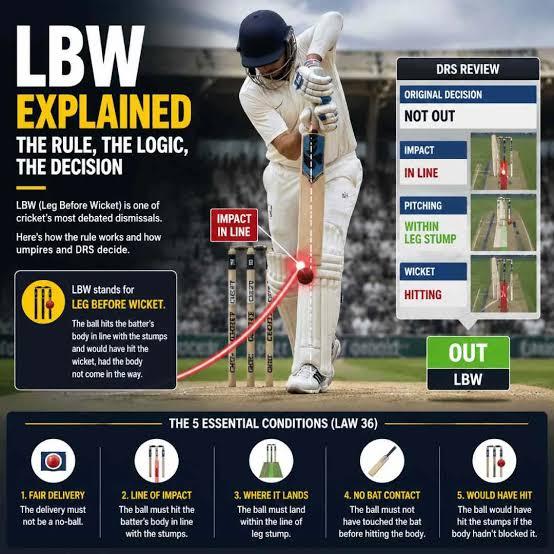
LBW is the most confusing dismissal in cricket, and it is also one of the most common.
LBW stands for Leg Before Wicket. It means a batter is out because the ball hit their leg — or their pad, or any part of their body — in front of the stumps, and the umpire believes the ball would have gone on to hit the stumps if it had not hit the batter.
In simple terms: if you do not hit the ball with your bat, and the ball hits your pad in front of the stumps, and it was going to hit the stumps, you are out LBW.
That sounds simple. In practice, there are three checks the umpire has to make, and if any one of them fails, the batter is not out. Those three checks are the reason LBW causes so many arguments, so many reviews, and so much confusion for new fans.
The Three Checks for LBW
For a batter to be given out LBW, all three of the following must be true.
1. Where did the ball pitch?
The ball must have pitched in line with the stumps, or outside the off stump. If the ball pitched outside the leg stump, the batter cannot be given out LBW, no matter what happens after that.
This is the first check, and it is the easiest to understand. The leg stump is on the leg side of the batter — the side of the batter's legs when they are standing at the crease. If the ball pitches outside that line, the umpire cannot give the batter out, because the ball was not heading towards the stumps from the start.
2. Where did the ball hit the batter?
The ball must have hit the batter in line with the stumps, or the batter must not have been playing a shot.
If the ball hit the batter outside the line of the off stump, and the batter was playing a shot, the batter cannot be given out. If the batter was not playing a shot — that is, if they were padding up, or leaving the ball, or not offering a stroke — they can be given out even if the ball hit them outside off stump.
This is the check that confuses most people. The rule is different depending on whether the batter played a shot or not. If they played a shot, they get protection outside off stump. If they did not play a shot, they do not get that protection.
3. Would the ball have hit the stumps?
The ball must have been going on to hit the stumps, if it had not hit the batter.
This is the hardest check, because the umpire has to predict where the ball would have gone. In the past, umpires had to guess, based on the ball's line and its movement. Today, they have Hawk-Eye to help them, in a DRS review, but the on-field umpire still has to make the first decision without it.
If the ball was going over the stumps, or missing the stumps on the leg side or the off side, the batter is not out. If the ball was going to hit the stumps, the batter is out — subject to the first two checks.
All three checks must be true. If the ball pitched outside leg stump, the batter is not out, even if it was going to hit the stumps. If the ball hit the batter outside off stump and the batter was playing a shot, the batter is not out, even if it was going to hit the stumps. If the ball was going over the stumps, the batter is not out, even if it pitched in line and hit the batter in line.
Pitching Outside Leg Stump: The Rule That Saves Batters
The pitching rule is the most important protection a batter has against LBW.
If a bowler bowls a ball that pitches outside leg stump, the batter cannot be out LBW. That is true even if the ball then cricbet 99 swings or spins back towards the stumps, and even if it hits the batter in line with the stumps.
The reason is simple: a ball that pitches outside leg stump is very hard for a batter to play, because it is coming from behind their legs. It would be unfair to give a batter out LBW to a ball that pitched in a place they could not easily reach.
Left-arm spinners and left-arm fast bowlers often bowl from around the wicket to a right-handed batter, with the ball pitching outside leg stump and turning or swinging away. That is a good tactic to get a batter out caught, or to get them to play a false shot, but it cannot get them out LBW, because the ball pitched outside leg stump.
The same rule applies to a right-handed batter facing a right-arm bowler from over the wicket. If the ball pitches outside leg stump, LBW is not possible.
Playing a Shot vs Not Playing a Shot
The second check — where the ball hit the batter — depends on whether the batter was playing a shot.
If a batter is playing a shot, and the ball hits them outside the line of the off stump, they cannot be given out LBW. This is because the batter was trying to hit the ball, and they were hit outside the line of the stumps. It would be unfair to give them out for a ball they were trying to play, but which hit them outside the stumps.
If a batter is not playing a shot — if they are padding up, or leaving the ball, or shouldering arms — they can be given out LBW even if the ball hits them outside off stump. This is because the batter chose not to play a shot, and they took the risk that the ball would hit them.
This is why you will see batters pad up to a spinner, with their bat behind their pad, and then be given out LBW when the ball hits them outside off stump. They were not playing a shot, so they do not get the protection that a batter who was playing a shot gets.
It is also why umpires look very carefully at whether the batter played a shot or not, when they are deciding an LBW appeal. A small movement of the bat can be the difference between out and not out.
Would the Ball Have Hit the Stumps?
The third check is the one that Hawk-Eye is used for in a DRS review.
Hawk-Eye uses cameras around the ground to track the ball's path, from the bowler's hand to the point where it hits the pad, and then it predicts where the ball would have gone if it had not hit the pad.
If Hawk-Eye shows the ball hitting the stumps full on, the batter is out. If it shows the ball missing the stumps, the batter is not out. If it shows the ball clipping the stumps — that is, only a small part of the ball would have hit the stumps — the decision is called "umpire's call", and the on-field decision stands.
Umpire's call exists because Hawk-Eye has a margin of error. The cameras are accurate, but they are not perfect, and the prediction is based on a model, not on a direct observation. When the ball is only clipping the stumps, the technology cannot say with certainty that it would have hit them, so the human decision is given the benefit of the doubt.
If the on-field umpire gave the batter out, and Hawk-Eye shows umpire's call, the batter is out. If the on-field umpire gave the batter not out, and Hawk-Eye shows umpire's call, the batter is not out. In either case, the team that asked for the review keeps its review, because the review was not clearly wrong.
LBW and DRS: How Reviews Work
LBW is the dismissal that is most often reviewed, and it is the dismissal where DRS has made the biggest difference.
Before DRS, umpires had to make LBW decisions based on what they saw in real time, without any technology to help them. They made mistakes, and those mistakes could decide matches.
Today, a team can review an LBW decision, and the third umpire will check all three of the LBW checks using Hawk-Eye and the video replay. The third umpire will check where the ball pitched, where it hit the batter, whether the batter was playing a shot, and whether the ball would have hit the stumps.
If the review shows that the on-field decision was wrong, it is overturned. If it shows that the on-field decision was right, it stands. If it shows umpire's call, the on-field decision stands, and the team keeps its review.
In Test cricket, each team gets three reviews per innings. In ODIs and T20Is, each team gets two reviews per innings. A team has 15 seconds from the moment the on-field decision is made to ask for a review.
That is why captains have to decide quickly whether to review an LBW decision. If they are confident the ball pitched outside leg stump, or that it was going over the stumps, they will review. If they are guessing, they may save the review for a clearer decision later in the innings.
Common LBW Mistakes and Myths
There are several common mistakes that fans make about LBW, and they are worth clearing up.
Myth 1: If the ball hits the pad in front of the stumps, it is always out.
No. The ball must also have pitched in line or outside off stump, and it must have been going to hit the stumps. If it pitched outside leg stump, or if it was going over the stumps, it is not out.
Myth 2: If the batter does not offer a shot, they are always out if the ball hits them.
No. The ball must still have pitched in line or outside off stump, and it must still have been going to hit the stumps. Not playing a shot only removes the protection outside off stump. It does not make every ball that hits the pad out.
Myth 3: If the ball hits the bat first, it cannot be LBW.
That is true, but it is also a different dismissal. If the ball hits the bat first, and then hits the pad, the batter cannot be given out LBW. They could be given out caught, if the ball goes to a fielder, but not LBW. That is why UltraEdge is used in DRS reviews, to check if the ball touched the bat before it touched the pad.
Myth 4: Umpire's call means the umpire was wrong.
No. Umpire's call means the technology was not conclusive enough to overturn the umpire. The on-field decision stands, whether it was out or not out, and the team that reviewed keeps its review.
Myth 5: LBW is only for spinners.
No. LBW is for any bowler — fast, medium or spin. Fast bowlers get batters out LBW with inswingers and yorkers, spinners get batters out LBW with balls that turn back into the stumps, and medium pacers get batters out LBW with balls that seam back in.
Famous LBW Decisions in Test Cricket
LBW has decided many famous Test matches, and it has produced some of the most controversial moments in cricket history.
In the 2001 Kolkata Test, Harbhajan Singh took 13 wickets, many of them LBW, to beat Australia after India followed on. In the 2005 Ashes, Shane Warne and Glenn McGrath took many LBW wickets, and the LBW decisions were reviewed and debated for days after each match.
In more recent cricket, LBW has become even more important, because DRS has made it easier to give batters out LBW, and because batters are more willing to review LBW decisions. The result is that LBW is now one of the most common dismissals in Test cricket, especially for spinners bowling to batters who pad up, and for fast bowlers bowling inswingers to right-handed batters.
For a batter, the best defence against LBW is to play the ball with the bat, not the pad. If you hit the ball with your bat, you cannot be given out LBW. If you pad up, you take the risk. That is why coaches tell young batters to play forward, to get their bat in front of their pad, and to offer a shot to every ball.
For a bowler, the best way to get an LBW is to bowl a ball that pitches in line, hits the batter in line, and is going to hit the stumps. That sounds simple, but it is very hard to do, because the batter is trying to hit the ball, and the ball has to do exactly the right thing at exactly the right time.
A cricbet cricket ID is sometimes mentioned in online cricket discussion when fans look for match updates, but it is worth remembering that Cricbet99 is a gaming and betting-related platform, not an official broadcaster, for adults only where legally permitted.
The name Kingexch also appears in wider online discussion around cricket, but LBW itself is the story — three checks, one prediction, and a decision that can change a match in a single ball.
FAQs
What does LBW stand for?
Leg Before Wicket. It means a batter is out because the ball hit their leg or pad in front of the stumps, and the ball would have gone on to hit the stumps if it had not hit the batter.
Can a batter be out LBW if the ball pitched outside leg stump?
No. If the ball pitched outside leg stump, the batter cannot be given out LBW, no matter what happens after that.
Can a batter be out LBW if the ball hit them outside off stump?
It depends. If the batter was playing a shot, they cannot be given out. If the batter was not playing a shot, they can be given out, if the ball was going to hit the stumps.
What is umpire's call in LBW?
Umpire's call means Hawk-Eye shows the ball clipping the stumps, but not hitting them fully. The on-field decision kingexch stands, whether it was out or not out, and the team that reviewed keeps its review.
How many reviews does each team get for LBW?
In Test cricket, three reviews per innings. In ODIs and T20Is, two reviews per innings. A team has 15 seconds to ask for a review.
If the ball hits the bat first, can it be LBW?
No. If the ball hits the bat first, and then hits the pad, the batter cannot be given out LBW. They could be given out caught, if the ball goes to a fielder, but not LBW.

 English
 Arabic
 French
 Spanish
 Portuguese
 Deutsch
 Turkish
 Dutch
 Italiano
 Russian
 Romaian
 Portuguese (Brazil)