
How to Manage Vehicle Inventory Across Multiple Dealership Locations Without Stock Errors
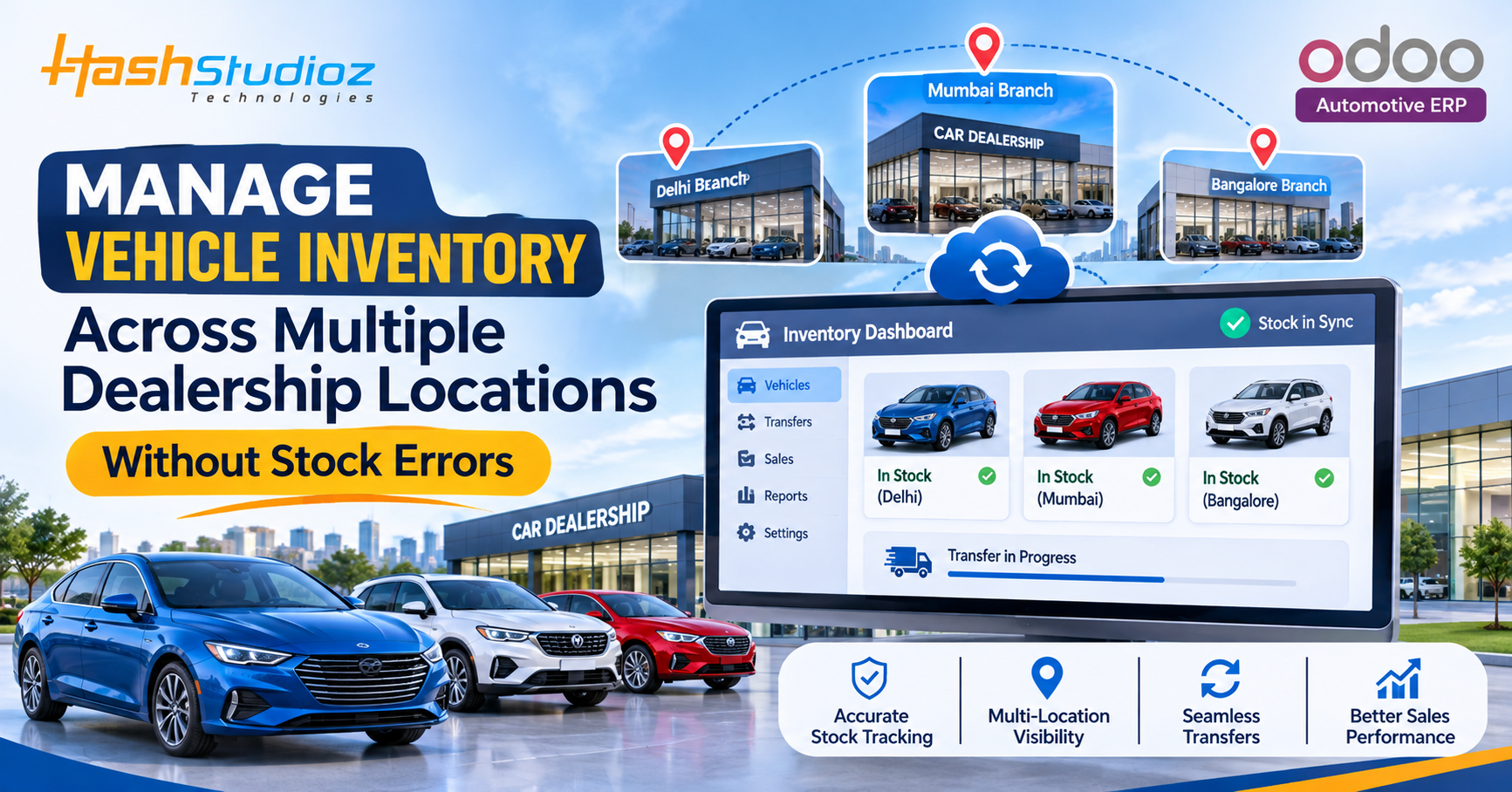
Managing vehicle inventory across multiple dealership locations can quickly become complicated as an automotive business expands. Each location may have different vehicle availability, customer demand, sales activity, and stock requirements. Without proper coordination, dealerships can experience duplicate vehicle records, inaccurate stock information, delayed transfers, and missed sales opportunities.
Imagine a customer visiting your dealership to purchase a specific car. Your sales representative checks the inventory system and confirms that the vehicle is available. However, when the customer is ready to complete the purchase, the team discovers that the vehicle has already been sold at another branch.
The challenge becomes even greater when businesses manage dozens or hundreds of vehicles across multiple showrooms and storage locations.
This is where an integrated automotive management system becomes valuable. Odoo Automotive ERP helps businesses organize inventory information, coordinate dealership operations, track vehicle movements, and improve visibility across locations. With the right Odoo for Automotive Dealerships implementation, businesses can establish a more organized inventory management process and reduce the risk of stock errors.
Why Managing Vehicle Inventory Across Multiple Dealerships Is Challenging
Unlike traditional retail products, vehicles require more detailed inventory tracking. Every vehicle has unique identification information, specifications, ownership details, pricing, and availability status.
When multiple dealership locations operate independently, maintaining accurate inventory records becomes difficult.
Here are some common challenges automotive businesses face.
1. Inaccurate Vehicle Availability
When different branches maintain separate inventory records, employees may not have access to updated vehicle availability.
A vehicle might appear available in one system even though it has already been reserved or sold at another location.
This creates confusion for sales teams and customers.
2. Duplicate Vehicle Records
Manually entering vehicle information across multiple branches can result in duplicate records.
For example, the same vehicle may be registered twice because employees use different identification details or naming formats.
This can lead to incorrect inventory reports and unnecessary stock discrepancies.
3. Delayed Inter-Branch Vehicle Transfers
Dealerships frequently move vehicles between locations based on customer demand, showroom capacity, and regional sales requirements.
Without proper transfer tracking, employees may struggle to determine where a vehicle is currently located or when it will arrive at another branch.
4. Poor Coordination Between Sales and Inventory Teams
Sales representatives need accurate vehicle information before confirming availability to customers.
When inventory updates are delayed, sales teams may offer vehicles that are no longer available or overlook suitable vehicles located at another dealership.
5. Difficulty Tracking Vehicle History
Automotive businesses need to maintain detailed information about each vehicle, including its identification number, purchase details, condition, ownership history, and sales status.
Scattered records make it difficult to access complete vehicle information when required.
Effective Ways to Manage Vehicle Inventory Across Multiple Dealership Locations
Improving multi-location inventory management requires more than maintaining a stock spreadsheet for every branch. Businesses need consistent processes, centralized information, and reliable inventory tracking.
Here are eight practical strategies that can help.
1. Centralize Vehicle Inventory Information
One of the most important steps is maintaining a centralized inventory database.
Instead of allowing each dealership to manage completely separate vehicle records, businesses should establish a common system where authorized employees can access relevant inventory information.
A centralized system should maintain:
-
Vehicle identification number (VIN).
-
Make and model.
-
Manufacturing year.
-
Vehicle variant and specifications.
-
Registration details, where applicable.
-
Purchase price and selling price.
-
Current dealership location.
-
Vehicle availability status.
-
Reservation and sales information.
Practical Example:
Consider an automotive company operating five dealership branches.
A customer visits the Delhi showroom looking for a particular SUV. The vehicle is unavailable at that location but is available at the company's Noida branch.
With centralized inventory visibility, the sales representative can identify the vehicle's location and coordinate the next steps without manually contacting every branch.
This improves customer service and helps dealerships use their existing stock more effectively.
2. Assign Unique Identification to Every Vehicle
Every vehicle should have a unique inventory record to prevent duplicate entries and confusion.
The Vehicle Identification Number (VIN) is particularly important because it provides a standardized way to identify individual vehicles.
Dealerships should use VIN-based records along with relevant internal stock identifiers.
Important details to maintain include:
-
VIN or chassis number.
-
Engine number, where applicable.
-
Stock reference number.
-
Vehicle make and model.
-
Vehicle condition.
-
Purchase information.
-
Current location.
-
Inventory status.
Practical Example:
A dealership receives two vehicles of the same model, color, and manufacturing year.
Although the vehicles appear identical, they have different VINs.
By maintaining separate vehicle records using unique identification details, employees can avoid mixing up purchase documents, inspection records, and customer reservations.
3. Track Vehicle Transfers Between Dealership Locations
Vehicle transfers are a regular part of multi-location dealership operations.
A branch may have excess stock of one vehicle model while another location experiences higher customer demand.
A structured transfer process helps businesses move vehicles without losing track of their location or status.
Every transfer should record:
-
Vehicle identification details.
-
Source dealership.
-
Destination dealership.
-
Transfer request date.
-
Dispatch date.
-
Expected arrival date.
-
Actual receipt date.
-
Transfer confirmation status.
Practical Example:
The Gurgaon branch has three additional units of a particular sedan, while the Noida branch has received several customer inquiries for the same model.
The inventory manager initiates a transfer request for one vehicle.
The system records the vehicle's movement from the Gurgaon branch to the Noida branch, allowing both locations to monitor its transfer status.
This improves coordination and reduces the risk of vehicles being incorrectly marked as available.
4. Update Inventory Status in Real Time
Vehicle availability changes whenever a dealership receives, reserves, transfers, or sells a vehicle.
If these changes are not recorded promptly, different departments may work with outdated information.
Businesses should establish clearly defined vehicle statuses, such as:
-
In Transit.
-
Available.
-
Under Inspection.
-
Reserved.
-
Awaiting Documentation.
-
Sold.
-
Delivered.
These statuses help employees understand the actual condition and availability of each vehicle.
Practical Example:
A customer pays an advance amount to reserve a vehicle.
The dealership updates the vehicle's status to Reserved.
Other sales representatives can then see that the vehicle should not be offered as freely available inventory.
This reduces double-booking and unnecessary customer disputes.
5. Standardize Inventory Processes Across All Locations
Different dealership branches may develop their own inventory management methods over time.
One branch might use spreadsheets, another may rely on manual registers, and another may use a separate software application.
These differences make centralized reporting and stock reconciliation difficult.
Businesses should establish standardized procedures for:
-
Vehicle receiving.
-
Stock registration.
-
Inspection and verification.
-
Vehicle reservation.
-
Inter-branch transfers.
-
Sales confirmation.
-
Vehicle delivery.
-
Stock reconciliation.
Standardization ensures that employees follow consistent procedures regardless of their dealership location.
6. Perform Regular Inventory Audits
Even with an ERP system, physical inventory verification remains important.
Vehicle records should match the actual vehicles available at each dealership or storage facility.
Regular audits help identify:
-
Missing vehicle records.
-
Incorrect stock locations.
-
Duplicate entries.
-
Vehicles marked available despite being reserved.
-
Delayed transfer confirmations.
-
Incorrect vehicle specifications.
Practical Example:
A dealership's inventory report shows 45 vehicles at its main branch, but a physical verification identifies only 43.
The inventory manager reviews recent transfers and discovers that two vehicles were dispatched to another location without the receiving branch confirming their arrival.
A proper transfer verification process can help prevent similar discrepancies.
7. Use Inventory Reports to Forecast Vehicle Demand
Vehicle demand can vary across dealership locations depending on customer preferences, regional requirements, pricing, and seasonal trends.
Keeping the same vehicle mix at every location may lead to excess stock in one branch and shortages in another.
Businesses should review:
-
Vehicle sales by location.
-
Fast-moving models.
-
Slow-moving inventory.
-
Average stock holding time.
-
Customer inquiries.
-
Pending reservations.
-
Branch-level stock availability.
Practical Example:
A dealership group discovers that compact SUVs sell faster in one city, while another branch receives more inquiries for premium sedans.
By analyzing sales and inventory reports, management can plan vehicle allocation according to local demand.
This helps reduce unnecessary stock accumulation and improves inventory utilization.
8. Connect Sales and Inventory Management
Inventory accuracy depends heavily on coordination between sales and stock management teams.
Whenever a vehicle is reserved, sold, or transferred, the relevant inventory information should be updated through a consistent process.
Connecting sales and inventory activities helps businesses:
-
Check vehicle availability before confirming orders.
-
Avoid selling already-reserved vehicles.
-
Track customer reservations.
-
Coordinate vehicle transfers.
-
Improve sales order accuracy.
-
Maintain updated dealership stock records.
An integrated ERP environment can help reduce the need for repeated manual updates between departments.
How Odoo Automotive ERP Helps Manage Multi-Location Vehicle Inventory
Managing multiple dealership locations through disconnected spreadsheets and software applications can create unnecessary complexity.
Odoo provides an integrated ERP platform that businesses can configure to support inventory, sales, purchasing, accounting, and other operational activities.
With the appropriate configuration and automotive-specific customization, Odoo Automotive ERP can help dealerships improve vehicle tracking and coordinate inventory across multiple locations.
Here are some important capabilities.
1. Centralized Inventory Management
Odoo Inventory supports centralized management of products, stock locations, and inventory movements.
Automotive businesses can configure their warehouse and location structure to represent individual dealership branches and storage facilities.
This helps authorized employees access relevant stock information through a common system.
2. Multi-Location Stock Tracking
Odoo supports warehouse and internal location management.
Businesses can organize inventory by dealership, warehouse, or designated storage area, depending on their operational requirements.
This makes it easier to understand where vehicles are physically recorded within the inventory structure.
3. Vehicle Identification and Custom Fields
Standard inventory configurations may require customization to capture automotive-specific information.
Using appropriate product configurations, serial or lot tracking, and custom fields, businesses can maintain information such as:
-
VIN and chassis number.
-
Engine number.
-
Vehicle model and variant.
-
Manufacturing year.
-
Vehicle color.
-
Purchase information.
-
Vehicle condition.
This helps create more detailed vehicle records.
4. Internal Vehicle Transfers
Odoo Inventory supports internal stock transfers between configured warehouse locations.
Dealerships can use this functionality to manage vehicle movements between branches and track the associated inventory operations.
Proper configuration and employee procedures help ensure that dispatch and receipt records remain accurate.
5. Integrated Sales Management
Odoo Sales works alongside inventory management to support quotation and sales order activities.
This helps sales teams coordinate customer orders with vehicle availability and stock operations.
With appropriate workflows, dealerships can improve communication between sales representatives and inventory managers.
6. Inventory Reporting and Analysis
Odoo provides inventory reporting and stock movement information that can help businesses review inventory activity.
Dealership managers can use relevant reports to understand stock levels, vehicle movements, and inventory performance.
Additional customized dashboards can provide automotive-specific insights, such as vehicle aging, branch-level availability, and sales performance by model.
Important Odoo Features for Automotive Dealership Inventory Management
The following Odoo applications and capabilities can support a multi-location automotive business.
|
Odoo Application / Capability |
How It Helps Dealerships |
|
Odoo Inventory |
Manages stock quantities and vehicle movements |
|
Odoo Sales |
Organizes quotations and customer orders |
|
Odoo Purchase |
Helps manage vehicle procurement |
|
Odoo Accounting |
Supports financial records and invoicing |
|
Odoo Barcode |
Supports scanning-based inventory operations where configured |
|
Odoo Reporting |
Helps analyze stock and business performance |
|
Custom Automotive Modules |
Support VIN tracking and specialized dealership workflows |
The exact configuration depends on dealership size, vehicle types, business processes, and integration requirements.
Common Vehicle Inventory Errors and How to Prevent Them
Even organized dealerships can experience inventory problems when processes are inconsistent.
Here are some common errors and practical ways to prevent them.
|
Inventory Error |
Possible Cause |
Prevention Strategy |
|
Duplicate vehicle records |
Manual data entry |
Use unique VIN-based identification |
|
Incorrect vehicle location |
Unconfirmed transfers |
Record dispatch and receipt transactions |
|
Double vehicle booking |
Delayed status updates |
Maintain clear reservation statuses |
|
Missing stock records |
Incomplete receiving process |
Verify vehicles during stock registration |
|
Incorrect vehicle details |
Inconsistent data entry |
Use standardized inventory fields |
|
Unbalanced branch inventory |
Poor stock planning |
Review location-wise demand |
|
Outdated availability |
Disconnected sales and inventory systems |
Use integrated workflows |
Key KPIs to Monitor for Better Multi-Location Vehicle Inventory Management
Tracking inventory performance helps dealership managers understand whether their stock management processes are working effectively.
Here are seven important KPIs to monitor.
1. Inventory Accuracy Rate
Measures how closely recorded inventory matches the actual physical vehicle stock.
2. Average Vehicle Holding Period
Measures how long a vehicle remains in inventory before being sold.
3. Vehicle Transfer Turnaround Time
Tracks the time required to move a vehicle from one dealership location to another.
4. Stock Turnover Rate
Measures how frequently inventory is sold and replenished over a specific period.
5. Reservation Accuracy
Tracks whether reserved vehicles are correctly identified and protected from duplicate sales.
6. Branch-Wise Sales Performance
Shows which dealership locations are selling specific vehicle models more effectively.
7. Vehicle Availability Accuracy
Measures whether the inventory system correctly reflects the availability status of each vehicle.
Reviewing these KPIs regularly helps businesses identify operational gaps and make better inventory decisions.
How Odoo Automotive ERP Implementation Services Improve Dealership Operations
Implementing an ERP system for an automotive dealership requires more than configuring basic inventory functions.
Businesses need to consider vehicle identification, branch-level stock management, transfer processes, sales coordination, and reporting requirements.
Professional Odoo implementation and consulting services can help dealerships configure the platform according to their actual operational needs.
An experienced implementation team can assist with:
-
Business process analysis: Understanding existing dealership workflows and inventory challenges.
-
Multi-location configuration: Setting up warehouses and stock locations for different branches.
-
Vehicle tracking customization: Configuring vehicle-specific fields and identification methods.
-
Inventory workflow setup: Organizing receiving, reservation, transfer, and delivery processes.
-
Sales integration: Connecting inventory availability with dealership sales activities.
-
Data migration: Moving existing vehicle records from spreadsheets or previous software.
-
Reporting and dashboards: Creating useful inventory and branch performance reports.
-
Employee training: Helping dealership teams follow consistent inventory procedures.
-
Ongoing support: Improving system workflows as dealership operations expand.
With the right Odoo Automotive ERP implementation, businesses can establish more reliable inventory management practices and improve coordination between dealership locations.
Conclusion
Managing vehicle inventory across multiple dealership locations requires accurate records, consistent processes, and effective coordination between sales and inventory teams.
Without a centralized management approach, dealerships may experience duplicate vehicle records, incorrect availability information, delayed transfers, and missed sales opportunities.
By standardizing inventory processes, tracking every vehicle using unique identification details, monitoring stock movements, and regularly reviewing inventory performance, businesses can significantly improve operational control.
Odoo Automotive ERP provides an integrated platform that can support multi-location inventory management through warehouse configuration, stock transfers, sales integration, and reporting capabilities.
With the right Odoo for Automotive Dealerships implementation, businesses can create a more organized inventory environment, improve communication between branches, and make better decisions about vehicle allocation.
Ultimately, accurate vehicle inventory management is not just about knowing how many vehicles you own. It is about knowing exactly which vehicles are available, where they are located, and how quickly they can reach the customers who need them.

 English
 Arabic
 French
 Spanish
 Portuguese
 Turkish
 Dutch
 Italiano
 Russian
 Romaian
 Portuguese (Brazil)
 Greek