
Demand Forecasting: Meaning, Importance, Types, Techniques & Methods
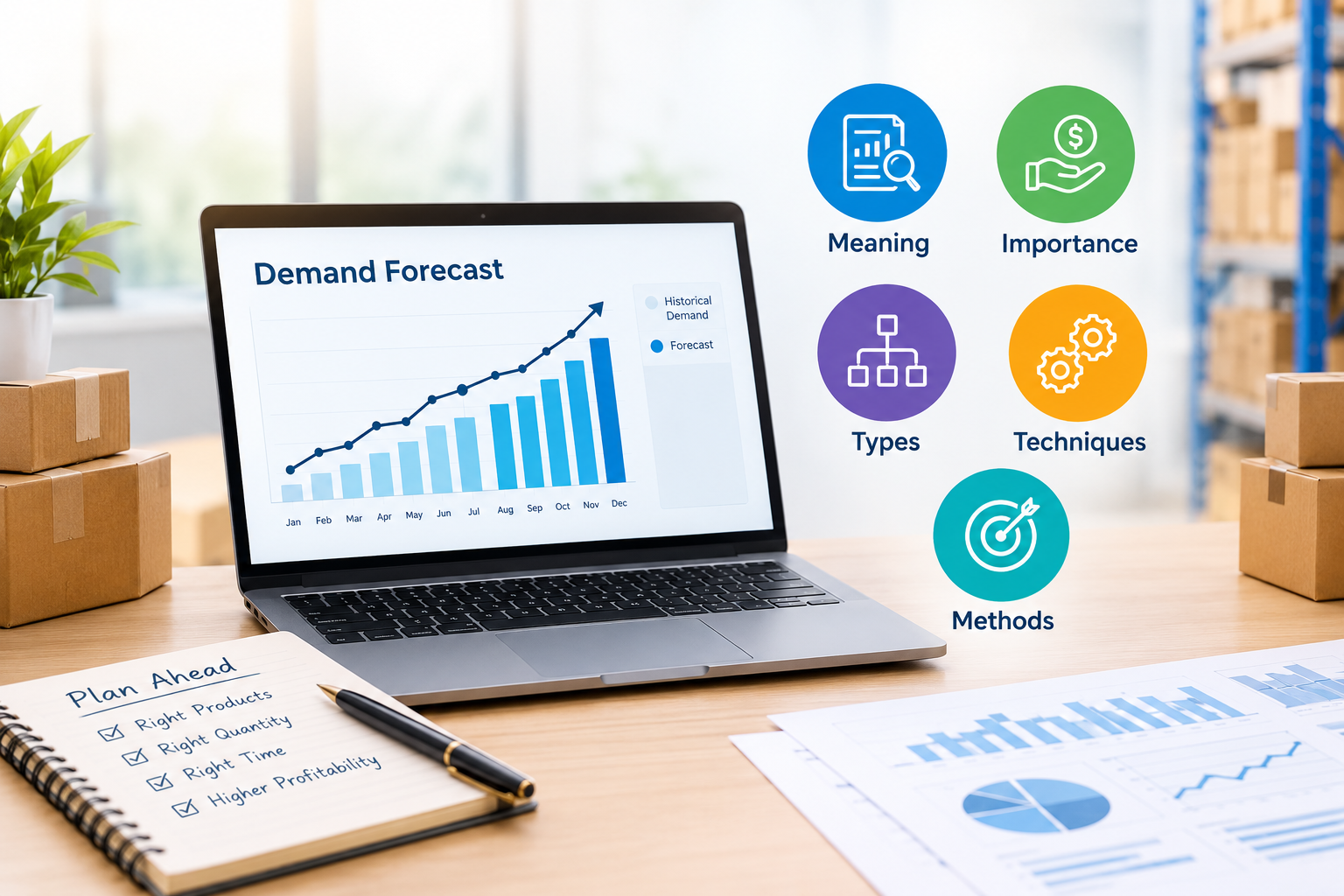
Meaning of Demand Forecasting
Demand forecasting means estimating how much of a product or service customers are likely to buy in the future. It is based on factors such as past sales, customer preferences, market trends, economic conditions, and business conditions.
In simple words, demand forecasting helps a business answer the question: “How much will customers need in the future?”
Types of Demand Forecasting
Demand forecasting can be classified in different ways depending on the time period, level of business activity, and purpose of the forecast.
1. Short-Term Demand Forecasting
Short-term forecasting estimates demand for a relatively short period, such as a few days, months, or up to one year.
Businesses use it for:
- Managing inventory
- Planning daily or monthly production
- Scheduling workers
- Managing cash requirements
- Planning sales and promotions
For example, a supermarket may forecast the demand for groceries for the next month to ensure that popular products do not go out of stock.
2. Long-Term Demand Forecasting
Long-term forecasting estimates demand for a longer period, usually several years into the future.
It is useful for major business decisions such as:
- Expanding production capacity
- Opening new branches
- Purchasing machinery
- Entering new markets
- Making long-term investment decisions
For example, an automobile company may forecast future demand before deciding to build a new manufacturing plant.
3. Micro-Level Demand Forecasting
Micro-level forecasting focuses on the demand for a particular product, service, company, customer group, or market segment.
For example, a smartphone company may forecast the demand for a particular model among young customers in a specific region.
4. Macro-Level Demand Forecasting
Macro-level forecasting looks at demand on a broader level. It considers overall market and economic conditions, such as income levels, inflation, employment, population growth, and changes in consumer spending.
For example, a company may study the growth of the overall electric vehicle market before deciding whether to increase its investment in electric vehicles.
5. Industry-Level Demand Forecasting
Industry-level forecasting estimates the future demand for products or services across an entire industry.
For example, companies in the tourism industry may forecast the expected growth in travel demand over the next few years.
Techniques & Methods of Demand Forecasting
There is no single method that works for every business. Companies choose forecasting methods based on the type of product, availability of data, market conditions, and purpose of the forecast.
The major techniques can be divided into qualitative methods and quantitative methods.
A. Qualitative Methods
Qualitative methods are mainly based on opinions, experience, judgment, and market knowledge. They are especially useful when historical data is limited or when a company is launching a new product.
1. Consumer Survey Method
Under this method, customers are directly asked about their future buying plans and preferences.
Businesses may collect information through questionnaires, interviews, online surveys, or feedback forms.
Example: A company planning to launch a new food product may ask consumers whether they would buy it and how frequently they would purchase it.
2. Expert Opinion Method
In this method, the opinions of experienced professionals, managers, industry experts, or sales specialists are used to estimate future demand.
Experts use their knowledge of the market, competitors, customers, and economic conditions to make predictions.
3. Sales Force Opinion Method
Salespeople regularly interact with customers, so they often have useful information about changing customer preferences and market demand.
A company can collect estimates from its sales team and combine them to prepare a demand forecast.
4. Delphi Method
The Delphi method collects opinions from a group of experts. The experts provide their estimates independently, and the information is reviewed through several rounds until a reasonable level of agreement is reached.
This method can be useful when forecasting demand for new products or uncertain markets.
B. Quantitative Methods
Quantitative methods use numerical data and statistical techniques to estimate future demand. These methods are more suitable when sufficient historical data is available.
1. Trend Analysis
Trend analysis studies past demand or sales data to identify a general pattern.
If sales have been steadily increasing over several years, the business may use that trend to estimate future demand.
2. Moving Average Method
The moving average method calculates the average demand over a selected number of previous periods.
For example, a company can use the average sales of the last three months to estimate demand for the next month.
This method helps reduce the effect of sudden fluctuations in sales data.
3. Exponential Smoothing
Exponential smoothing gives greater importance to recent sales data while calculating future demand.
It is useful when recent changes in demand are more relevant than older information.
4. Regression Analysis
Regression analysis studies the relationship between demand and factors that may influence it.
For example, the demand for a product may depend on:
- Product price
- Customer income
- Advertising expenditure
- Population
- Competitors' prices
- Seasonal conditions
By studying these relationships, businesses can estimate how changes in these factors may affect future demand.
5. Time Series Analysis
Time series analysis uses historical data collected over a period of time. It examines patterns such as trends, seasonal changes, and cycles.
For example, an ice cream company may notice that demand increases every summer. This seasonal pattern can be considered while preparing the forecast.
Importance of Demand Forecasting
Demand forecasting plays an important role in business planning and decision-making. A good forecast helps a company prepare for future market conditions and use its resources more effectively.
1. Production Planning
Forecasting tells a business how much customers are likely to purchase. Based on this information, the company can plan its production levels.
This reduces the chances of producing too much or too little.
2. Inventory Management
Businesses need to maintain enough stock to meet customer demand. Accurate forecasting helps determine the right level of inventory.
It can reduce both stock shortages and excess inventory.
3. Supports Financial Planning
Future demand has a direct effect on sales and revenue. Demand forecasts help businesses prepare budgets, estimate future income, and plan their expenses.
4. Workforce Planning
When demand is expected to increase, a company may need additional workers. When demand is expected to fall, it may need to adjust staffing levels.
Therefore, forecasting supports better workforce planning.
5. Pricing Decisions
Demand forecasting provides useful information for pricing products and services. Businesses can study expected demand before deciding whether to increase, decrease, or maintain their prices.
Conclusion
Demand forecasting is an important part of modern business planning. It helps a company estimate future customer demand and make informed decisions about production, inventory, finance, pricing, employees, marketing, and expansion.

 English
 Arabic
 French
 Spanish
 Portuguese
 Deutsch
 Turkish
 Dutch
Dutch
 Italiano
 Romaian
 Portuguese (Brazil)
 Greek
Greek