
How an Employee Management System Reduces HR Administrative Work
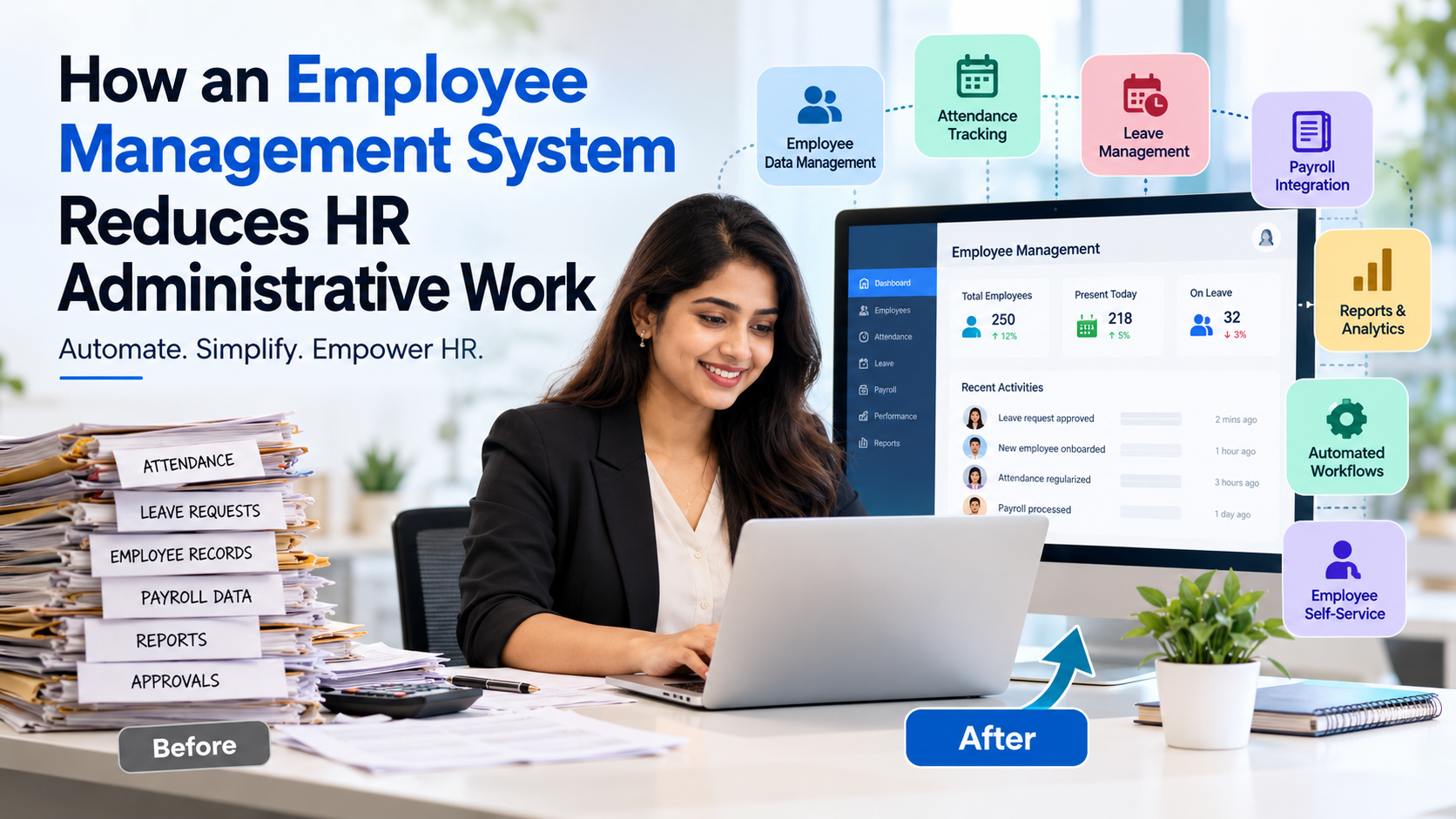
Human Resource departments play a crucial role in managing employees, maintaining workplace productivity, and ensuring smooth business operations. However, HR professionals often spend a significant portion of their working hours handling repetitive administrative tasks such as maintaining employee records, tracking attendance, processing leave requests, updating payroll information, and preparing reports.
As organizations grow, these responsibilities become increasingly complex. Managing employee information manually through spreadsheets, emails, and paperwork can lead to errors, delays, and unnecessary workloads.
This is where an employee management system can make a difference. By automating routine HR activities and centralizing employee information, businesses can reduce administrative work, improve accuracy, and allow HR teams to focus on more valuable responsibilities.
Instead of spending hours updating records or responding to routine employee queries, HR professionals can dedicate more time to employee engagement, talent development, workforce planning, and organizational growth.
In this article, we will explore how an employee management system helps reduce HR administrative work and why businesses should consider adopting one.
What Is an Employee Management System?
An employee management system is a digital platform designed to simplify and automate various activities involved in managing employees throughout their employment lifecycle.
It provides a centralized system where HR teams can store employee information, monitor attendance, manage leave requests, track performance, and handle other workforce-related activities.
Traditionally, organizations maintained employee records using physical files or multiple spreadsheets. While these methods might work for smaller teams, managing hundreds or thousands of employees manually can become time-consuming and challenging.
An employee management system brings essential HR functions together, making information easier to access, update, and manage.
Key Features of an Employee Management System
Some important features include:
-
Employee Database Management: Stores employee details, documents, and employment history in one location.
-
Attendance Management: Tracks employee attendance, working hours, shifts, and overtime.
-
Leave Management: Simplifies leave applications, approvals, and balance tracking.
-
Payroll Integration: Connects employee attendance and salary-related information with payroll processing.
-
Employee Self-Service: Allows employees to access their information and complete routine HR requests independently.
-
Performance Management: Helps organizations monitor employee goals, achievements, and performance reviews.
-
HR Reports and Analytics: Provides insights into workforce trends and HR operations.
These features help reduce manual effort while improving operational efficiency.
Why HR Administrative Work Is a Challenge for Businesses
Before understanding how an employee management system reduces administrative work, it is important to identify the challenges associated with traditional HR processes.
In many organizations, HR professionals are responsible for maintaining employee records, tracking attendance, managing leave balances, coordinating approvals, responding to employee queries, and preparing payroll inputs.
When these activities are handled manually, several challenges can arise.
1. Repetitive Data Entry
HR teams often enter the same employee information into multiple spreadsheets or software applications. This duplication increases workload and creates opportunities for errors.
2. Time-Consuming Approvals
Leave applications, attendance corrections, and employee requests may require multiple emails and follow-ups before receiving approval.
3. Difficulty Managing Employee Records
Searching for employee documents, employment details, or historical records can take considerable time when information is scattered across different systems.
4. Increased Risk of Human Errors
Manual calculations and data entry can result in incorrect attendance records, payroll discrepancies, and outdated employee information.
5. Limited Visibility into HR Operations
Without centralized reporting, HR managers may struggle to obtain timely information about absenteeism, workforce availability, or pending approvals.
An employee management system addresses these challenges by introducing automation, centralized information, and standardized workflows.
10 Ways an Employee Management System Reduces HR Administrative Work
1. Automates Employee Data Management
Employee information is one of the most important resources managed by HR departments.
From joining details and contact information to salary structures and employment documents, organizations must maintain accurate records throughout an employee's journey.
Managing this information manually can become challenging, especially when employees change departments, receive promotions, or update personal information.
An employee management system simplifies the process by maintaining employee details in a centralized database.
HR professionals can easily access relevant records without searching through spreadsheets or physical documents.
Additionally, authorized employees can update certain personal details through employee self-service features, subject to organizational approval policies.
How it reduces administrative work:
-
Eliminates repetitive data entry across multiple records.
-
Makes employee information easier to search and update.
-
Reduces paperwork and manual recordkeeping.
-
Helps maintain consistent employee information.
As a result, HR teams spend less time managing employee records and more time supporting organizational needs.
2. Simplifies Attendance Tracking
Attendance management is another administrative task that consumes significant HR resources.
In traditional workplaces, HR professionals may need to manually review attendance sheets, verify employee working hours, calculate overtime, and identify attendance discrepancies.
These tasks become even more complex when organizations operate across multiple offices or manage employees working in different shifts.
An employee management system simplifies attendance tracking by collecting attendance information from integrated sources such as biometric devices, mobile attendance applications, or web-based attendance systems.
Depending on the configuration, the system can automatically calculate working hours, late arrivals, early departures, and overtime.
HR teams can then review exceptions instead of checking every attendance record manually.
How it reduces administrative work:
-
Reduces manual attendance calculations.
-
Simplifies shift and overtime tracking.
-
Makes attendance discrepancies easier to identify.
-
Provides attendance reports for payroll processing.
This improves attendance accuracy and minimizes the time required for monthly attendance reconciliation.
3. Streamlines Leave Management
Handling employee leave requests manually can create unnecessary administrative work.
Employees may submit leave applications through emails or messages, while managers must verify leave balances and approve requests.
HR teams are then responsible for updating leave records and ensuring accurate balances.
An employee management system automates many of these activities through digital leave management workflows.
Employees can submit leave requests through an online portal or mobile application. Managers receive notifications and can approve or reject applications based on organizational policies.
Once approved, leave balances and relevant records can be updated automatically.
How it reduces administrative work:
-
Eliminates paper-based leave applications.
-
Automates leave balance calculations.
-
Reduces approval follow-ups.
-
Provides visibility into team leave schedules.
-
Simplifies leave reporting.
This allows HR professionals to manage employee leave more efficiently without maintaining separate trackers.
4. Reduces Payroll Preparation Efforts
Payroll processing is one of the most sensitive and time-consuming responsibilities of an HR department.
Before processing salaries, HR teams must ensure that attendance details, leave records, overtime, deductions, and salary changes are accurate.
When this information is maintained across separate spreadsheets, collecting and verifying payroll inputs can require substantial manual effort.
An employee management system integrated with payroll software can simplify this process.
Attendance records, approved leave, and other relevant payroll inputs can flow into the payroll system based on configured rules.
This reduces the need for manual data transfers and minimizes the possibility of discrepancies.
For example, if an employee takes unpaid leave, the relevant leave information can be reflected in payroll calculations according to company policies.
How it reduces administrative work:
-
Reduces manual payroll data collection.
-
Simplifies attendance and leave reconciliation.
-
Minimizes duplicate data entry.
-
Helps identify payroll discrepancies.
-
Supports more consistent payroll processing.
However, HR teams should continue reviewing payroll inputs, exceptions, and statutory requirements before finalizing salaries.
5. Empowers Employees Through Self-Service
One of the biggest contributors to HR administrative work is responding to routine employee requests.
Employees frequently contact HR teams to obtain payslips, check leave balances, update personal details, request documents, or clarify attendance records.
While these requests are necessary, handling them individually can take up valuable working hours.
An employee management system with an Employee Self-Service (ESS) portal helps reduce this dependency.
Employees can log in to the portal and access relevant employment information independently.
For example, an employee who needs a previous month's payslip can download it directly instead of contacting HR.
Similarly, employees can view leave balances, apply for leave, submit attendance regularization requests, and track approval statuses.
How it reduces administrative work:
-
Reduces repetitive employee queries.
-
Minimizes manual document-sharing requests.
-
Gives employees direct access to relevant information.
-
Speeds up routine HR transactions.
Employee self-service improves convenience for employees while helping HR teams focus on more complex responsibilities.
6. Automates Employee Onboarding
Employee onboarding involves several administrative activities, including collecting personal information, verifying documents, creating employee profiles, sharing company policies, and coordinating with different departments.
When these activities are handled manually, HR teams may need to send multiple emails, track pending documents, and maintain onboarding checklists.
An employee management system can simplify onboarding by introducing standardized digital workflows.
New hires may be able to complete onboarding forms, upload necessary documents, and access company information through a centralized platform.
HR professionals can track onboarding progress and identify pending activities without maintaining separate spreadsheets.
For example, instead of repeatedly following up with new employees for missing documents, the system can highlight incomplete onboarding tasks and send reminders where supported.
How it reduces administrative work:
-
Simplifies document collection.
-
Standardizes onboarding activities.
-
Reduces manual follow-ups.
-
Improves visibility into onboarding progress.
-
Helps maintain organized employee records from day one.
A structured onboarding process also creates a more professional experience for new employees.
7. Simplifies Performance Management
Employee performance management often involves collecting feedback, tracking goals, scheduling reviews, and maintaining performance evaluation records.
In organizations using manual processes, HR teams may need to coordinate multiple spreadsheets, evaluation forms, and email conversations.
An employee management system with performance management capabilities helps organize these activities.
Managers can assign goals, review employee achievements, provide feedback, and complete performance evaluations through structured workflows.
HR professionals can monitor pending reviews and identify employees whose evaluations require attention.
How it reduces administrative work:
-
Centralizes employee performance records.
-
Reduces manual review coordination.
-
Simplifies goal tracking.
-
Supports automated review reminders.
-
Makes performance reports easier to prepare.
This enables HR teams to spend more time improving performance management practices rather than coordinating administrative activities.
8. Generates HR Reports Automatically
HR reporting is essential for understanding workforce trends and making informed business decisions.
Organizations frequently require reports related to employee headcount, attendance, absenteeism, leave utilization, employee turnover, and other HR metrics.
Preparing these reports manually often involves gathering information from multiple spreadsheets, checking data accuracy, and creating summaries.
An employee management system can simplify reporting through predefined reports and configurable dashboards.
HR managers can access workforce information without manually compiling data every time.
For example, instead of reviewing individual attendance sheets to identify absenteeism trends, HR teams can use attendance reports to analyze relevant patterns.
How it reduces administrative work:
-
Reduces manual report preparation.
-
Provides faster access to workforce information.
-
Minimizes repetitive data compilation.
-
Makes HR trends easier to identify.
-
Supports data-driven workforce planning.
With reliable reporting tools, HR departments can shift their focus from collecting data to interpreting it.
9. Improves Document Management
HR departments manage numerous employee documents, including appointment letters, identity records, policy acknowledgments, performance letters, and employment-related forms.
Maintaining these documents manually can create storage challenges and make document retrieval difficult.
An employee management system with digital document management capabilities provides a centralized location for organizing employee files.
Authorized HR professionals can upload, access, and manage documents according to their assigned permissions.
Some systems also support document-related workflows and reminders for activities such as contract renewals.
How it reduces administrative work:
-
Reduces physical paperwork.
-
Makes employee documents easier to retrieve.
-
Helps prevent misplaced records.
-
Simplifies document organization.
-
Supports controlled access to sensitive information.
Centralized document management also helps organizations maintain more consistent recordkeeping practices.
10. Automates Approval Workflows and Notifications
HR operations often depend on approvals from managers, department heads, or other authorized personnel.
Whether an employee requests leave, submits an expense claim, or applies for an attendance correction, the request may need to pass through multiple approval stages.
Manual approval processes often create delays because HR professionals must track requests and remind managers to take action.
An employee management system can automate these workflows based on predefined approval rules.
Requests can be routed to the appropriate approvers, while notifications and reminders help keep the process moving.
Managers can view pending requests and take action through the system.
How it reduces administrative work:
-
Eliminates unnecessary email follow-ups.
-
Improves visibility into pending approvals.
-
Reduces manual request tracking.
-
Helps standardize approval processes.
-
Maintains records of approval actions.
This creates a more organized and transparent process for both employees and managers.
Benefits of Reducing HR Administrative Work
Reducing administrative responsibilities does more than save time. It can improve the overall effectiveness of HR operations.
Improved HR Productivity
When repetitive tasks are automated, HR professionals can manage their responsibilities more efficiently and focus on activities that require human judgment.
Better Employee Experience
Employees benefit from faster access to information, simplified requests, and clearer approval processes.
Reduced Operational Errors
Automated calculations and centralized records help minimize errors caused by repetitive manual data entry. Regular audits and accurate system configurations remain important.
Improved Data Accuracy
Maintaining employee information in a centralized platform reduces inconsistencies between separate records and systems.
Faster Decision-Making
Timely workforce reports help HR managers identify trends and make informed decisions.
Greater Scalability
As businesses grow, employee management systems can help HR teams manage larger workforces without increasing manual work at the same rate.
How to Choose the Right Employee Management System
Not every employee management system offers the same features or capabilities. Businesses should evaluate their operational requirements before selecting a solution.
Here are some important factors to consider.
|
Feature |
Why It Matters |
|---|---|
|
Centralized employee database |
Simplifies employee information management |
|
Attendance and leave management |
Reduces manual tracking and calculations |
|
Payroll integration |
Streamlines payroll input preparation |
|
Employee self-service |
Reduces routine HR requests |
|
Automated approval workflows |
Minimizes manual follow-ups |
|
HR analytics and reporting |
Improves workforce visibility |
|
Mobile accessibility |
Supports employees working across locations |
|
Data security and access controls |
Helps protect confidential employee information |
|
Scalability |
Supports workforce and business growth |
Businesses should also evaluate the software's ease of use, implementation support, integration capabilities, and overall cost.
A system that aligns with existing HR processes is more likely to deliver meaningful improvements in administrative efficiency.
How Can Businesses Successfully Implement an Employee Management System?
Simply purchasing employee management software does not automatically eliminate administrative work. Successful implementation requires planning and employee adoption.
Organizations should begin by identifying the HR activities that consume the most time.
For example, if attendance reconciliation and payroll preparation are the biggest challenges, automating those processes may deliver immediate operational benefits.
Businesses should then review their existing employee data, standardize HR policies, and configure workflows according to organizational requirements.
Employee training is equally important. HR teams, managers, and employees should understand how to use the system effectively.
After implementation, organizations should monitor administrative workloads, employee adoption, and process accuracy to identify opportunities for improvement.
A gradual, well-planned implementation can help businesses achieve better results while minimizing operational disruption.
The Future of Employee Management: Less Administration, More Strategy
Employee management technology continues to evolve with advancements in artificial intelligence, workflow automation, and workforce analytics.
Modern HR software are increasingly designed to help employees find information quickly, assist managers with routine approvals, and provide HR professionals with more actionable insights.
AI-powered chatbots, for example, can answer common employee questions without requiring HR intervention for every request.
Advanced analytics can also help organizations identify workforce patterns and anticipate potential operational challenges.
However, technology should support HR professionals rather than replace their judgment.
Sensitive employee matters, complex workplace decisions, and organizational policies still require human involvement.
The objective of employee management automation is to reduce repetitive work so HR professionals can devote more attention to people, performance, and business growth.
Conclusion
HR departments are responsible for much more than maintaining employee records and processing routine requests. They play an important role in employee development, workplace culture, workforce planning, and organizational success.
However, excessive administrative work can prevent HR professionals from focusing on these strategic responsibilities.
An employee management system helps address this challenge by automating attendance tracking, simplifying leave management, centralizing employee records, supporting payroll preparation, and streamlining approval workflows.
It also empowers employees through self-service capabilities and gives HR teams easier access to workforce information.
For businesses looking to improve HR efficiency, adopting the right employee management system can be an important step toward creating a more productive, organized, and employee-friendly workplace.
Ultimately, the real value of employee management technology lies not only in reducing paperwork but also in giving HR professionals more time to focus on what matters most: their people.

 English
 Arabic
 French
 Spanish
 Portuguese
 Turkish
 Dutch
Dutch
 Italiano
 Russian
 Romaian
 Portuguese (Brazil)
 Greek
Greek