
Augmented Reality AR Hardware Market to Reach USD 192.8 Billion by 2034
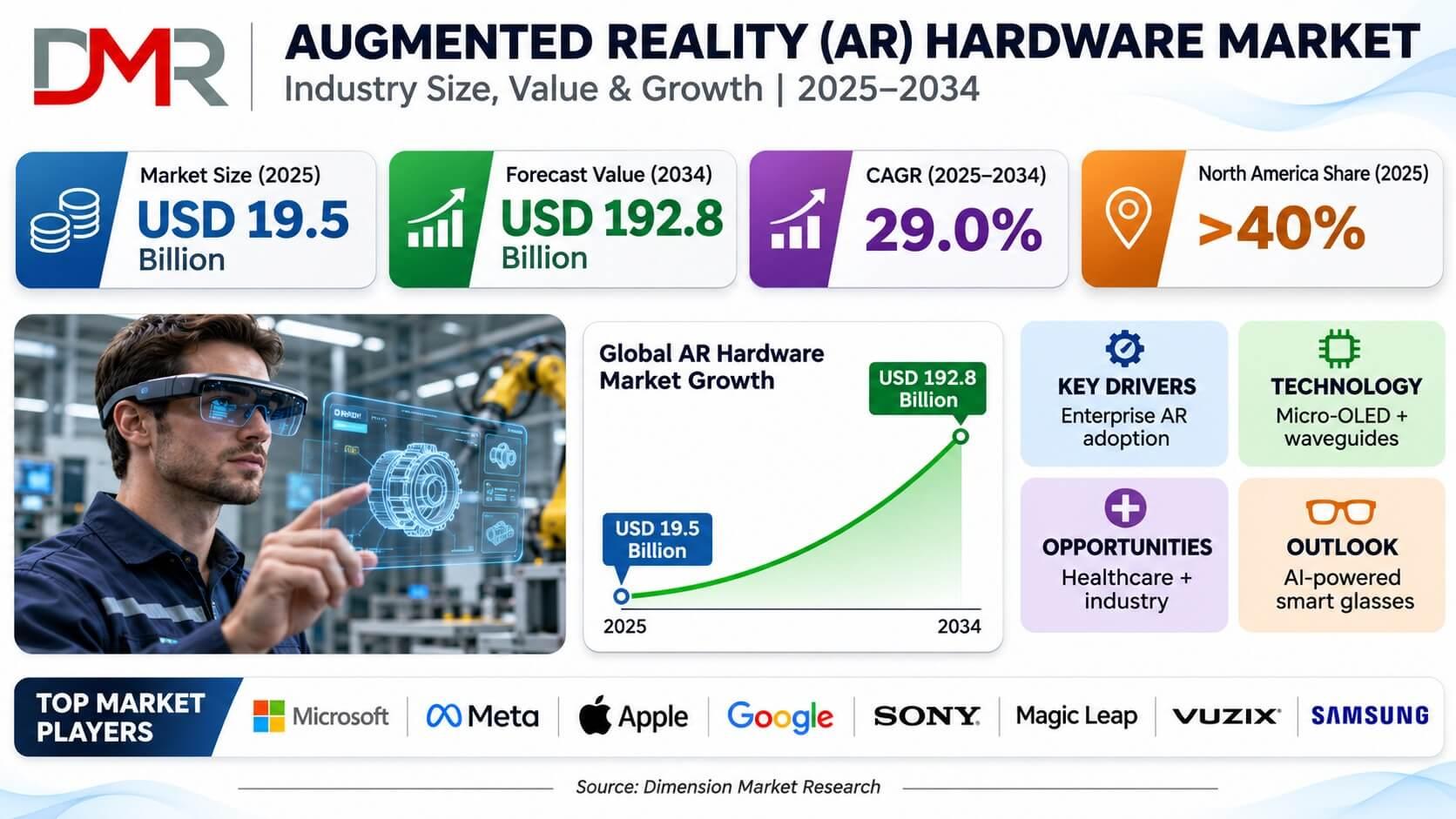
Augmented Reality AR Hardware Market to Reach USD 192.8 Billion by 2034, Growing at 29.0% CAGR
The global Augmented Reality AR Hardware Market is witnessing significant expansion as businesses and consumers increasingly adopt immersive digital technologies. According to Dimension Market Research, the market is valued at USD 19.5 billion in 2025 and is projected to reach approximately USD 192.8 billion by 2034, registering a compound annual growth rate (CAGR) of 29.0% from 2025 to 2034. Increasing investments in smart glasses, head-mounted displays, advanced optical systems, and AI-powered wearable devices are strengthening market demand worldwide.
From industrial manufacturing to healthcare and entertainment, augmented reality hardware is changing how people interact with digital information. Growing demand for hands-free operations, real-time visualization, remote assistance, and immersive experiences is creating new commercial opportunities for hardware manufacturers.
What Is the Current Overview of the Augmented Reality AR Hardware Market?
The Augmented Reality AR Hardware Market comprises physical devices and components that integrate digital information with real-world environments. These technologies include AR headsets, smart glasses, head-up displays, optical waveguides, cameras, sensors, processors, and specialized connectivity modules.
Market growth is primarily supported by enterprise digital transformation, Industry 4.0 initiatives, and advancements in display miniaturization. Manufacturing companies use AR devices for assembly guidance and maintenance, while healthcare professionals leverage them for surgical visualization and medical training. Consumer applications, including gaming, navigation, and social experiences, are also expanding the adoption landscape.
Technological improvements in micro-OLED displays, eye tracking, spatial mapping, and edge AI processing are making devices more functional and comfortable. However, high equipment costs, limited battery capacity, and field-of-view limitations continue to influence purchasing decisions.
Request Sample PDF of This Report: https://dimensionmarketresearch.com/request-sample/augmented-reality-ar-hardware-market/
What Is the Expected Value of the Augmented Reality AR Hardware Market by 2034?
According to Dimension Market Research, the global market is expected to experience substantial growth throughout the forecast period.
Market Statistics Snapshot
● The global market is valued at USD 19.5 billion in 2025.
● The market is projected to reach USD 192.8 billion by 2034.
● The industry is forecast to grow at a 29.0% CAGR through 2034.
● North America accounts for over 40.0% of global revenue in 2025.
● The US market is valued at USD 6.6 billion in 2025.
● The US market is projected to reach USD 57.1 billion by 2034.
● Europe is valued at approximately USD 4.9 billion in 2025.
● Japan is projected to reach USD 17.35 billion by 2034.
What Are the Latest Augmented Reality AR Hardware Market Research Findings?
The research identifies enterprise and industrial applications as major sources of AR hardware revenue, supported by demand for operational efficiency and workforce productivity. Head-mounted displays represent a leading device category, while displays and optics remain important components because they determine visual quality and device performance. Industrial manufacturing leads application adoption through assembly guidance, maintenance, and quality inspection. North America maintains the largest regional revenue share, while Asia-Pacific is expected to record the fastest growth. AI integration, lightweight smart glasses, spatial computing, and advanced optical technologies are emerging as important innovation priorities. Healthcare, defense, automotive, and consumer entertainment provide additional opportunities for hardware manufacturers.
Why Is the Augmented Reality AR Hardware Market Growing?
The market is growing as organizations increasingly recognize the operational benefits of augmented reality technology. Industrial businesses are adopting AR wearables to reduce assembly errors, improve maintenance procedures, and provide remote technical assistance. Healthcare organizations are exploring AR visualization for surgical planning, medical education, and clinical applications. Meanwhile, automotive manufacturers are integrating AR head-up displays into vehicles to improve navigation and driver awareness. Improvements in connectivity, processing capabilities, battery efficiency, and optical engineering are further supporting the development of commercially viable devices. Expanding consumer interest in smart glasses and immersive entertainment is creating another important source of demand.
What Are the Key Growth Drivers of the Augmented Reality AR Hardware Market?
● Increasing enterprise adoption of industrial AR wearables.
● Growing demand for hands-free workforce assistance.
● Advancements in micro-OLED and waveguide technologies.
● Rising investments in spatial computing and AI integration.
● Expanding healthcare and surgical visualization applications.
● Growing consumer interest in smart glasses and immersive gaming.
● Increasing defense spending on augmented reality systems.
Which Region Is Expected to Witness the Fastest Market Growth?
Asia-Pacific is expected to register the highest CAGR during the forecast period. The region benefits from its strong consumer electronics manufacturing ecosystem, growing investments in advanced displays, and increasing adoption of industrial automation. China, Japan, South Korea, and Taiwan play important roles in the production of optical components, sensors, batteries, and micro-displays used in AR devices.
North America is expected to maintain its leadership in revenue, accounting for over 40.0% of the global market in 2025. The United States benefits from established technology companies, venture capital investments, defense procurement, and early enterprise adoption.
Europe represents another important regional market, with a projected value of USD 4.9 billion in 2025 and approximately USD 48.2 billion by 2034. Germany, France, and the United Kingdom are supporting adoption through automotive engineering, industrial automation, and digital manufacturing initiatives.
Japan's market is estimated at USD 1.76 billion in 2025 and is expected to reach approximately USD 17.35 billion by 2034. Its advanced electronics, robotics, and optical technology industries provide a strong foundation for AR hardware innovation.
Which Segments Show the Highest Growth Potential Within the Augmented Reality AR Hardware Market?
Head-Mounted Displays and Smart Glasses
Head-mounted displays represent a leading device category in the Augmented Reality AR Hardware Market, particularly across enterprise and industrial applications. Optical see-through and mixed reality headsets allow users to access digital information while maintaining awareness of their physical surroundings. These devices support complex workflows in manufacturing, aerospace, healthcare, and defense. Smart glasses are also gaining attention because of their lightweight construction, hands-free functionality, and suitability for everyday professional activities. Growing investments in wearable optics, improved battery systems, and compact computing components are strengthening the commercial potential of these products.
● Optical see-through head-mounted displays.
● Mixed reality headsets and enterprise smart glasses.
● Monocular and binocular wearable displays.
● Automotive and industrial head-up displays.
Read More About This Market: https://dimensionmarketresearch.com/report/augmented-reality-ar-hardware-market/
Displays, Optics, Sensors, and Processing Components
Displays and optics represent a major component category because they directly influence visual clarity, brightness, field of view, and overall user experience. Waveguides, micro-OLED displays, and micro-LED technologies are becoming increasingly important for developing compact AR devices. Sensors and cameras also play a critical role by enabling motion tracking, eye tracking, depth perception, and environmental understanding. Meanwhile, integrated processors and edge AI computing units support real-time graphics rendering and spatial mapping. Continuous innovation across these components is expected to improve device performance, portability, and commercial affordability.
● Advanced waveguide and holographic optical systems.
● Micro-LED and micro-OLED display technologies.
● Depth, motion, and eye-tracking sensors.
● Integrated processors and edge AI computing units.
Augmented Reality AR Hardware Market Dynamics
What Are the Major Trends Shaping the Market?
One of the most significant trends is the transition toward lightweight, everyday wearable smart glasses. Manufacturers are focusing on comfortable designs, improved battery efficiency, integrated audio, and advanced display technologies. Another important trend is the integration of artificial intelligence with spatial computing. AI-enabled AR hardware can recognize objects, interpret surroundings, and deliver contextual information in real time. Eye tracking, gesture recognition, and improved spatial mapping are also creating more natural interaction methods. These innovations are gradually transforming AR hardware from specialized equipment into versatile digital devices for professional and consumer applications.
What Are the Future Growth Opportunities in the Market?
Healthcare, industrial automation, defense, and consumer electronics offer substantial opportunities for market participants. In healthcare, AR headsets can support surgical visualization, medical training, and anatomical education. Industrial organizations can expand deployments for equipment maintenance, remote collaboration, and employee training. Consumer smart glasses also offer opportunities through navigation, entertainment, communication, and AI-powered assistance. Asia-Pacific presents additional potential because of its electronics manufacturing capabilities and growing demand for immersive technologies. Companies investing in affordable optics, efficient processors, and application-specific hardware are positioned to address these emerging opportunities.
What Challenges Are Affecting the Market?
Despite strong growth prospects, the AR hardware industry faces several adoption barriers. High device prices can discourage small and medium-sized businesses from investing in advanced equipment. Limited battery life, restricted fields of view, display brightness, and device weight can also affect user experience. In addition, privacy concerns surrounding cameras and environmental data collection require careful attention. Software compatibility, content availability, and integration with existing enterprise systems can increase deployment complexity. Manufacturers must address these challenges through cost optimization, ergonomic improvements, stronger data protection, and more reliable hardware platforms.
Who Are the Leading Companies in the Augmented Reality AR Hardware Market?
The competitive landscape includes global technology companies, electronics manufacturers, specialized wearable device developers, and optical component suppliers. Leading participants are investing in product innovation, strategic partnerships, AI integration, and enterprise deployment capabilities.
● Microsoft Corporation
● Meta Platforms, Inc.
● Apple Inc.
● Google LLC (Alphabet)
● Sony Corporation
● Magic Leap, Inc.
● Vuzix Corporation
● Epson
● Nreal (Now Lynx)
● Lenovo
● HTC Corporation
● Samsung Electronics
● Bosch
● Qualcomm
● Intel Corporation
Competition is increasingly centered on display performance, device comfort, processing efficiency, AI capabilities, and ecosystem development. Strategic collaborations between hardware manufacturers and software developers are also influencing product differentiation and commercialization.
Get 10% instant discount on report purchase
Related Reports:
● Edge Computing In Smartphone Market
FAQs
1. What is the projected size of the global Augmented Reality AR Hardware Market by 2034?
2. What is the expected CAGR of the Augmented Reality AR Hardware Market from 2025 to 2034?
3. Which region is expected to experience the fastest growth in the AR hardware industry?
4. What are the major factors driving demand for augmented reality hardware devices?
5. Which device types are included in the global augmented reality hardware market?
6. How is artificial intelligence influencing AR smart glasses and head-mounted displays?
7. Which applications are creating new opportunities for AR hardware manufacturers?
8. What challenges are limiting the widespread adoption of augmented reality hardware?
9. Who are the major companies competing in the global AR hardware market?
10. What are the emerging technology trends shaping the future of AR hardware?
About Us
Dimension Market Research (DMR) is a global market intelligence and consulting firm delivering data-driven insights that help organizations make informed strategic decisions. With expertise across 12+ industries and global markets, DMR provides syndicated reports, custom research, competitive analysis, white space analysis, and business strategy consulting.
Our research solutions combine analytical rigor, industry expertise, and forward-looking intelligence to identify opportunities, reduce risks, and support sustainable growth. Trusted by clients across diverse sectors, DMR is committed to delivering accurate, actionable insights that enable businesses to navigate evolving market landscapes with confidence.
Contact Us
Phone USA: +17323699777
Phone India: +919310023843
E-mail: [email protected]
Address USA: 957 Route 33, Suite 12 #308, Hamilton Square, NJ-08690
Address India: D44, Sector 6, Noida 201301, India

 English
 Arabic
 French
 Spanish
 Portuguese
 Deutsch
 Turkish
 Dutch
 Italiano
 Russian
 Romaian
 Greek