
Healthcare ERP Software Development: Features, Benefits, Cost & Development Process
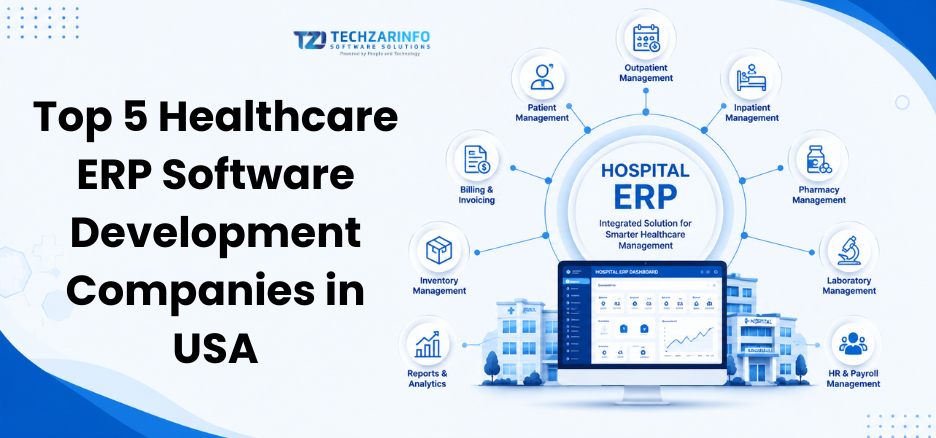
Healthcare organizations manage patients, employees, appointments, billing, inventory, medical equipment, and financial operations every day. Managing all these activities through separate systems can create data gaps, manual work, and delays.
A centralized ERP system helps connect these operations through one platform. It gives healthcare teams better visibility into their processes while making it easier to manage data, resources, and administrative activities.
Businesses looking for medical ERP development can build a solution around their specific workflows instead of depending on a standard system. A customized ERP can support hospitals, clinics, diagnostic centers, pharmacies, and multi-location healthcare organizations.
What Is Healthcare ERP Software?
Healthcare ERP software is a centralized business management system designed for healthcare organizations. It connects departments and business processes through a single platform.
Instead of using separate software for billing, inventory, HR, purchasing, finance, and administration, organizations can manage these activities through an integrated ERP system.
How Healthcare ERP Works?
A healthcare ERP collects information from different departments and makes it available to authorized users. For example, the finance team can manage billing and payments while administrators can monitor staff, inventory, and operational reports.
Role-based access helps ensure that employees can access only the information required for their responsibilities. Dashboards and reports can also provide management teams with a clearer view of business performance.
Who Can Use Healthcare ERP?
Healthcare ERP can be developed for:
-
Hospitals and hospital networks
-
Clinics and specialty centers
-
Diagnostic and laboratory centers
-
Pharmacies
-
Medical equipment businesses
-
Healthcare franchises
-
Multi-location healthcare organizations
Why Do Healthcare Organizations Need ERP Software?
Healthcare operations involve many connected activities. A delay in one department can affect other areas of the organization.
For example, poor inventory visibility can lead to shortages, while disconnected billing and finance systems can make financial reporting more difficult.
A centralized ERP can help organizations:
-
Reduce repetitive administrative work
-
Connect different departments
-
Improve data visibility
-
Manage inventory more effectively
-
Track financial activities
-
Improve resource utilization
-
Support multi-location operations
-
Generate real-time reports
The goal is not simply to replace existing software. The goal is to create a connected operational system that makes everyday healthcare management easier.
Key Modules of Healthcare ERP Software
A healthcare ERP can include different modules based on the organization's size, workflow, and requirements.
Patient and Appointment Management
The system can manage patient information, appointments, schedules, registrations, and related administrative activities from one platform.
Billing and Financial Management
Healthcare businesses can manage invoices, payments, expenses, financial records, and reporting. Integration with payment systems can further simplify the payment process.
Pharmacy and Inventory Management
The inventory module can track medicines, medical supplies, equipment, stock levels, purchases, suppliers, and expiry information.
Human Resource Management
HR teams can manage employee information, attendance, leave, payroll-related activities, departments, and workforce records.
Procurement and Vendor Management
Healthcare organizations can manage purchase requests, suppliers, purchase orders, approvals, and vendor information through a centralized system.
Reporting and Analytics
Management teams can access dashboards and reports covering financial performance, inventory, workforce, operational activities, and other important business metrics.
Advanced Features to Include in Healthcare ERP
Modern ERP systems can go beyond basic data management by adding automation, analytics, and intelligent features.
AI-Powered Analytics
AI can analyze operational data and help management identify patterns, unusual activity, and areas that may require attention.
Predictive Planning
Predictive analytics can help organizations estimate future workforce requirements, inventory demand, patient capacity, and operational needs.
Automated Alerts
The system can send alerts for low inventory, pending approvals, scheduled activities, payment issues, and other important events.
Executive Dashboards
Management can view key business information through dashboards instead of manually collecting data from different departments.
Multi-Branch Management
Organizations operating multiple hospitals, clinics, or healthcare centers can manage branch-level information while maintaining centralized control.
Benefits of Custom Healthcare ERP Development
A customized ERP is designed around the organization's actual processes rather than forcing teams to change their workflows to fit generic software.
Improved Operational Efficiency
Automating repetitive activities can reduce manual data entry and allow employees to focus on more important tasks.
Better Data Visibility
Centralized information makes it easier for authorized users to find the data they need and monitor business activities.
Reduced Administrative Work
Automated workflows for approvals, billing, purchasing, reporting, and notifications can reduce unnecessary manual processes.
Better Resource Management
Organizations can monitor employees, inventory, equipment, and other resources more effectively.
Scalable Operations
A properly designed ERP can support additional users, branches, modules, and integrations as the organization grows.
Healthcare ERP Integration With Existing Systems
Healthcare organizations may already use different applications for clinical and administrative operations. A new ERP should be able to communicate with these systems where required.
EHR and EMR Integration
ERP software can be integrated with electronic health record and electronic medical record systems to improve information flow between administrative and clinical operations.
Laboratory Integration
Integration with laboratory systems can help connect diagnostic workflows and related administrative processes.
Payment Integration
Payment gateway integration can simplify online payment collection and transaction management.
HL7 and FHIR Integration
Healthcare data standards such as HL7 and FHIR can be considered when building integrations with healthcare applications and systems.
Healthcare ERP Development Process
A structured development process helps ensure that the final ERP matches business requirements.
1. Requirement Analysis
The development team studies the organization's departments, workflows, user roles, existing systems, and business requirements.
2. ERP Architecture and Planning
The system architecture, modules, database structure, integrations, security requirements, and technology approach are planned.
3. UI/UX Design
Simple dashboards and interfaces are designed for administrators, finance teams, HR teams, inventory managers, and other users.
4. Module Development
The required ERP modules are developed based on the approved requirements and workflows.
5. Integration
The ERP can be connected with EHR, EMR, laboratory systems, payment gateways, accounting software, APIs, and other required applications.
6. Testing and Security
The system is tested for functionality, performance, usability, integrations, and security before deployment.
7. Deployment and Support
After deployment, the ERP requires monitoring, maintenance, updates, and technical support to keep the system reliable as requirements change.
How Much Does Healthcare ERP Development Cost?
The cost of ERP development depends on the complexity and scope of the project. There is no single price that applies to every healthcare organization.
The main factors affecting the cost include:
-
Number of ERP modules
-
Number of users
-
Level of customization
-
Third-party integrations
-
AI and analytics requirements
-
Security requirements
-
Cloud or on-premise deployment
-
Multi-branch support
-
Mobile application requirements
-
Maintenance and support
A small clinic may require only a few modules, while a large healthcare network may need a complete ERP with multiple branches, integrations, advanced analytics, and complex user permissions.
For this reason, businesses should define their required modules and workflows before requesting a development estimate.
How to Choose a Healthcare ERP Development Partner?
Choosing the right development partner is important because healthcare ERP can involve complex workflows and sensitive business information.
Look for a company with experience in:
-
Custom ERP development
-
Healthcare workflows
-
API and third-party integrations
-
Cloud-based systems
-
Data security
-
Scalable architecture
-
AI and analytics
-
Long-term maintenance
The development partner should also understand your business process instead of simply providing a fixed software package.
Why Choose Techzarinfo for Healthcare ERP Development?
Techzarinfo builds customized ERP solutions based on the operational requirements of healthcare organizations. As an erp development company for healthcare, the focus is on creating software that connects departments and simplifies business processes.
The development approach can include custom modules, dashboards, workflow automation, third-party integrations, reporting, role-based access, and scalable architecture.
The solution can be designed for clinics, hospitals, diagnostic centers, pharmacies, and larger healthcare organizations. Existing applications can also be integrated where required.
Healthcare ERP Development Services
Organizations may require different levels of customization depending on their current systems and future plans. Healthcare ERP development services can cover the complete lifecycle, from requirement analysis and UI/UX design to development, integration, testing, deployment, and ongoing support.
Services can include:
-
Custom healthcare ERP development
-
ERP module development
-
ERP modernization
-
Cloud ERP development
-
ERP integration
-
AI-powered ERP development
-
ERP maintenance and support
A modular approach also allows businesses to start with their most important requirements and add additional functionality as they grow.
Conclusion
Healthcare organizations need more than separate tools to manage their growing operational requirements. A centralized ERP can connect finance, HR, inventory, procurement, administration, appointments, reporting, and other business processes through one platform.
Custom healthcare ERP software allows organizations to build workflows around their actual requirements while keeping the system flexible for future growth. With the right modules, integrations, automation, and analytics, ERP can help healthcare businesses improve operational visibility and manage their resources more efficiently.
If your organization is planning a new ERP or wants to replace disconnected systems, healthcare ERP software development can provide a scalable foundation for building a centralized healthcare management platform.
Frequently Asked Questions
How long does it take to develop healthcare ERP software?
The timeline depends on the number of modules, customization level, integrations, testing requirements, and overall project scope. A basic ERP will generally require less development time than a large multi-branch enterprise system.
Can healthcare ERP integrate with EHR and EMR systems?
Yes. ERP software can be integrated with EHR, EMR, laboratory, payment, accounting, and other healthcare systems depending on the available APIs and integration requirements.
Can ERP support multiple hospitals or branches?
Yes. A scalable ERP can include multi-branch functionality, allowing organizations to manage individual locations while maintaining centralized reporting and administration.
Can AI be added to healthcare ERP?
Yes. AI can be used for analytics, forecasting, automation, alerts, reporting, and other operational use cases depending on the organization's requirements.
Share Your Requirements: https://www.techzarinfo.com/contact-us
Schedule a Free Consultation: https://calendly.com/techzarinfo-sales/30min
Mobile Number/Whatsapp(India): https://wa.me/919952885799

 English
 Arabic
 French
 Spanish
 Portuguese
 Turkish
 Dutch
Dutch
 Italiano
 Russian
 Romaian
 Portuguese (Brazil)
 Greek
Greek