
Can I Get A Free Boiler?
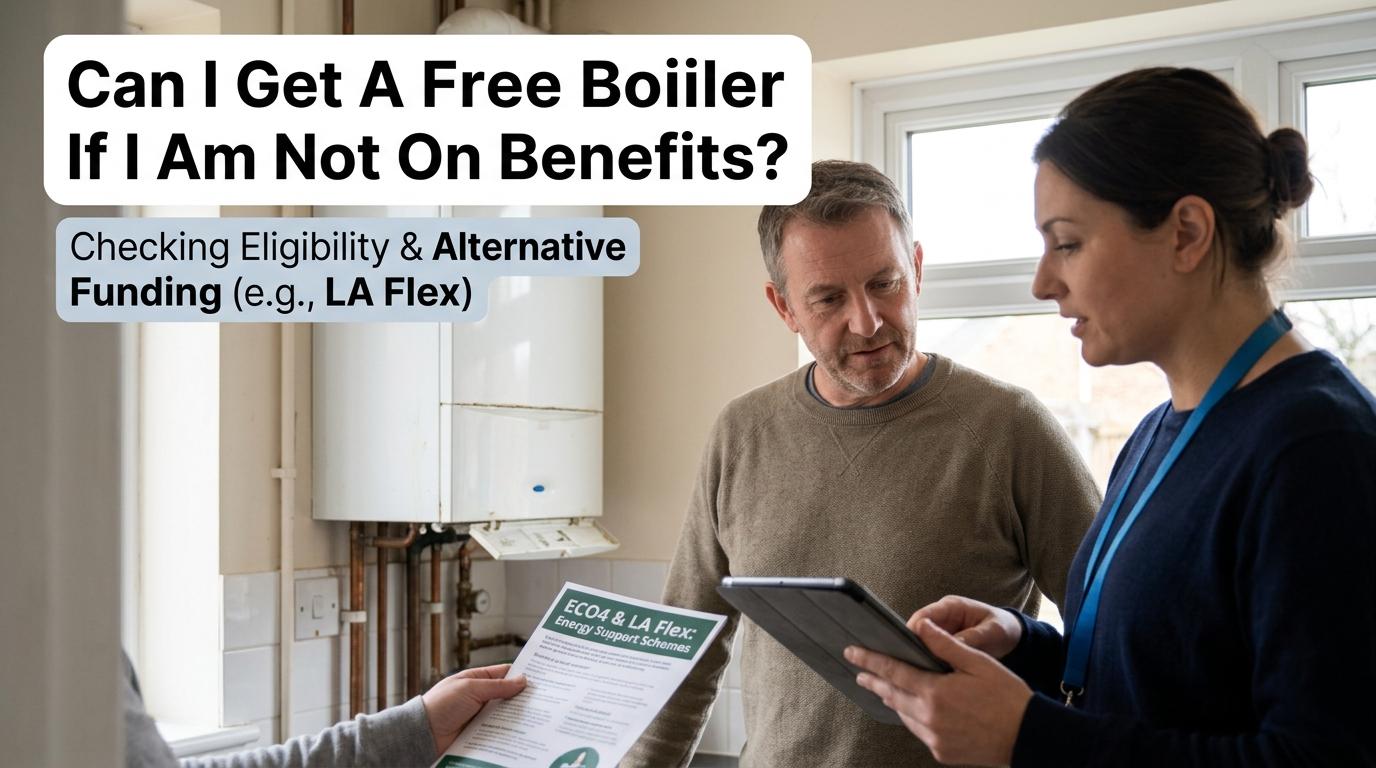
Yes, you may still qualify for heating support even if you do not receive benefits. But being outside the benefits system does not automatically mean you can get a completely free boiler.
The main point to understand is that different government schemes use different eligibility rules. Some look at household income and the condition of your home, while others are based on the heating system you are replacing and the technology you want to install.
So, if you are not on benefits, it is worth checking more than one route before assuming you have to pay for a new heating system yourself.
Can You Get A Free Boiler Without Receiving Benefits?
In some cases, yes. The route can depend on your income, where you live, your home's EPC rating and whether you meet other scheme conditions.
For example, the Warm Homes: Local Grant is available in England to some privately owned homes with an EPC rating from D to G. Household income will usually need to be £36,000 or less. There are also routes for some households above that income level, including certain postcode areas and households receiving specified benefits.
This does not mean every household under the income limit receives a free boiler. The council first checks the property and decides which improvements are suitable. Support can include insulation, smart controls, solar panels and air source heat pumps rather than a standard replacement gas boiler.
That distinction matters because the phrase free boiler scheme is often used online to describe several different types of heating support.
What If Your Income Is Too High For A Free Boiler?
A higher income does not necessarily rule out every government-backed heating grant.
The Boiler Upgrade Scheme works differently. It is not a benefits-based boiler replacement programme. Property owners in England and Wales can apply when replacing an eligible fossil fuel heating system with a qualifying heat pump or, in certain circumstances, a biomass boiler.
Current support includes:
- £7,500 towards an air-to-water heat pump
- £7,500 towards a ground source or water source heat pump
- £5,000 towards an eligible biomass boiler
- £2,500 towards an air-to-air heat pump for residential properties
- Up to £9,000 towards an air-to-water or ground source heat pump for qualifying off-gas-grid properties currently heated by oil or LPG.
There is no benefits test for the Boiler Upgrade Scheme. Instead, you need to meet the property and heating-system requirements.
That makes it particularly relevant to homeowners who earn too much to qualify for income-based support but want to replace an older fossil fuel heating system.
Could Oil-Heated Homes Get More Help?
They can. Since 21 July 2026, eligible off-gas-grid properties replacing an oil or LPG heating system can receive the higher £9,000 Boiler Upgrade Scheme grant for an air-to-water or ground source heat pump. The property must meet the scheme's off-gas-grid requirements.
This is useful for households that do not receive benefits because the grant is not based on receiving income-related support.
It also gives oil-heated homeowners another reason to look at their heating costs. If you are comparing options, questions such as are oil heaters expensive to run should be considered alongside the installation cost, fuel use, maintenance and the grant available for changing the heating system.
The £9,000 figure is a contribution towards a qualifying heat pump installation. It does not mean every oil-heated home receives a free heating system.
What About ECO4 If You Are Not On Benefits?
ECO4 has routes that can help some households without means-tested benefits.
The standard ECO4 route covers households receiving certain qualifying benefits, but ECO4 Flex allows participating local authorities and suppliers to identify some low-income or vulnerable households outside the standard benefits route.
One ECO4 Flex route can cover households with combined gross annual income below £31,000. Other routes can apply where a household has circumstances such as a serious or long-term health condition affected by living in a cold home. Local authorities decide which Flex routes they use.
ECO4 is currently scheduled to run until 31 December 2026. It is also worth knowing that ECO is not a simple grant scheme. Suppliers decide which projects they fund, how much support they provide and which measures they install. Meeting an eligibility route does not guarantee a free replacement.
What Should You Check If You Are Not On Benefits?
Before applying for heating support, check the factors below rather than focusing only on whether you receive benefits.
| What to check | Why it matters |
|---|---|
| Household income | Some schemes use income thresholds |
| EPC rating | Several home improvement schemes focus on less efficient homes |
| Property ownership | Some grants are limited to property owners |
| Existing heating | The type of boiler or heating system can affect eligibility |
| Gas connection | Off-gas-grid properties can qualify for higher heat pump support |
| Location | Some schemes have England-only or local authority rules |
| Scheme availability | Funding and local programmes can affect whether support is offered |
Your EPC is particularly useful when checking home improvement schemes. For the Warm Homes: Local Grant, the property must normally have an EPC rating of D, E, F or G.
Does Not Receiving Benefits Mean You Have To Pay?
No. It simply means you may need to use a different eligibility route.
A household with a moderate income might qualify through a local authority scheme. Another homeowner might not qualify for a free boiler replacement but could receive a substantial Boiler Upgrade Scheme contribution towards a heat pump. Someone else may fall outside both routes and need to fund the work privately.
The important point is to match your circumstances to the scheme rules rather than assuming that benefits are the only way to receive heating support.
For homeowners considering a replacement, checking the existing heating system, EPC rating, household income and property location together gives a much clearer picture of what help may be available.

 English
 Arabic
 French
 Portuguese
 Deutsch
 Turkish
 Dutch
Dutch
 Italiano
 Russian
 Romaian
 Portuguese (Brazil)
 Greek
Greek