
Strike Off a Company: UK Guide to Form DS01
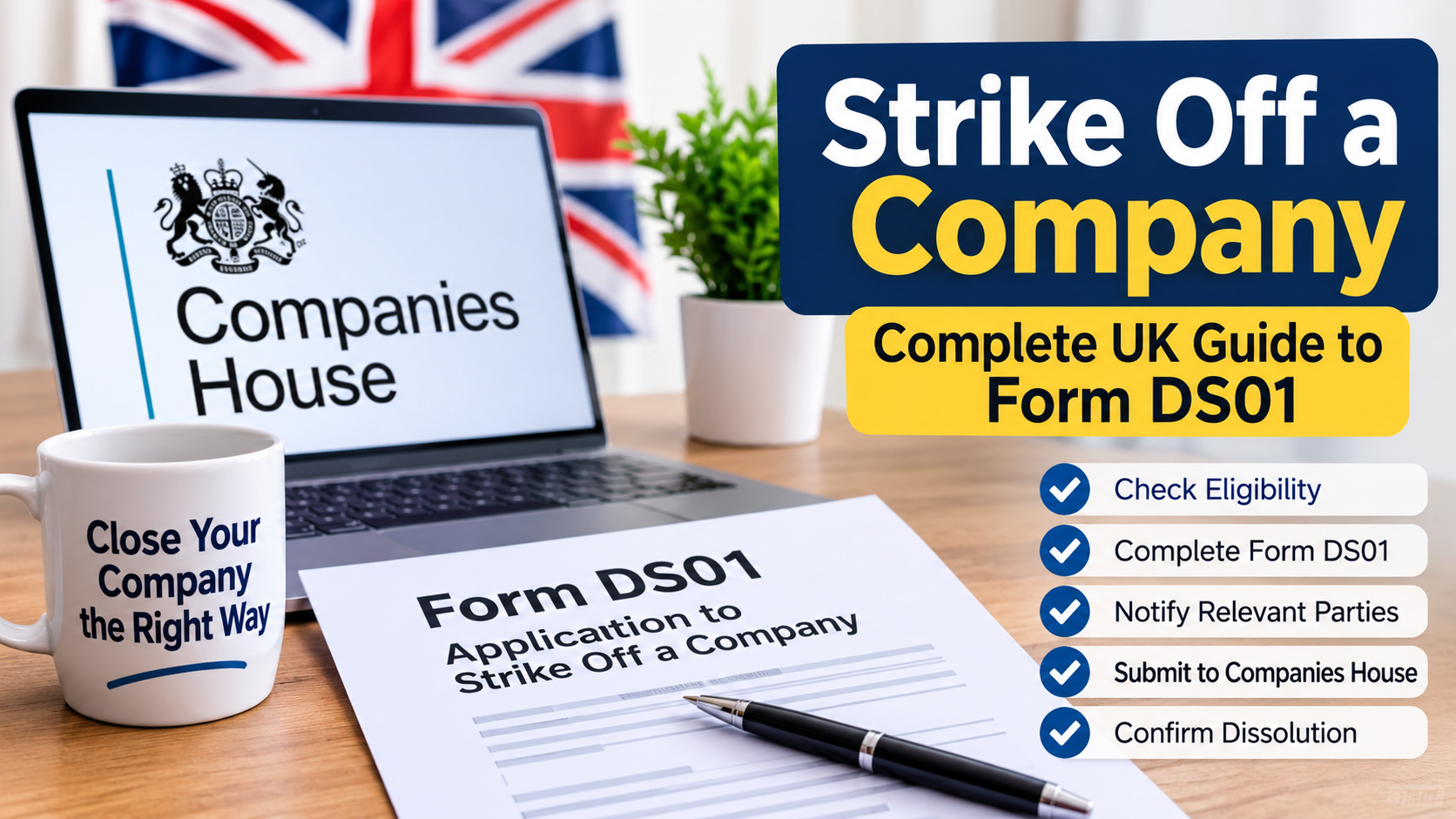
Closing a limited company requires careful planning and proper legal procedures. Many business owners choose to strike off a company when operations end. This process removes the company from the Companies House register. It is also known as voluntary strike off or company dissolution.However, closing a business involves more than submitting a simple application. Directors must consider outstanding debts, company assets, employees, taxes, and legal obligations. Missing important steps can cause delays or serious complications.Understanding the process helps directors close their companies with greater confidence. It also reduces the risk of unexpected problems after dissolution.This guide explains how to strike off a company in the UK. It covers eligibility, the form DS01, Companies House requirements, and common mistakes. You will also discover alternatives when voluntary strike off is unsuitable.
What Does It Mean to Strike Off a Company?
To strike off a company means removing it from the official register. Companies House maintains this register for companies incorporated in the UK.Once dissolved, the company no longer legally exists. It cannot continue operating as an ordinary registered company.Voluntary strike off is commonly used by businesses that have stopped trading. For example, an owner might retire or close an unsuccessful business. A company may also become unnecessary after completing its original purpose.However, striking off is not suitable for every business. Directors must meet specific legal conditions before submitting an application.The company must also deal with its remaining affairs appropriately. This includes addressing debts, assets, tax responsibilities, and employment matters.
Who Can Apply to Strike Off a Company?
Company directors generally submit voluntary strike-off applications to Companies House. The application requires approval from the appropriate majority of directors.Where two directors exist, both must sign the application. For three directors, at least two must sign.The application must contain accurate information about the company. Directors should check the company's registered name and number carefully.Before applying, directors should confirm that the company meets eligibility requirements. Applying when the company is ineligible can create legal consequences.
Eligibility Requirements for Voluntary Strike Off
A company generally cannot apply if it has traded during the previous three months. Selling stock during that period can also affect eligibility.The company must not have changed its name during those three months. Certain property disposals can also prevent an application.The company must not be involved in relevant insolvency proceedings. It must also avoid prohibited arrangements with creditors.Certain activities remain permitted during the final three months. These include preparing the application and concluding outstanding business affairs.Directors should review the official guidance before proceeding. The rules contain specific conditions and exceptions.
When Is Strike Off Unsuitable?
Voluntary strike off is not an alternative to proper insolvency procedures. Directors must consider creditors when the company cannot pay its debts.A company with serious financial difficulties may require formal insolvency proceedings. Depending on its circumstances, liquidation could be more appropriate.Directors should not use strike off to avoid creditor responsibilities. Doing so may lead to legal consequences.Professional advice can help directors choose the correct closure method.
What Is Form DS01?
Form DS01 is the traditional paper application for voluntary company strike off. It allows an eligible company to request removal from the register.The form is associated with Companies House and the Companies Act 2006. Directors use it when a paper application is appropriate.However, Companies House now provides an online closure service. You should generally apply online whenever possible.The paper form is intended for situations where online applications cannot be used.You can find the official form and guidance through the government website.
What Information Does Form DS01 Require?
The form requires accurate details identifying the company. This includes its registered name and company registration number.The relevant directors must sign the application. Their printed names and signature dates must also be included.The application must be completed according to the official instructions. Missing details can cause rejection or unnecessary delays.Directors should check every section before submitting the form. They should also confirm the correct fee and payment method.
Who Must Sign Form DS01?
A majority of the company's directors must sign the application.For a company with one director, that director signs. Both directors must sign when the company has two directors.For companies with three directors, at least two must sign. The same majority principle applies to larger boards.Directors should verify the current requirements before submission. Incorrect signatures can delay the application.
How to Strike Off a Company in the UK
Closing a company involves several practical and legal steps. Completing them in the correct order makes the process easier.
Step 1: Check Whether the Company Qualifies
First, confirm that the company meets the voluntary strike-off conditions. Review its recent trading and business activities.Check whether insolvency proceedings or creditor arrangements affect eligibility. Consider whether the company has outstanding legal obligations.Do not submit an application until eligibility is established. Seek professional advice if the position remains unclear.
Step 2: Stop Trading and Complete Outstanding Business
The company must satisfy the applicable three-month restrictions. During this period, directors should conclude its remaining affairs.Collect outstanding payments and settle legitimate business liabilities. Resolve contracts and other commitments where necessary.Directors should also review company property and intellectual property. These assets may include equipment, domain names, and valuable business rights.Consider whether any refunds remain due from HMRC. Outstanding tax matters should be addressed before dissolution.
Step 3: Deal With Company Assets
Company assets should be dealt with before dissolution. These may include money, equipment, vehicles, investments, and intellectual property.Close the company's bank account at the appropriate time. Transfer or dispose of assets through proper legal procedures.Do not leave valuable assets unaddressed when applying for strike off. Remaining assets can pass to the Crown upon dissolution.This can include money left in company bank accounts. Recovering those assets may require restoring the dissolved company.
Step 4: Address Tax and Employment Responsibilities
Directors must deal with outstanding tax obligations. These may include Corporation Tax, VAT, PAYE, and other liabilities.Contact HMRC regarding the company's tax position. Follow the relevant procedures for ending employer responsibilities.If employees are involved, comply with employment law. Pay outstanding wages and handle redundancy obligations where applicable.Construction businesses should also review their contractor reporting responsibilities. Requirements depend on the company's activities and tax registrations.Keep records of relevant tax filings and payments. These documents may prove useful if questions arise later.
Step 5: Submit the Application
Eligible companies can use the online Companies House closure service. You will need the company's registration number and authentication details.The online service also requires appropriate sign-in information. Each director signing may need to provide an email address.Alternatively, eligible applicants can use the paper DS01 form. Paper applications should follow the latest official instructions.The majority of directors must approve and sign the application. Check every detail before submitting it.
Step 6: Notify Relevant Parties
Directors must send a copy of the application to relevant parties. This must happen within seven days of applying.Those parties include shareholders and existing or likely creditors. Employees and relevant pension fund representatives must also receive notification.Directors who did not sign the application must be informed. Other affected parties may also require notification.Keep evidence showing when and how notices were delivered. This helps demonstrate compliance with the legal requirements.Failure to notify relevant parties can have serious consequences.
Step 7: Wait for Companies House to Process the Application
Companies House reviews the application after receiving it. If acceptable, the proposed strike off is advertised in The Gazette.Interested parties then have an opportunity to raise objections. An objection may delay or prevent the company's dissolution.If no valid obstacle arises, the process can continue. The company is generally struck off after the notice period expires.A second Gazette notice confirms the company's dissolution. The company then ceases to exist legally.The process can take longer if objections or administrative issues arise.
Companies House DS01: Understanding the Fees
The cost of applying depends on the submission method. Companies House currently charges different fees for online and paper applications.The online application fee is £13. A paper application using DS01 costs £18.These fees reflect the published Companies House charges. Check the latest government guidance before submitting your application.Online applications are generally cheaper and more convenient. The digital service also includes checks that help prevent common mistakes.Paper applications may take longer to process. Incorrect paperwork can cause further delays.
How Can You Avoid Application Delays?
Start by checking the company's registered details carefully. Ensure the company name and registration number match official records.Confirm that the correct directors have signed. Include all required names, dates, and payment details.Use the latest DS01 form when paper submission is necessary. Follow the official instructions rather than relying on outdated templates.Keep copies of the application and supporting records. These documents can help resolve later queries.
What Happens After a Company Is Struck Off?
Once the company is dissolved, it no longer legally exists. Its bank accounts are frozen, preventing ordinary transactions.Any remaining bank balance may pass to the Crown. Other assets may also become Crown property.This can create problems if directors overlook refunds or valuable property. Restoring the company may become necessary to recover those assets.Directors should therefore complete a thorough review before applying. A careful closure can prevent avoidable complications.
Can a Company Be Restored After Strike Off?
Yes, restoration may be possible in qualifying circumstances. The appropriate process depends on how the company was dissolved.Administrative restoration is available for certain companies removed by Companies House. Court restoration may be necessary in other situations.Former directors, shareholders, and creditors may have relevant restoration rights. Eligibility depends on the circumstances and applicable legal requirements.Restoration can involve additional costs and administrative work. It may also require outstanding filings or other matters to be addressed.This makes preparation particularly important before voluntary strike off.
Common Mistakes When Applying to Strike Off a Company
Many application problems arise from incomplete preparation. Understanding common mistakes can help directors avoid unnecessary difficulties.
Applying Before Meeting the Eligibility Conditions
A company must satisfy the relevant legal conditions. Recent trading can make an application ineligible.Directors should review the previous three months carefully. They should also consider insolvency proceedings and creditor arrangements.
Leaving Money in the Company Bank Account
Directors sometimes forget about remaining bank balances. Dissolution can cause those funds to pass to the Crown.Review every account before submitting the application. Resolve outstanding refunds and payments wherever possible.
Ignoring Creditors
Outstanding debts do not disappear simply because directors submit DS01. Creditors may object to the proposed strike off.Directors must consider creditor interests and applicable legal obligations. Insolvent companies may need a formal insolvency procedure instead.
Failing to Notify Relevant Parties
The application must be shared with specified interested parties. Directors should complete these notifications within the required timeframe.Maintain evidence of delivery for future reference. Proper records can help demonstrate compliance.
Using Incorrect Information on DS01
Incorrect company details can lead to application delays. Missing signatures and dates can also cause problems.Review the completed form before submission. Compare its information against the Companies House register.
Alternatives to Voluntary Company Strike Off
Strike off is not the only way to close a company. The right option depends on its financial position and circumstances.
Members' Voluntary Liquidation
Members' voluntary liquidation may suit certain solvent companies. It involves a formal liquidation process managed by an insolvency practitioner.This route can be appropriate where substantial assets require distribution. It may also provide a structured method for closing complex businesses.However, the process usually costs more than straightforward strike off. Directors should obtain professional advice before deciding.
Creditors' Voluntary Liquidation
Creditors' voluntary liquidation may be appropriate for insolvent companies. It involves a formal process for dealing with company debts.Creditors' interests receive priority under the applicable insolvency rules. Directors must consider their legal responsibilities throughout the process.
Keeping the Company Dormant
Some businesses do not need immediate dissolution. A company can remain dormant if the relevant conditions are satisfied.Dormant companies generally retain filing obligations at Companies House. Directors must also consider any applicable HMRC requirements.This option may suit owners planning future business activity. However, it does not automatically remove administrative responsibilities.
Frequently Asked Questions
1. How Do I Strike Off a Company in the UK?
Check eligibility and resolve outstanding company affairs first. Apply online through Companies House or use DS01 when necessary.Notify relevant parties within seven days of applying. Companies House then reviews the application and publishes the required notice.
2. What Is Form DS01 Used For?
Form DS01 is used to request voluntary removal from the company register. It is the paper application for an eligible company.Companies House generally recommends using its online closure service. Paper DS01 is intended for cases where online applications cannot be used.
3. How Much Does It Cost to Strike Off a Company?
The published fee is £13 for online applications. A paper DS01 application costs £18.Always check the latest Companies House fees before applying. Additional professional fees may apply if you seek advice.
4. How Long Does Company Strike Off Take?
The process includes a statutory notice period. The company is generally struck off after at least two months following publication.Objections or administrative problems can extend the timeline. Directors should avoid relying on a guaranteed completion date.
5. Can I Strike Off a Company With Outstanding Debts?
Outstanding debts require careful consideration before applying. Strike off should not be used to avoid creditor responsibilities.If the company cannot pay its debts, consider formal insolvency options. Professional advice can help identify the appropriate procedure.
6. Can I Apply Using DS01 If My Company Still Trades?
Generally, the company must not have traded during the previous three months. Certain other activities can also make it ineligible.Review the legal conditions before submitting an application. Do not assume that temporarily stopping operations automatically makes the company eligible.
7. Do All Directors Need to Sign DS01?
A majority of directors must sign the application. If the company has two directors, both must sign.For three directors, at least two signatures are required. Check the current form instructions before submission.
8. What Happens to Company Assets After Dissolution?
Remaining company assets can pass to the Crown. These may include bank balances, property, and other valuable rights.Directors should deal with assets before dissolution. Recovering assets afterwards may require company restoration.
9. Can a Creditor Stop a Company Being Struck Off?
A creditor may object when the company owes money. Companies House may delay the strike off while considering the objection.Creditors should provide supporting evidence for their concerns. The correct objection procedure depends on the current rules.
10. Is Online Company Strike Off Better Than Paper DS01?
Online applications generally cost less and are more convenient. The service also checks information before submission.Paper DS01 remains available when online applications cannot be used. Choose the method appropriate to your circumstances.
Conclusion
Choosing to strike off a company can simplify the closure process. However, directors must understand the legal requirements before proceeding.Check eligibility, resolve outstanding affairs, and deal with company assets. Address tax matters, employee obligations, and creditor responsibilities carefully.The form DS01 remains relevant for paper applications. Companies House also provides an online service for eligible companies.Correct preparation can reduce delays and prevent avoidable mistakes. Always review the latest official guidance before submitting an application.If your circumstances are complicated, consider professional legal or insolvency advice. Making an informed decision helps protect everyone affected by the closure.

 Arabic
 French
 Spanish
 Portuguese
 Deutsch
 Turkish
 Dutch
 Italiano
 Russian
 Romaian
 Portuguese (Brazil)
 Greek