
Bespoke Packaging on a Budget for Luxury Brands
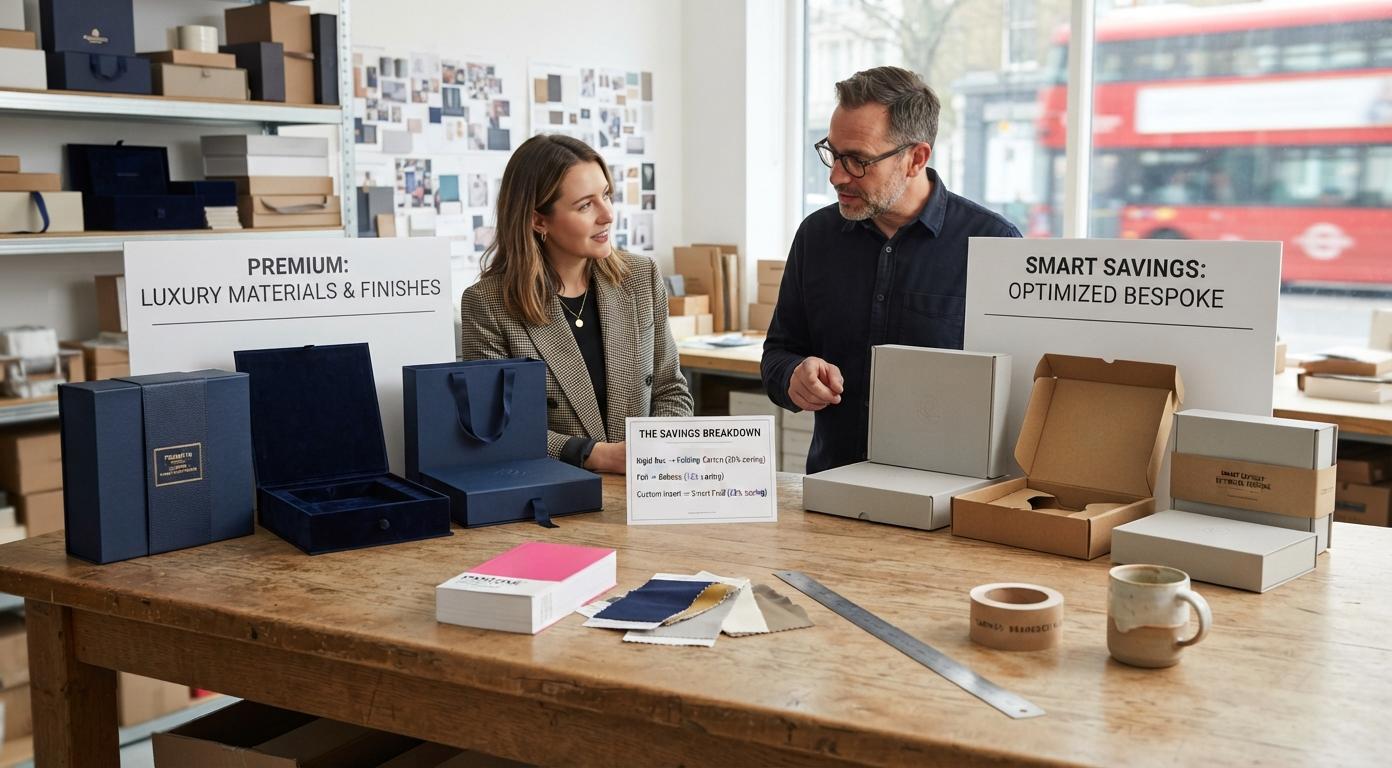
Luxury brands are often told that premium packaging has to be expensive. It’s true that a heavy rigid box with foil, embossing, a satin ribbon and a velvet insert costs more than a plain carton. But the most memorable luxury packaging isn’t necessarily the most expensive. It’s the most considered.
For smaller luxury and premium brands, the challenge is to deliver a high-end experience without spending more on the box than the product can support. The good news is that bespoke packaging offers plenty of ways to save money in places customers won’t notice, so you can spend where they will. This guide shows you where.
What makes packaging feel luxurious?
Before cutting costs, it helps to understand what customers actually notice. Research and experience both point to a few key signals:
• Weight and rigidity. A box that feels solid suggests quality.
• Touch. Textured papers, soft-touch coatings and embossing invite people to handle the box.
• Restraint. Luxury design is usually simple, with lots of space and few colours.
• Precision. Clean edges, tight corners and a perfect lid fit signal craftsmanship.
• The reveal. How the box opens, and what customers see first, shapes the whole experience.
Notice that none of these require every possible finish at once. They depend more on good choices than on big budgets.
1. Choose one hero finish, not five
It’s tempting to add foil, embossing, spot UV and a special coating all on one box. Each process adds cost, and together they can make the box look busy rather than refined.
Instead, pick one hero finish that matches your brand:
• Foil stamping for a classic, high-shine logo.
• Blind embossing (a raised logo with no ink) for quiet, understated luxury.
• Soft-touch lamination for a velvety feel on every surface.
One well-executed detail often looks more expensive than several competing ones.
2. Spend on the lid, save on the base
Customers look at the lid first, and often only the lid. For two-piece bespoke boxes, concentrate your print and finishing budget there. The base can be a plain colour that complements the lid. This approach can cut costs noticeably without changing how premium the box feels.
The same applies to sleeves. A plain rigid box with a beautifully printed sleeve can look as luxurious as a fully printed box, and sleeves are cheaper to reprint when you launch new products.
3. Standardise your sizes
Bespoke packaging boxes don’t have to mean a different size for every product. Every new size needs its own tooling and setup, which adds cost. Instead:
• Group products that are close in size into one box size with different inserts.
• Use one lid design across several sizes.
• Keep a core range of two or three sizes for most of your products.
Fewer sizes also mean larger order quantities per size, which brings the unit price down.
4. Use colour wisely
Full-colour printing on every panel isn’t necessary for a luxury look. Many premium brands use:
• A coloured paper wrap on a rigid box, with only the logo printed.
• One or two spot colours rather than full CMYK.
• Black, white, cream, navy or deep green, which all read as premium.
Coloured or textured wrapping papers give a rich finish without the cost of heavy printing.
5. Rethink inserts
Inserts can be a surprisingly large part of the cost. Foam and velvet-covered inserts look luxurious, but card inserts wrapped in the same paper as the box can look just as refined and are easier to recycle. For many products, a simple card platform with a cut-out is all you need.
If you sell sets, design one insert that works for several product combinations. It reduces the number of different components you need to order.
6. Consider collapsible rigid boxes
Traditional rigid boxes arrive fully assembled, which means you pay to ship and store a lot of air. Collapsible or foldable rigid boxes arrive flat and are folded into shape when packing. They keep the solid feel of rigid packaging while reducing delivery and storage costs. For brands shipping online, this can be a significant saving.
7. Pick the right closure
Magnetic gift boxes are hugely popular because the closure feels premium and the boxes are reused. But magnets add cost. Ask yourself whether your product needs one:
|
Closure type |
Cost |
Best for |
|
Lift-off lid |
Lower |
Most gift and retail products |
|
Drawer with ribbon pull |
Medium |
Small luxury items and sets |
|
Magnetic flap |
Higher |
Hero products, gift sets, jewellery |
|
Ribbon tie |
Medium |
Wedding, event and special-edition boxes |
Keep the magnetic flap for your hero products or gift sets, and use simpler lift-off lids elsewhere.
8. Order smartly
How and when you order makes a big difference to price:
• Order larger quantities of bestsellers to bring down unit costs.
• Plan ahead to avoid rush charges, especially before Christmas.
• Combine orders for different products with the same supplier.
• Ask about stock materials. Suppliers often hold certain papers and boards that cost less than special orders.
• Request a quote breakdown so you can see which elements cost most.
A good supplier will suggest alternatives that keep the look you want at a lower price.
9. Don’t forget the experience inside
Some of the most memorable luxury touches are inexpensive:
• A handwritten or printed thank-you card.
• Tissue paper in a brand colour, sealed with a sticker.
• A short message printed inside the lid.
• A scented card for fragrance or candle brands.
These details create an emotional connection that customers remember long after the box is opened.
10. Keep sustainability in the picture
Luxury customers increasingly expect packaging to be responsible. Fortunately, many sustainable choices also save money:
• Smaller, better-fitting boxes use less material.
• Card inserts are cheaper than foam and easier to recycle.
• Avoiding plastic lamination can simplify production.
• Designing boxes to be kept and reused adds value without extra cost.
A sustainable approach to bespoke box packaging can strengthen your brand story as well as your margins.
Where not to cut corners
Some savings are a false economy. Avoid compromising on:
• Board thickness for rigid boxes. Flimsy walls undermine the luxury feel instantly.
• Lid fit. A loose or tight lid ruins the opening experience.
• Print quality on your logo. It’s the one element every customer sees.
• Protection. A damaged product is far more expensive than a slightly better box.
A quick budget checklist
Before you sign off your next packaging order, run through these questions:
• Have you limited the design to one hero finish?
• Is the base plain, with the budget focused on the lid or sleeve?
• Could two or more products share one box size with different inserts?
• Would a collapsible rigid box cut your storage and shipping costs?
• Is the magnetic closure reserved for hero products and gift sets?
• Have you asked the supplier for a quote breakdown and cheaper material alternatives?
If you can answer yes to most of these, you are getting a premium look without paying for features customers won’t notice.
Final thoughts
Luxury packaging is about intention, not excess. By choosing one strong finish, standardising sizes, focusing on the lid and reserving premium features for your hero products, you can deliver bespoke gift boxes that feel expensive while keeping costs under control.
If you’re planning a new range, talk to a specialist about bespoke packaging UK brands can scale as they grow, from short premium runs to larger orders. For hero products and gift sets, magnetic gift boxes remain one of the best ways to create a lasting first impression. With the right choices, your packaging can look like it belongs to a much bigger brand, without the big-brand budget.

 English
 Arabic
 French
 Spanish
 Portuguese
 Deutsch
 Turkish
 Italiano
 Russian
 Romaian
 Portuguese (Brazil)
 Greek