
How Modern Blackout Blinds Improve Bedroom Privacy
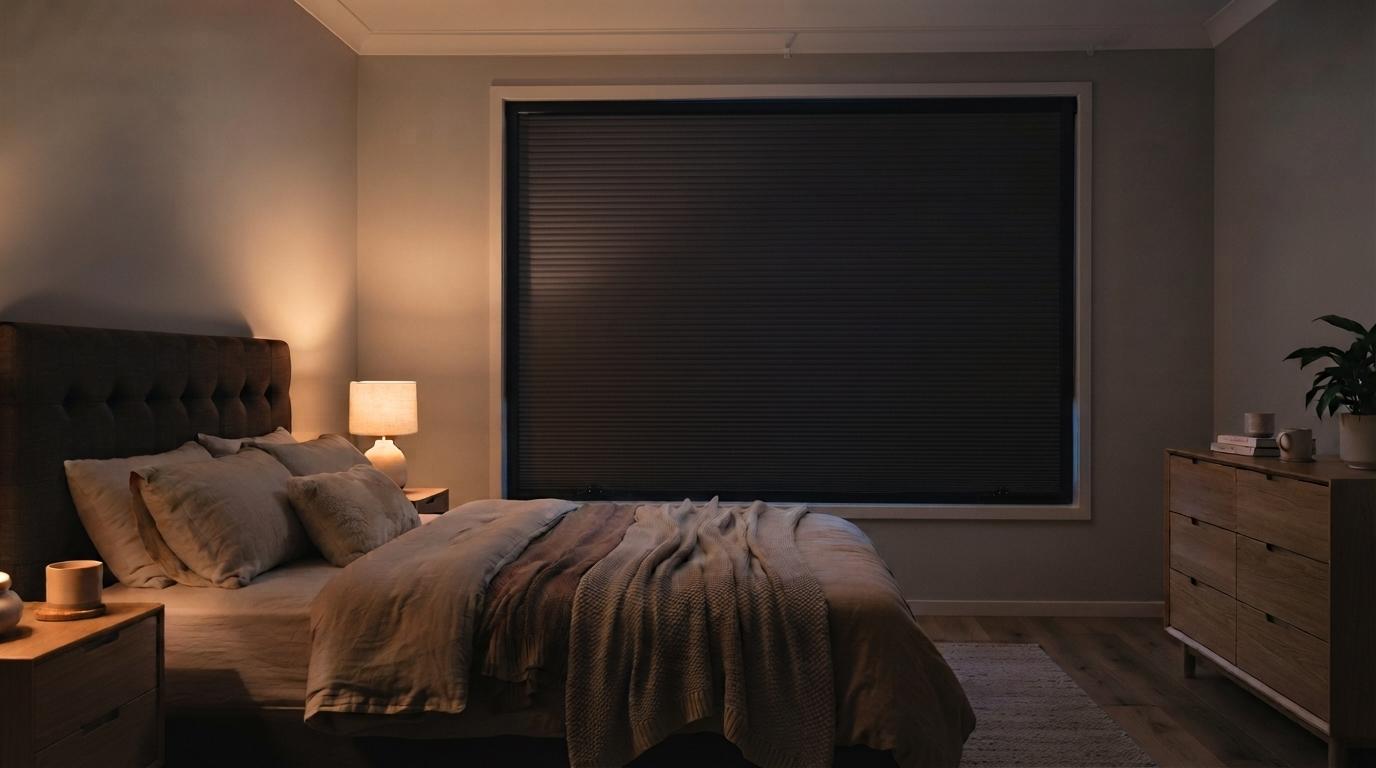
Blackout blinds can do more than make a bedroom darker. A well-fitted system can also reduce unwanted visibility, limit light leaking around a window and create a more private sleeping space. For bedrooms facing busy streets, neighbouring properties or outdoor lighting, the difference can be surprisingly noticeable.
Privacy is easy to overlook when choosing window coverings. People often think about colour, style and how much daylight a blind will block. But a bedroom window has another job: it should help you feel comfortable when the lights are on, you're changing clothes, or you're simply trying to sleep without feeling exposed.
That's where modern blackout blinds have an advantage.
Why bedroom privacy is more complicated than closing a blind
A conventional blind may cover the glass without completely solving the privacy problem.
Light can still enter around the edges. Depending on the blind's position and the angle of the window, silhouettes may also become visible from outside when a bedroom is illuminated at night.
This is particularly noticeable in rooms with:
- Large or unusually shaped windows
- Windows close to neighbouring houses
- Street-facing bedrooms
- External security lights
- Ground-floor bedrooms
- Thin curtains or blinds that leave gaps
- Windows positioned directly opposite another property
The issue isn't necessarily that the blind itself is transparent. It's often the space around it.
A bedroom can look private during the day and feel surprisingly exposed after sunset, when indoor lighting makes the room brighter than the outside.
How blackout blinds support better privacy
The main benefit of blackout blinds is obvious: they reduce unwanted light.
But the way they achieve that can also affect privacy.
A close-fitting blackout system is designed to cover the window more completely than a simple roller blind or loosely fitted curtain. When the covering sits tightly around the window area, there are fewer obvious routes for light to escape.
That matters because reducing visible light from inside the room can make it harder for people outside to see what's happening indoors.
Think about a bedroom at night. A brightly lit room behind a partially covered window can create a strong contrast with the darkness outside. Even if someone can't see the entire room, movement and silhouettes may still be noticeable.
A darker window removes much of that contrast.
It's a small change, but it can make a bedroom feel considerably more secluded.
The importance of eliminating light gaps
When people search for blackout blinds, they often focus on the fabric.
The fabric matters, of course. But the overall design matters just as much.
A blind can use a blackout material and still allow light through gaps at the sides, top or bottom. This is one reason two window coverings described as "blackout" can produce very different results in an actual bedroom.
For privacy, look beyond the fabric specification.
Consider:
- How closely the system fits the window
- Whether the sides leave visible gaps
- How the blind closes
- Whether the frame or surrounding structure helps contain light
- How the covering behaves when the bedroom is illuminated at night
This is where made-to-measure blackout blinds can make practical sense. Instead of treating every window as though it were the same size, the covering is specified around the individual window dimensions.
A closer fit doesn't automatically guarantee perfect privacy in every room, but it can address one of the common weaknesses of standard window coverings: excessive space around the edges.
Privacy matters even more in ground-floor bedrooms
Ground-floor bedrooms deserve particular attention.
A first-floor window may already have some natural separation from pedestrians and neighbouring properties. A ground-floor window doesn't always have that advantage.
If a bedroom faces a pavement, driveway, garden or another nearby building, privacy becomes a daily consideration.
During the evening, even a short period with the bedroom lights switched on can make the occupants visible from outside.
Blackout blinds can help create a stronger visual barrier while serving another useful purpose: controlling the amount of daylight entering the room.
This makes them particularly practical for bedrooms where privacy and darkness are linked rather than separate concerns.
Privacy and sleep often go together
A bedroom that feels exposed can be difficult to relax in.
That's not just about what someone outside can physically see. The feeling of being overlooked can change how comfortable a room feels, particularly at night.
The same window covering that prevents streetlights from shining across a pillow can also make the room feel more enclosed and private.
This is one reason blackout blinds are commonly associated with sleep-focused bedrooms.
For people who sleep during the day, the privacy benefit can be just as relevant. Shift workers, night workers and parents with young children may need a bedroom that remains dark and secluded while the rest of the neighbourhood is active.
A darker room isn't necessarily a quieter room or a better-sleeping room by itself. But controlling the bedroom environment removes one more source of distraction.
No-drill options can make privacy easier for renters
Privacy improvements can be harder to make in rented accommodation.
Tenants may want better window coverage but hesitate to drill into frames, walls or surrounding surfaces. Even homeowners may prefer an installation that doesn't require permanent alterations.
This has helped create interest in no-drill blackout blinds.
A tool-free installation can be useful when the goal is to improve a bedroom without committing to a more permanent installation method. It can also make sense for people who move frequently or want a solution that leaves the existing window structure largely untouched.
The important point is that "no drill" shouldn't be confused with "one size fits all."
Privacy still depends on the fit.
A no-drill system that has been designed around the dimensions of the window can offer a different experience from simply hanging a loose blind over the glass.
Made-to-measure blackout blinds can address awkward windows
Bedrooms rarely have perfectly standard windows.
Some are recessed. Some sit unusually close to walls or furniture. Others have frames that make conventional blinds difficult to position neatly.
A made-to-measure approach allows the dimensions of the individual window to become part of the design.
That can be particularly useful when privacy is the priority.
Instead of asking, "Which blind looks right?", it makes more sense to ask:
"How can this window be covered as completely as practical?"
That shift in thinking helps explain why modern blackout systems increasingly combine the blind, frame and closing mechanism rather than relying on fabric alone.
What to look for when choosing bedroom blackout blinds
Not every blackout blind will provide the same level of privacy. Before choosing one, consider the room rather than just the product description.
1. Check the window position
Is it overlooked by another house, road or footpath? Ground-floor and street-facing bedrooms usually deserve extra attention.
2. Look at the edges
Ask where daylight could enter. Side gaps can be particularly obvious once the room is dark.
3. Consider the fit
Made-to-measure blinds can be useful where standard sizes leave unwanted spaces around the window.
4. Think about nighttime use
A blind that looks effective in daylight may behave differently once the bedroom lights are switched on. Privacy should be considered in both conditions.
5. Consider installation restrictions
If drilling isn't desirable or permitted, investigate no-drill alternatives before committing to a traditional fitting.
6. Don't ignore comfort
Some modern blackout systems are designed with additional layers intended to help with heat and outside noise as well as light. These features aren't essential to privacy, but they can contribute to a more comfortable bedroom environment.
A modern approach to bedroom privacy
Bedroom privacy doesn't necessarily require heavy curtains, frosted glass or permanently closed windows.
Modern blackout blinds offer another approach: control the window when privacy is needed, while keeping the room flexible during the day.
The most effective solution will depend on the window, the property and the level of privacy required. A bedroom overlooking a quiet garden has different needs from one facing a busy road or neighbouring block of flats.
Still, the principle is simple.
The closer the window covering fits and the better it controls light around the window, the easier it is to create a bedroom that feels private after dark.
For anyone comparing options, total blackout systems such as the made-to-measure approach offered by LumiGlide illustrate how modern designs combine light control, close fitting and privacy rather than treating the blind as a piece of fabric alone.
The best choice isn't necessarily the most complicated one. It's the one that matches the actual problem: unwanted light, visible gaps, an overlooked bedroom, difficult installation, or all four.
And sometimes improving privacy starts with something as simple as making the window disappear at night.

 English
 Arabic
 French
 Spanish
 Portuguese
 Deutsch
 Dutch
Dutch
 Italiano
 Russian
 Romaian
 Portuguese (Brazil)
 Greek
Greek