
The Role of Text Annotation in Developing Reliable Retrieval-Augmented Generation (RAG) Systems
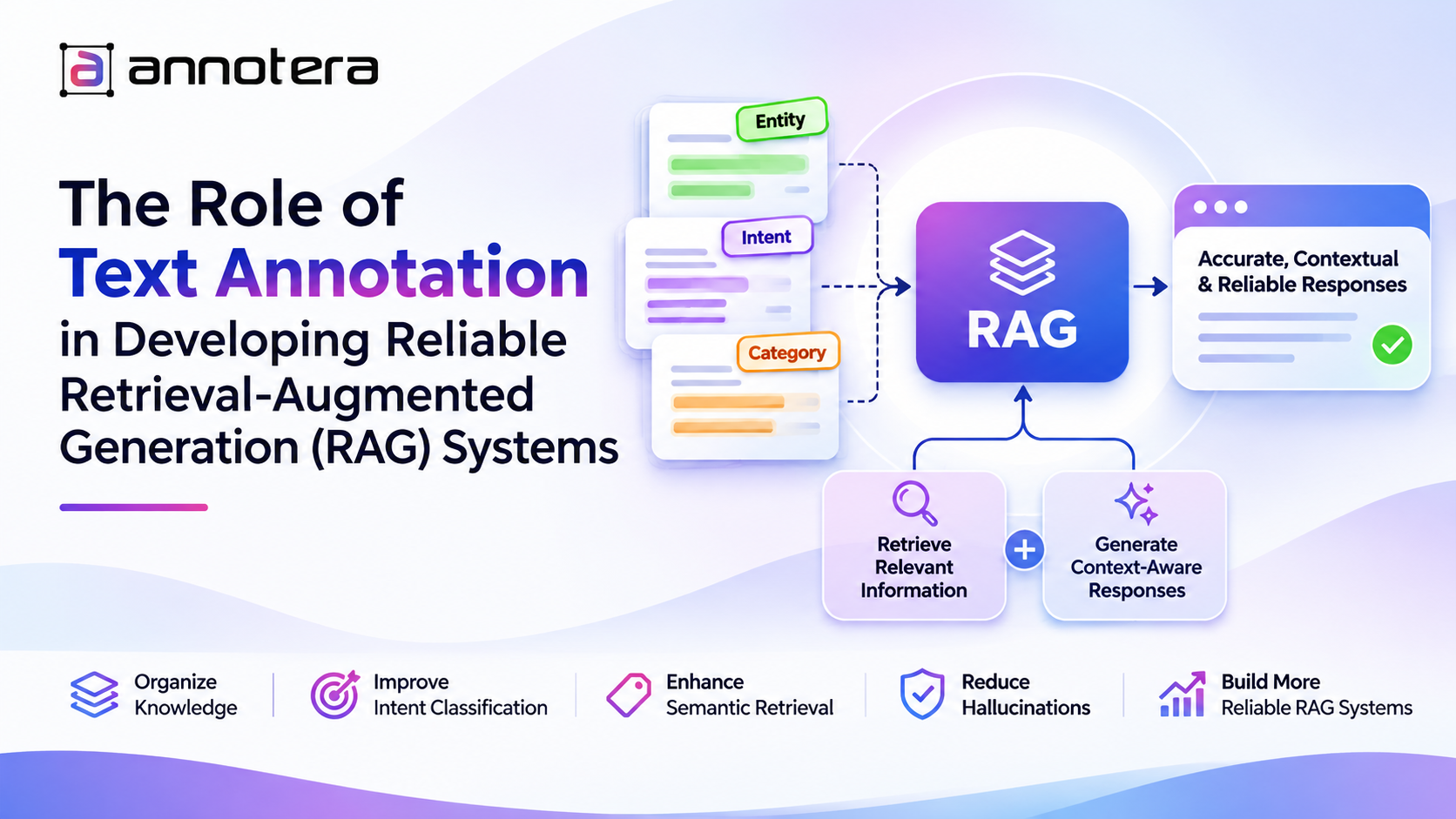
Retrieval-Augmented Generation (RAG) is transforming how artificial intelligence systems retrieve information and generate contextually relevant responses. By combining large language models (LLMs) with external knowledge sources, RAG enables AI applications to deliver more accurate, relevant, and up-to-date answers. However, the effectiveness of these systems depends heavily on the quality of the underlying data. Even advanced retrieval mechanisms can produce misleading results when the source content is poorly structured, inconsistently labeled, or difficult to interpret.
This is where text annotation becomes essential. Through structured labeling, classification, and contextual enrichment, text annotation helps AI systems understand relationships between information and retrieve the most relevant content. For organizations building dependable RAG applications, investing in high-quality annotation processes is an important step toward improving retrieval accuracy and response reliability.
Understanding the Connection Between Text Annotation and RAG
A typical RAG architecture consists of two primary components: a retrieval mechanism and a generative model. When a user submits a query, the retrieval component searches an external knowledge base for relevant information. The retrieved content is then provided to an LLM, which uses that context to generate an answer.
Although this process appears straightforward, several challenges can affect its performance. Documents may contain ambiguous language, overlapping topics, inconsistent terminology, or unstructured information. Without proper preparation, the retrieval system may select irrelevant passages or overlook important contextual relationships.
Text annotation addresses these challenges by adding meaningful labels and metadata to textual information. It helps organize documents, identify entities, classify user queries, and establish relationships between different pieces of information. These annotations make knowledge repositories easier for AI systems to process and search.
1. Improving Document Classification and Knowledge Organization
RAG systems frequently work with large knowledge repositories containing product documentation, technical manuals, customer support conversations, research papers, and business records.
Managing these diverse sources requires a consistent classification structure. Text annotation enables datasets to be categorized according to topics, document types, industries, subjects, and other relevant attributes.
For example, an enterprise customer support RAG application may contain thousands of documents covering billing, account management, technical troubleshooting, and product features. Annotators can assign appropriate category labels to these documents, helping retrieval systems identify relevant information more efficiently.
A structured classification framework also reduces the likelihood of retrieving unrelated content. When documents are accurately categorized, the retrieval pipeline can use metadata filters alongside semantic search to narrow down relevant results.
2. Strengthening Intent Classification for Better Query Understanding
Understanding what users actually want is fundamental to successful RAG implementation. Two queries may contain similar words but represent entirely different information needs.
Intent classification helps identify the purpose behind a user's query. Through text annotation, training datasets can be labeled with intent categories such as informational requests, troubleshooting questions, transactional queries, and product-related inquiries.
For example, consider the following queries:
-
"How can I reset my account password?"
-
"Why is my account password not working?"
Although both queries mention account passwords, their underlying intentions differ. The first requests instructions, while the second seeks troubleshooting assistance.
Accurately annotated intent datasets help AI systems distinguish between such requests and retrieve more appropriate supporting information. This improves query routing, contextual retrieval, and the relevance of generated responses.
3. Enhancing Named Entity Recognition and Contextual Understanding
Named Entity Recognition (NER) is another important application of text annotation in RAG systems. It involves identifying and labeling entities such as people, organizations, locations, products, dates, and technical terms within textual content.
Consider a technical knowledge base containing references to multiple products, software versions, and service providers. Without proper entity recognition, a retrieval system may confuse similarly named products or retrieve information associated with an incorrect version.
Human-annotated NER datasets help models recognize these entities and understand their context. Entity-level metadata can also support more precise retrieval by allowing systems to filter information based on specific names, categories, or relationships.
This is particularly valuable in industries such as healthcare, finance, retail, and technology, where retrieving information about the wrong entity can significantly affect the usefulness of an AI-generated response.
4. Improving Chunking and Semantic Retrieval Quality
Most RAG pipelines divide large documents into smaller sections called chunks before converting them into vector embeddings. These embeddings represent the semantic meaning of text and help retrieve relevant passages based on user queries.
However, poorly segmented content can reduce retrieval accuracy. A paragraph separated from its heading, definition, or supporting explanation may lose important context.
Text annotation can help establish document structure by identifying headings, paragraphs, tables, lists, definitions, and topic boundaries. Annotators can also label relationships between sections to preserve contextual information during preprocessing.
For instance, a product manual may contain a troubleshooting procedure followed by specific safety instructions. Proper structural annotation helps ensure that related information remains identifiable and can be retrieved together when necessary.
The result is a more organized knowledge base that supports meaningful chunking and more effective semantic search.
5. Reducing Hallucinations and Improving Answer Grounding
One of the major challenges associated with generative AI is hallucination, where models produce information that sounds convincing but is unsupported by available evidence.
RAG helps reduce this problem by providing external information as context. However, retrieval alone does not guarantee factual accuracy. If irrelevant, outdated, or incorrectly classified passages enter the generation process, the resulting answer may still be misleading.
High-quality text annotation supports better source identification, relevance labeling, and contextual organization. Human reviewers can evaluate whether passages accurately address particular queries and whether the information is sufficiently complete to support an answer.
These labeled datasets can also support retrieval evaluation and relevance-ranking models. By improving the quality of retrieved evidence, annotation contributes to more grounded and trustworthy AI-generated responses.
6. Why Professional Text Annotation Services Matter
Developing reliable RAG systems requires more than sophisticated algorithms. It demands consistent data preparation, domain knowledge, and rigorous quality assurance.
Partnering with a specialized text annotation company can help organizations build structured datasets that meet their specific AI requirements. Professional annotation teams can support document classification, entity recognition, intent classification, semantic labeling, and contextual relationship annotation.
Reliable text annotation outsourcing services also provide scalability when organizations need to process large volumes of documents across multiple languages, domains, and content formats.
An effective annotation workflow should include clear labeling guidelines, trained annotators, multi-level quality checks, and regular validation of annotated datasets. These practices help maintain consistency and reduce labeling errors as knowledge repositories expand.
7. Establishing a Continuous Annotation and Quality Improvement Process
RAG systems are not static. New documents, changing business information, evolving terminology, and emerging user queries continuously influence retrieval performance.
Organizations should therefore treat annotation as an ongoing process rather than a one-time data preparation activity. Regular dataset reviews help identify outdated information, inconsistent labels, and gaps in knowledge coverage.
Human-in-the-loop quality assurance can further strengthen this process by allowing domain experts to review complex or ambiguous annotations. Retrieval evaluation results can also highlight areas where additional labeling or revised classification guidelines may be necessary.
Combining continuous annotation with performance monitoring helps RAG systems remain relevant, accurate, and dependable over time.
Conclusion
Reliable Retrieval-Augmented Generation systems depend on the quality and structure of the information they retrieve. Text annotation provides the foundation for organizing knowledge repositories, understanding user intent, identifying entities, improving document segmentation, and supporting accurate information retrieval.
As businesses increasingly adopt RAG-powered applications, structured and consistently annotated datasets will become essential for building trustworthy AI experiences.
Annotera supports organizations with professional text annotation capabilities designed to strengthen AI training and data preparation workflows. Through accurate labeling, structured classification, and quality-focused annotation processes, Annotera helps businesses prepare high-quality textual datasets for more reliable and context-aware AI applications.
Build better RAG systems with better data. Partner with Annotera for scalable, quality-driven text annotation solutions.

 English
 Arabic
 French
 Spanish
 Portuguese
 Deutsch
 Turkish
 Dutch
 Italiano
 Romaian
 Portuguese (Brazil)
 Greek