When Is Your Coursework Actually Ready for a Final Proofread?
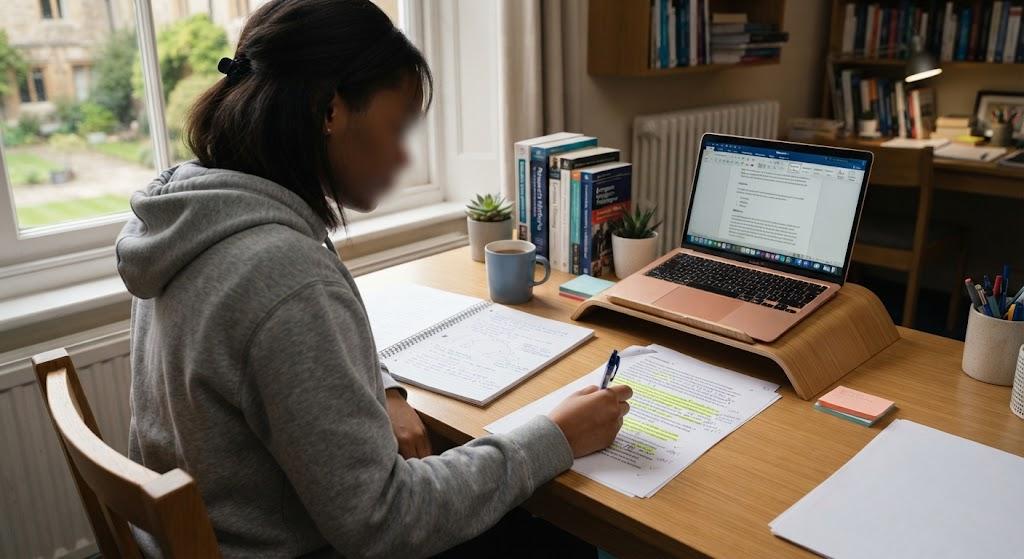
You finish the last paragraph, save the document, and tell yourself you are done. Then five minutes later, you open it again. A heading suddenly looks wrong. One sentence feels awkward. You spot a typo you somehow missed six times before.
That is usually the point where students start wondering: am I proofreading this, or am I still editing it?
The difference matters. Proofreading works best when the main thinking is already settled. If you are still changing arguments, moving sections or adding evidence, you probably have not reached the final proofreading stage yet.
1. Understanding What a Final Proofread Actually Means
Editing and proofreading are often treated as the same thing, but they serve different purposes.
Editing deals with bigger decisions. You might change the structure, remove repetition, strengthen an argument or rewrite a paragraph because the evidence does not support your point clearly enough.
Proofreading comes later. It focuses on the version you are actually preparing to submit: missing words, grammar, punctuation, references, headings, formatting and small inconsistencies.
A useful test is simple:
If the change affects what you are arguing, you are probably editing. If it affects how accurately that argument appears on the page, you are probably proofreading.
2. The Problems Students Often Discover Too Late
One reason proofreading can be surprisingly difficult is that your brain already knows what you meant to write. You can read the sentence correctly in your head even when a word is missing from the page.
This is why final checks often reveal small problems such as:
-
a citation appearing in the text but missing from the reference list
-
different spellings of the same key term
-
headings using inconsistent formatting
-
a paragraph containing an unfinished sentence
-
page numbers, captions or spacing being inconsistent
-
a reference being listed but not actually cited
These errors may look minor individually, but several of them can make a finished assignment feel less controlled.
There is also a deeper issue. Sometimes an editing change creates a mismatch between a claim and the evidence supporting it. That is no longer just a grammar problem. It is an academic accuracy problem.
3. Why Editing and Proofreading Need Different Thinking
Imagine a student writing about two business models. During editing, they realise the comparison would make more sense if the second model were discussed first. They move the sections and rewrite the transition.
Later, they notice that the name of one model is written differently in three places. That is proofreading.
The distinction helps because trying to do both jobs at once can become exhausting. You keep finding something to improve, and the final check never really ends.
Good proofreading is therefore partly about knowing when to stop making major decisions.
4. Key Factors to Consider Before the Final Check
Before you start, ask whether the assignment itself is settled. Have you answered the actual question? Are the required sections present? Is the evidence in place? Have you checked the relevant marking criteria and submission requirements?
A student searching for a Best coursework proofreading service may initially think the task is mainly about correcting grammar. But a reliable final review involves much more than sentence-level errors. It can also mean checking that citations match references, terminology stays consistent, headings reflect the argument and presentation follows the relevant requirements.
The key point is that proofreading cannot rescue an unfinished argument. It works on a piece of coursework that is already academically complete.
5. A Better Way to Proofread the Final Version
Trying to catch every problem in one reading is rarely effective. Give each pass a different purpose.
First pass — the assignment:
Read the question, brief and learning outcomes again. Make sure the final version actually responds to them.
Second pass — the flow:
Look at how each paragraph connects to the next. Check whether your points appear in a sensible order and whether conclusions follow from the evidence.
Third pass — the language:
Look for missing words, awkward sentences, punctuation, grammar and repeated wording. Reading aloud can expose problems that silent reading hides.
Final pass — presentation:
Check citations, reference entries, headings, page numbers, quotations, figures, spacing and any required formatting.
Changing the way you read can also help. A printed version, a different screen size or even reading sentences from the bottom of the page upwards can make familiar mistakes easier to notice.
6. Mistakes to Avoid
The biggest mistake is proofreading too early. If you are still rewriting paragraphs, you will probably have to proofread them again.
Another common problem is making the language unnecessarily complicated. Academic writing does not become stronger simply because every sentence contains sophisticated vocabulary.
Grammar software can help identify possible errors, but it should not make the final decision for you. A tool may flag a sentence because it is unusual even though the wording is appropriate for your subject.
Most importantly, do not use the final proofread as an excuse to reopen the entire assignment. If you suddenly discover that a section needs major restructuring, stop and edit it properly before beginning the final check again.
7. Bringing the Main Lessons Together
Your coursework is ready for a final proofread when the important decisions have already been made. The question has been answered, the evidence is in place, the structure works and you are no longer trying to discover what the assignment is supposed to say.
At that stage, proofreading becomes much more focused. You are not searching for a better argument. You are making sure the argument you have built reaches the reader clearly and accurately.
That is perhaps the simplest way to think about the final check: finish deciding first, then start correcting.

 English
 Arabic
 French
 Spanish
 Portuguese
 Deutsch
 Turkish
 Dutch
Dutch
 Italiano
 Russian
 Portuguese (Brazil)
 Greek
Greek